howto make a quarter sheet daily planner from an ical file in linux

My Planner

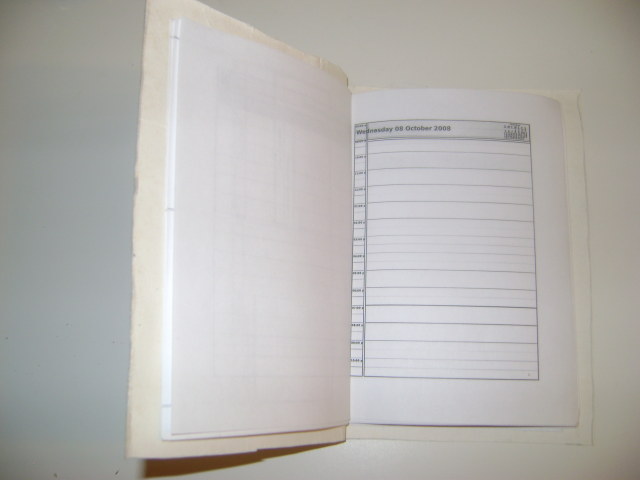
Update: Photos of my planner! Mine is on the left, next to a moleskin to give you an idea of the relative size.  Below is what each day looks like.

Inside of my planner

I use Sandy for most of my calendaring, but don’t have a PDA or mobile phone with a convenient calendar app (and can’t afford one).  So, I needed a paper daily planner that could be generated on a weekly basis from the events that I shoot into Sandy.  I find that it’s no too hard to do a daily paper->electronic sync to update my calendar in Sandy.  Sandy has an ics export which is really nice if I want to view my appointments along with appointments from my other calendars (like my work one, managed by Webcalendar).

What you need:

  • Calendar software that supports printing a daily view (I used KOrganizer)
  • psutils package

Import your remote calendar(s)

I first imported my calendar into KOrganizer (File->Import->Import Calendar and then entered the URL of my iCal feed in the Location field) .

Print the calendar to a postscript file

I printed a page for each day of my calendar with  File->Print and then chose Print Day for the Print Style.  I selected a month worth of dates for the Date & Time Range.  I clicked Print and chose the Print to File (Postscript) option for the printer Name.  The ability to print to a file came with my default KDE setup, but it shouldn’t be too hard to get this ability from whatever printing management system you’re using.

Make the postscript file 4up

I used the psnup program to put four days on one letter sized page.

 ghing@silvertongue:~/tmp$ psnup -pletter -b0.25in -4 planner.ps planner-up.ps

The above options say that the output paper size is letter, that there should be a .25 inch margin around each page (I did this to allow for a binding on the left hand side of the sheets), that there should be 4 pages from the file planner.ps combined into every one page in the output file planner-up.ps.

Open the postscript file and print it

I used evince to open and print my planner.

Cut the pages into quarters

I used a paper cutter to cut the printed pages into quarters.  Take care to keep track of the order of pages so it’s easier to assemble your calendar.

Find a cover and a binding

For mine, I used part of the cover of a notebook that I dumpstered in Bologna and held everything together with a butterfly clip that I got from the supply closet at work.  Be resourceful!

Liveblogging from Linuxfest

Linuxfest 2008 web page.

In the first talk the presenter said that he felt the greatest contribution of Linux was that it was the great equalizer and that it was responsible for the generation of skilled IT workers in India, China, and other parts of the world that are emerging as producing a lot of technology and technology workers.

Building Community and Taking Linux to the Masses

Zonker talked about Linux and Community and offered this definition of community, saying that FOSS communities have a lot to learn from communities in general:

“Community is when a group of people come together for common cause, work together, and become something greater than the sum of the individuals.”

He pointed out that community building in FOSS is taking software and not just making it free of cost but letting people drive the creation of the technology.

Despite his employment with Novell, he said that people using Linux, even if it’s not OpenSUSE, is a win for him and he’s happy to point out other FOSS communities that are doing things right.

FOSS communities getting it right: Fedora, Mozilla.

FOSS communities getting it wrong: KDE (releasing beta release as 4.0, dropping support for KDE 3.5), OpenOffice (great product, not growing or good community, lots of head butting with Sun)

Community building

When do you start building a community? As soon as you start a project!  Do you want people to contribute to your code, or are you just pushing it to the world?

OpenSUSE is responsive to calls from Japan for more translations.  He feels like Europe has accepted English as a lingua franca for Linux distros, but Japan hasn’t.  Zonker pointed out that this is totally legitimate and noted the challenges of western Europeans/Americans trying to navigate signs in a non-latin alphabet.  He said signs leading to people being invovled in your community need to be clear to lots of different people.

Community building is in the long term (years ! months).  With FOSS projects it’s important to realize that the projects have to be responsible to the community and not just managers or developers.  From the Ubuntu community manager his job is “Making sure the community is getting screwed by Canonical and making sure that Canonical isn’t getting screwed by the community.”

How do you manage community?  Build up trust so that people (developers) want to contribute.

How do you meet the goals of both the community and managers?  E.g. different milestones for Novell and OpenSUSE community.

A community manager’s job is finding and connecting the body parts, but the community itself provides the spark to bring the project to life.

One of the challenges at Novell was to take people who had worked forever answering to managers and they had to learn how to also be responsive to people who weren’t their managers and didn’t even work for the company.

openSUSE build system allows people to build packages for distros that aren’t just openSUSE.

Cool stuff: Helping Hands sessions to help new users with using openSUSE.

Zonker came to being a community manager from being a technology journalist.  This experience has been helpful because it’s made him a good writer and communicator which is crucial for managing a community.  He misses the objectivity of being a journalist and not being perceived as being connected with a company.

Developing on Mac

Had a really nice slideshow.  Lots of big icons.  As with Zonker, the slides were really sparse with most of the details being filled in with the talk.

Presenter defined the fundamental concept of Unix as:

$ ls | wc

“Little bits of functionality that you can link together in interesting ways”

Quartz composer tool is analogous to the pipe.  Patches link together graphic effects.  All the animations on the Mac are built this way. 

This Japanese artist uses Quartz composer in cool ways to make cool works (and he gives you the source).

This stuff is so cool.  The downside is that you have to be able to afford mac hardware and the OS.  I think the reason that people like Macs so much is because they’re fun to use.  Apparently all 6,7, and 8 graders in Maine get new Mac notebooks.  Kids found a way to cheat on a test, even with iChat disabled by creating ad-hoc wireless networks named things like ‘The answer to question 5 is D’.

Virtualization

There were two talks on virtualization.  The first was on enterprise virtualization and the second was on virtualization security.  Apparently, a lot of the big apps at IU like Oncourse, Onestart, and the IU home page are all running on virtual servers.  They did a cool demo where they moved a virtual machine from on physical host to another with no perceivable downtime.

One big advantage of a virtualization that I didn’t really think about was the fact that, by consolidating VMs on fewer physical machines, all the environmentals like electrical, cooling, cabling, space.

FYI: change of address and voter registration

Procrastinating as usual, I went to change my voter registration address today, the last possible day to do it.  I asked what would have happened if I hadn’t changed my address and the answer was that, at least in Monroe County, you are allowed to vote once at your previous polling location.  The challenge is that, with redistricting, your previous district’s polling location may now be the polling location for a new district.  So, in that case, one would most likely have to wait in line, only to be sent to a new location.  In any case, I was told that having different addresses wouldn’t keep you from voting, but could delay voting.  Info about this was mailed out to registered voters, but in a community like Bloomington where, for students, and many of my peers, housing situations change a lot, it’s easy to not get the info.  So, for those who moved, but didn’t change their voter registration address, I would just call the local election office and find out where the polling place is for the address under which you’re registered.  If you go there, you should be able to vote.

Xubuntu Gutsy Gibbon on Dell Latitude D810

I got Rich’s old notebook from work and installed Xubuntu 7.10 (Gutsy Gibbon) see update below on it. I’m tracking issues I’m having with the distro/platform here.

Spell Checking in OpenOffice Writer – FIXED

After having this machine for a while, I just noticed this issue.  I followed some instructions I found here and tried File > Wizards > Install New Dictionaries.

Update: Volume Control Widget – FIXED

My volume control widget up and disappeared.  This post made the suggestion that instead of clicking the ‘Add’ button from the widget list (accessed by right clicking on the taskbar and choosing ‘Add New Item’), you can drag the volume control widget from the list window onto the taskbar and it works.

Update: Upgraded to 8.04

I upgraded via package updates to 8.04 (Hardy Heron) without any problems.

Can’t lock screen – FIXED

I added the screen locking widget to my top panel, but clicking it didn’t do anything. I fixed this by installing the xlockmore-gl package.

Can’t suspend/hibernate – FIXED

When I try to use the buttons to suspend/hibernate (I think these are from some gnome program), the screen goes blank, but I’m not able to resume.

Link to launchpad bug report about this issue.

Apparently, others with this laptop were able to have success by using the uswsusp package. However, they were running Feisty, not Gutsy.

Link to userspace software suspend home page.

Debian has a newer version of the uswsusp package, so I tried installing that because I found what appeared to be thorough docs on using the 0.7 version. Things still didn’t work.

I found another post on the ubuntu forums that aggregated a bunch of information about this issue. link.

I removed the fglrx video driver (a non-free driver) as this was mentioned as causing problems. After removing this driver, suspend to ram didn’t work, but hibernate did using the default login,shutdown,etc. menu. Using the s2ram program from the command line also worked!

Update: If I want to lock the screen on resuming from suspension, I use

s2ram; xlock&

Trackpad is slow

The trackpad seems to move extremely slowly. I can configure the eraserhead using the Mouse Settings panel, but this doesn’t effect the trackpad.

EVDO Card – FIXED

This was the most straightfoward thing so far. This forum thread helped my get my PC5750 EVDO card working just fine with pppd and wvdial.

Playing Encrypted DVDs

Add the following line to /etc/apt/sources.list

deb http://packages.medibuntu.org/ gutsy free non-free

Then run

sudo apt-get install libdvdcss2

Function Keys on Keyboard

These are the keys on the keyboard with additional functionality (written in blue on the keys and accessed by holding down the Fn key to the right of the left-hand-side Ctrl key) that do things like switch between CRT/LCD, eject CD media, change volume or brightness, etc.

Healthcare and the state update

Healthcare and the State continued

There are few feelings better than knowing that someone’s got your back, or at least is looking out for you, or at the very, very least is holding up their end of being accountable to you.  So, I was really excited when my primary medical provider’s office called me and told me that, while the surgeon I had originally been scheduled to see didn’t accept the Healthy Indiana Plan insurance, they had scheduled an appointment with another surgeon.  They couldn’t find a dermatologist who accepted the HIP in Bloomington, but I could see one about the wart on my hand in Indy, in December.

Today I went to see the surgeon.  I had to wait an long time, or what seemed like a long time, but the receptionist was friendly and clear.  Being fairly healthy, and fairly irresponsible, I haven’t used healthcare services in a long time.  So, I feel like I have few points of reference to evaluate the quality of care that I’m receiving.  I think this is a common problem with folks who haven’t been able to see healthcare providers in a long time – you don’t know what to expect, so it’s hard to hold doctors, insurance providers, and paramedical staff accountable.  The surgeon was to the point, but moved through what he wanted to tell me really fast.  He was glad I didn’t smoke (it saved him a lecture), I had a sebacious cyst which was the result of a natural glogging of the sebacious glands, since it seemed inflamed and was on my neck where infection could easily spread to dangerous places like the spine it should be removed, I could choose to have it removed under local anesthetic at the office or by going under at the hospital.  The first option would be faster and cheaper, but bad if I had a low pain tolerance or an aversion to shots.  The doctor paused only briefly to allow me to make my decision. I chose the local anasthetic because I didn’t want to spend my day at the hospital, and, as I understand it, I am only covered for up to $1100 in healthcare expenses, so I need to watch costs.  The doctor prescribed some generic antibiotics (covered by the HIP, but they would have only cost me $4 out-of-pocket) to get rid of any infection of the cyst and scheduled a date for the surgery.
All in all, I’m happy with how things are going so far, but would be really nervous if I had to deal with more serious or complex medical issues.  I get this sense that I’m being herded through a big system, as efficiently as possible, and that I’d have to really struggle to make my concerns known and have my questions answered.