Posts Tagged ‘community’

Liveblogging from Linuxfest

Friday, October 10th, 2008

Linuxfest 2008 web page.

In the first talk the presenter said that he felt the greatest contribution of Linux was that it was the great equalizer and that it was responsible for the generation of skilled IT workers in India, China, and other parts of the world that are emerging as producing a lot of technology and technology workers.

Building Community and Taking Linux to the Masses

Zonker talked about Linux and Community and offered this definition of community, saying that FOSS communities have a lot to learn from communities in general:

“Community is when a group of people come together for common cause, work together, and become something greater than the sum of the individuals.”

He pointed out that community building in FOSS is taking software and not just making it free of cost but letting people drive the creation of the technology.

Despite his employment with Novell, he said that people using Linux, even if it’s not OpenSUSE, is a win for him and he’s happy to point out other FOSS communities that are doing things right.

FOSS communities getting it right: Fedora, Mozilla.

FOSS communities getting it wrong: KDE (releasing beta release as 4.0, dropping support for KDE 3.5), OpenOffice (great product, not growing or good community, lots of head butting with Sun)

Community building

When do you start building a community? As soon as you start a project!  Do you want people to contribute to your code, or are you just pushing it to the world?

OpenSUSE is responsive to calls from Japan for more translations.  He feels like Europe has accepted English as a lingua franca for Linux distros, but Japan hasn’t.  Zonker pointed out that this is totally legitimate and noted the challenges of western Europeans/Americans trying to navigate signs in a non-latin alphabet.  He said signs leading to people being invovled in your community need to be clear to lots of different people.

Community building is in the long term (years ! months).  With FOSS projects it’s important to realize that the projects have to be responsible to the community and not just managers or developers.  From the Ubuntu community manager his job is “Making sure the community is getting screwed by Canonical and making sure that Canonical isn’t getting screwed by the community.”

How do you manage community?  Build up trust so that people (developers) want to contribute.

How do you meet the goals of both the community and managers?  E.g. different milestones for Novell and OpenSUSE community.

A community manager’s job is finding and connecting the body parts, but the community itself provides the spark to bring the project to life.

One of the challenges at Novell was to take people who had worked forever answering to managers and they had to learn how to also be responsive to people who weren’t their managers and didn’t even work for the company.

openSUSE build system allows people to build packages for distros that aren’t just openSUSE.

Cool stuff: Helping Hands sessions to help new users with using openSUSE.

Zonker came to being a community manager from being a technology journalist.  This experience has been helpful because it’s made him a good writer and communicator which is crucial for managing a community.  He misses the objectivity of being a journalist and not being perceived as being connected with a company.

Developing on Mac

Had a really nice slideshow.  Lots of big icons.  As with Zonker, the slides were really sparse with most of the details being filled in with the talk.

Presenter defined the fundamental concept of Unix as:

$ ls | wc

“Little bits of functionality that you can link together in interesting ways”

Quartz composer tool is analogous to the pipePatches link together graphic effects.  All the animations on the Mac are built this way. 

This Japanese artist uses Quartz composer in cool ways to make cool works (and he gives you the source).

This stuff is so cool.  The downside is that you have to be able to afford mac hardware and the OS.  I think the reason that people like Macs so much is because they’re fun to use.  Apparently all 6,7, and 8 graders in Maine get new Mac notebooks.  Kids found a way to cheat on a test, even with iChat disabled by creating ad-hoc wireless networks named things like ‘The answer to question 5 is D’.

Virtualization

There were two talks on virtualization.  The first was on enterprise virtualization and the second was on virtualization security.  Apparently, a lot of the big apps at IU like Oncourse, Onestart, and the IU home page are all running on virtual servers.  They did a cool demo where they moved a virtual machine from on physical host to another with no perceivable downtime.

One big advantage of a virtualization that I didn’t really think about was the fact that, by consolidating VMs on fewer physical machines, all the environmentals like electrical, cooling, cabling, space.

books on community informatics and radical mathematics teaching that I want to read

Monday, April 21st, 2008

CI

  • Researching with Communities: Grounded perspectives on engaging communities in research Edited by Andy Williamson and Ruth DeSouza
  • Networked neighbourhoods : the connected community in context / Patrick Purcell (ed.).
  • Community informatics : shaping computer-mediated social relations / edited by Leigh Keeble and Brian D.
    Loader.
  • Social and community informatics : humans on the Net / Gunilla Bradley.

Math

  • Rethinking mathematics : teaching social justice by the numbers / edited by Eric Gutstein and Bob Peterson.

Jail Resistence in Bloomington

Friday, April 11th, 2008

Some folks have started organizing to plan resistance to plans to organize against a proposed “justice campus” in Bloomington that would include a new, larger jail (as the jail is notoriously overcrowded and there is a federal lawsuit about conditions in the jail), a juvenile “treatment” facility (as youth from Monroe County who are sentenced to one of these facilities have to be sent out of county), and court and administrative facilities (to make transport of inmates between the jail and the courts (and other services?) easier).  Ideologically, I am opposed to the expansion of the number of incarcerated people and a sad reality in most communities is that larger prisons and jails are quickly filled (either by sentencing or by the moving of inmates to take advantage of available space or recover costs), but there needs to be some remediation of the conditions at the existing jail for the inmates and the Federal lawsuit may require some kind of action in the end.

So, I don’t want to frame this issue solely in terms of supporting or opposing jail construction.  If I oppose the jail construction and lose on this and don’t manage to push for increased programming and services for people in the jail and the community at large or assurances that the capacity of the jail will not be used to import people from elsewhere, this is a failure.  Similarly, calls for increased support of social services, to end injustices that are connected with incarceration, and to change the court system or make other changes to incarcerate fewer people are not dependent on jail construction either way.  These things need to be part of the dialog and I think it will be a failure if focusing on jail construction as the sole issue means there isn’t space for talking about things.

My personal goals when it comes to this issue are:

  • Empower incarcerated people, their friends and family to have a central role in the dialog and policy shaping of the jail and criminal justice in Monroe County
  • Include the voice of youth in the dialog about juvenile justice facilities
  • Accurately depict the reasons that people are incarcerated in Monroe County and explode the cultural mythologies of crime and incarceration
  • Explore alternatives to incarceration in Monroe County and move towards expanding and implementing them
  • Address prejudices and stigma about crime, “criminals”, and incarceration
  • Connect issues of economic and racial privilege in Monroe County, support (or lack there of) for social services or grassroots community-based support, and development policies and paradigms with incarceration

Ideally, achieving these things would result in a decision to not expand the jail or build a juvenile facility.  However,  because I see these things as important, I wouldn’t see the defeat of the jail proposal on fiscal grounds (as is the position of many Republican county government officials/candidates) as a victory because it would be likely that there would community support or support from the county officials who rejected jail construction for the things I mentioned above.

community wireless vaporware

Tuesday, March 25th, 2008

Update: Apparently Houston is going for it, planning on deploying 10 wifi ‘bubbles’ in low-income areas.  Link to Houston Chronicle article about the plan.

From the NYTimes (via the Community Informatics Researchers mailing list):

PHILADELPHIA — It was hailed as Internet for the masses when Philadelphia officials announced plans in 2005 to erect the largest municipal Wi-Fi grid in the country, stretching wireless access over 135 square miles with the hope of bringing free or low-cost service to all residents, especially the poor.

Municipal officials in Chicago, Houston, San Francisco and 10 other major cities, as well as dozens of smaller towns, quickly said they would match Philadelphia’s plans.

But the excited momentum has sputtered to a standstill, tripped up by unrealistic ambitions and technological glitches. The conclusion that such ventures would not be profitable led to sudden withdrawals by service providers like EarthLink, the Internet company that had effectively cornered the market on the efforts by the larger cities.

Now, community organizations worry about their prospects for helping poor neighborhoods get online.

Link to NYT article Hopes for Wireless Cities Fade as Internet Providers Pull Out

california communities at the margin

Tuesday, March 18th, 2008

I think that California always has had this iconic quality of Americanness, capturing the most extreme visions of both this country’s aspirations and its challenging realities.

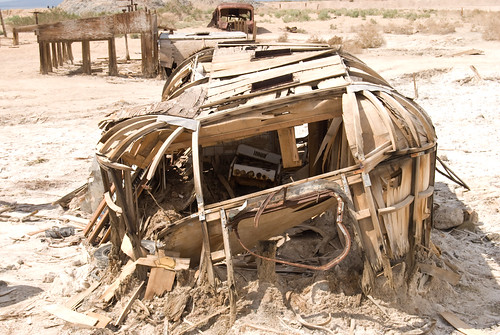
Collapsed structure near the Salton Sea

This weekend, Greg rented a documentary called Plagues and Pleasures on the Salton Sea about the Salton Sea, an area in California that, in the previous century, due to a strange set of ecological circumstances, saw both incredible development and growth and later, an equally magnificent collapse.  The landscape is now one of flooded and collapsed mobile homes and other structures and a small population of people, many of who moved there to escape conditions in larger California cities, or who moved to the area during the Sea’s boom and now find themselves without the economic resources to leave.

Today, I saw this video from the BBC via BoingBoing about tent cities inhabited by people who have lost their homes in the fallout of the subprime mortgage crisis.

Men Against Sexual Assault and Domestic Violence Discussion @ MCPL Auditorium. 7-9p.

Tuesday, November 13th, 2007
November 15, 2007
7:00 pmto9:00 pm

On behalf of Nu Alpha Alpha Chapter of Omega Psi Phi Fraternity, Inc., I
would like to invite you to participate in our “Men Against Sexual Assault
and Domestic Violence.”  This program will be held at the Monroe County
Public Library’s Auditorium on Thursday November 15, 2007 from 7pm-9pm.
The program will be divided into three sections. First, a representative
from the Middle Way House of Bloomington Indiana will speak about sexual
assault/domestic violence.  Then, we will facilitate a dialogue on the
issues surrounding sexual assault/domestic violence. Last, there will be a
resource fair providing information about preventing sexual
assault/domestic violence and ways to support victims of sexual
assault/domestic violence.

Please join us for this important conversation!

Sincerely,

Russell Hollis, Basileus
Omega Psi Phi Fraternity, Inc.
Nu Alpha Alpha Chapter
P.O. Box 8542
Bloomington, IN  47407

media check for the week of 2007-08-19

Monday, August 20th, 2007

I decided to go to the IU library to check out the book The Suburbanization of New York: Is the World’s Greatest City Becoming Just Another Town? (ISBN-13: 978-1-56898-678-4) and found a wealth of other interesting books in the HN80.N5 section on the 7th floor. I also checked out There Goes The Neighborhood (ISBN-10: 0-394-57936-4), a book about the politics of race and class in Chicago neighborhoods, and passed on Praciticing Community (ISBN-10: 0-292-73118-3), a book about similar dynamics, but in Cincinatti, though it also looked good.

I heard an interesting recording of a Michael Parenti talk on Alternative Radio on WFHB on Monday, 2007-08-20 that was kind of all over the place, but mostly about how identity politics are exploited to divide people who are marginalized by race, gender, or sexual orientation. He also suggested that the division of power in this country often finds people with very different ethnic, gender, sexual, or other cultural identities on the same side of that power divide.

I read this article by Dave Zirin, author of What’s My Name Fool?: Sports and Resistance in the U.S., Welcome to the Terrordome, and other books about sports and politics. Zirin writes about the difficulties in sending copies of his books to a Texas death row inmate because

“It contains material that a reasonable person would construe as written solely for the purpose of communicating information designed to achieve the breakdown of prisons through offender disruption such as strikes or riots.”

The offending content, according to the TXDOC, included quotations such as this from baseball great Jackie Robinson:

“I felt tortured and I tried to just play ball and ignore the insults. But it was really getting to me. … For one wild and rage-crazed moment I thought, ‘To hell with Mr. Rickey’s “noble experiment.” … To hell with the image of the patient black freak I was supposed to create.’ I could throw down my bat, stride over to that Phillies dugout, grab one of those white sons of [expletive] and smash his teeth in with my despised black fist. Then I could walk away from it all.”

I use del.icio.us for managing my bookmarks. Often, I want to access my del.icio.us bookmarks through my browser instead of having to visit the del.icio.us site. The del.icio.us Bookmarks Firefox add-on lets me do just that.

Roy F. Baumeister’s talk, Is There Anything Good About Men? is really interesting. It talks about the different ways that culture have used men and women to achieve its ends. It also talks about how a fundamental difference between men and women is that men favor wider, shallower relationships and women prefer closer, more intimate relationships and how this has driven the different cultural realms that are inhabited disproportionally by men and women. At the base of this, claims Baumeister, is the evolutionary reality that far more women reproduce than men. The wider, shallower, relationships or more risk-taking activities favored by men, in general, facilitates the differentiation that will allow some men to reproduce.

On a somewhat related note, this is a program that my friend is working with. The program is trying to organize
Men of Strength (MOST) Clubs in DC and other communities. A friend who works with the Middleway House, a Bloomington shelter for women and children affected by rape and family violence says that young men who stay in the shelter really lack a community of other males to critically examine their ideas of identity and masculinity and to model ideas of gender or relationships that differ from the violence that they’ve experienced. These clubs seem like a rare example of something that might begin to provide this support/education. The clubs are described as:

The
Men of Strength (MOST) Club has provided young men in Washington, DC and California high schools and colleges with a safe and supportive haven to connect with male peers while exploring masculinity and male strength.


Exposing young men to healthier, nonviolent models/visions of manhood, the MOST Club challenges members to define their own definition of masculinity and to translate their learning into community leadership, progressive action, and social change.


MOST CLUB AIMS TO:

  • Provide young men with a safe, supportive space in which to connect with male peers through exploring notions of masculinity and male strength.
  • Promote an understanding of ways that traditional masculinity contributes to sexual assault and other forms of men’s violence, perpetuates gender inequity, and compromises the health of men and women.
  • Expose young men to healthier, nonviolent models/visions of manhood.
  • Build young men’s capacity to become peer leaders and allies with women in promoting gender equality and preventing men’s violence.

I have Debian Etch with KDE installed as my workstation at work, and I had a hard time figuring out how to make Iceweasel (Debian’s all-free software version of Firefox) the default browser instead of Konqueror.  Turns out it was as easy as

$ update-alternatives –config x-www-browser

questions

Tuesday, July 11th, 2006

In a way, the question of how you deal with the scumfucks who probably have been breaking into buildings around the fest is the same question as what you do with the wealthy college kids who live in the fancy apartments, is the same question as the ones asked by “The Hardest Question Ever”. How do you deal with being part of the same community but having a relationship between people that is fucking disfunctional or even violent?

Other hard questions:

Did the costs that we thought we saved keeping the fest cheap and loosely organized just  get transferred to the community at large?