Reframings

Since writing my proposal for my independent study, I’ve realized that I need to contextualize and re-frame my inquiry a bit.  First, I want to add a little historical context of the fragmentation of contemporary media that I’ve picked up, then I want to describe some of the mis-assumptions that I’ve made about the nature of audiences in Chicago.  Finally, I want to lay out a new direction for my inquiry.

Fragmented Media, Fragmented Audiences, Fragmented Communities

In his book “Post-Broadcast Democracy“, Markus Prior wrote:

“Accepted generalizations about political behavior – that the actions of politicians and the reporting of the news media affect what people consider to be important political issues, that people can reach meaningful voting decisions even in the absence of comprehensive political knowledge, that party identification is a major determinant of vote choice, to name three – become ingrained in the literature as invariant patterns.  Yet as the environment changes, so might the behavior. “

One critical change in the media environment that Prior identified is the movement away from watching network news broadcasts as cable television brought more viewing choices for media consumers.  This shift, Prior wrote, made political information less accessible to those who didn’t neccessarily seek political information from the media they consumed.  He described this shift this way:

“It is more difficult for the same signal to get through to people who take advantage of increased media choice to avoid exposure to political information.  From the point of view of these entertainment fans the flow of political information has become much weaker in recent years as media choice has increased.”

Changes in the media environment, Prior writes, have polarized information consumers between news junkies and entertainment fans, which in turn affects electoral turnout and voting behavior resulting in more polarized elections.

Even before the nightly network news lost its role as a central point for American consciousness, changes in the media environment split apart more diverse audiences.  In “Audience Economics: Media Institutions and the Audience Marketplace“, Philip Napoli wrote:

By the same token, advertisers may, for various reasons, transfer their advertising dollars away from a certain medium, which may undermine its financial viability.  For instance, the introduction and rapid diffusion of television led many national advertisers to abandon radio as an advertising vehicle (Baughman 1997; Dimmick and Rothenbuhler 1984).  As a result the overall structure and function of the industry changed dramatically.  Radio stations abandoned their efforts to appeal to broad diverse audiences, because television had become the mass-advertising vehicle of choice.  Instead, radio stations focused on appealing to narrow audience segments, thereby cultivating relationships with smaller or more specialized advertisers seeking niche audiences.  In doing so, radio station content changed dramatically, moving away from broad appeal to content with more narrow appeal (Baughman 1997; Napoli 1998a).  Thus today few radio stations attempt to program to different audience segments at different times of the day or to appeal to a broad audience base throughout the day.  Instead, individual radio stations maintain the same, narrowly targeted program format all day (MacFarland 1997), which reflects their focus on delivering a narrow and specific audience demographic to advertisers.

Many new media innovations that dramatically increase the amount of available information and its pervasiveness and technologies such as the The Huffington Post’s Social News, which helps users identify relevant news content based on the news consumed within their social networks, seem to continue this trajectory of media and audience fragmentation.

In the context of this media fragmentation, what then are its implications for media trying to meet the information needs of a city like Chicago that is fragmented along racial, economic and geographic boundaries (to name a few)?  Even with these barriers, reporting happens.  Stories about violence in neighborhoods on one side of the city get filed by reporters living on another for readers, viewers or listeners in the suburbs.  The plight of the homeless gets covered, even if the majority of those getting the report are unlikely to be directly affected.  These reports seem to reveal an underlying truth not always reflected in the social construction of the city: it is filled with millions of people with diverse experiences who must live together, whether their interests are competing or shared.

Why does this reporting across geographic or social boundaries happen?  Some would say “because it’s news.”  Even if this is the case, the information carried with the news is more than just the who, what, when, where and how.  Along with these things comes a framing of how the audience member understands their city and other people in it.  The news helps people make decisions about how they will (or if they will) vote, what they buy or use, where they live or even how they interact with their neighbors.

As a new journalist, I am told time and time again how these are exciting times,  how the media environment is wide open or malleable.  Given the huge responsibility of media to meet information needs, now must be a time for journalists, particularly new journalists to ask (and hopefully answer) some tough questions about how we report across boundaries.  I’ll get to these questions soon, but first, I want to address a misunderstanding in my original independent study proposal.

Audiences vs. Demographics

In writing my original proposal, I made the mistake of thinking of and referring to audiences and demographics as the same thing.  This is an easy thing to do.  If one views media in terms of an audience marketplace, where audiences are bought and sold to advertisers, there is a tendency to identify audiences by their demographics rather than their purchasing goals.  Napoli wrote, “One study found that when media buyers had access to product-purchasing variables, they largely ignored the information in favor of traditional demographic variables” even when “a growing number of studies show that demographic data in fact do a poor job of predicting purchasing patterns, accounting for as little as 2 percent of the variance in consumers’ purchasing behavior.”

So audiences are best thought of as those looking to do something.  For advertisers, their desired audience is people looking to hire their product.  For journalists, it should be people looking to hire the journalists’ information to do some useful work in their lives.

Even with this clarification, reports across demographics aren’t transparent (or self-aware) about the work the information can do, and who is employing it.  Again, new journalists need to be aware, not only of the utility of the information they create, but also to whom it is useful.

Big Questions

These are the questions whose answers I hope will help me understand why reporters report across social boundaries, the implications of this reporting and how it can do it better.  I hope to write a story around each of these questions this quarter.

Who do we think we are?  Who do we think you are?

Who is Chicago media?  Who do the different pieces of Chicago identify as their audience?  How did they measure this audience?  When and why have they reported about those outside their audience?  Who reports for these media players?  How has the background or experience of these reporters affect the stories?  What information do communities need and how do they get it?

I intend to spend the next week looking into these questions.  I’ve asked a few professors about the existence of a “map” of Chicago media with little success, but I’m going to try to check on the IMC side to see if anyone has anything like this.  I found that Community Media Workshop has created a Chicago Online Ethnic Media Database that I also want to review.  It looks like some folks tried t0 map Chicago media, from an activist perspective, but it seems like the project is likely out of date.  Still, it might be useful to contact the map’s original compilers.  I don’t have very much interest in trying to create or update this work, because of how quickly the information becomes stale, but I do want to look at this to get an idea of who to interview for my inquiry.

What are the hazards (or merits) of reporting across boundaries?

How do reporters report on communities that are not their own?  How do they remain accountable to those communities?  Do different communities think the media does a good job of reporting the things happening in their community to others?  What interest do communities have in this kind of reporting?  How does the format of contemporary media products impact reporting across boundaries?

My interview with Torey Malatia of WBEZ brought up a very obvious, but often overlooked and interestingly circular impact:  he said that a study by the station of non-listeners found a common complaint is that reporters just didn’t get the stories right.  If reporting about an issue or community in a way that doesn’t capture the depth of the issue keeps people from that community or connected to that issue from tuning in, it seems like it will be harder to have accountability and feedback for future reporting or access to broad and diverse sources.

Father Bruce Wellems spoke to one of my classes last quarter and described the impact of MSM reporting about gang violence and teen pregnancy as amplifying those dynamics in Back of the Yards.  I need to review my notes from my initial questions for him and get back in touch to see if he can clarify or put me in touch with youth who can tell me about their experience with media and their community.

I know some folks who have worked with Community TV Network and Street Level Youth Media and these might offer additional perspectives as both organizations aim at empowering youth to produce more relevant independent media.  Why is there the need for such media?  What work should this media do?

Finally, my colleague Zak Koeske did a lot of reporting around an event looking at how the media covered youth violence.  Revisiting some of these sources might be helpful for my study, as would talking to Zak about what he learned.

Many of these leads are youth-oriented.  There seems to be a lot of traction for youth media, but I don’t think youth are the only ones in Chicago who feel misrepresented in the media, or aren’t getting served by media that’s available to them, but other groups don’t seem as visible or vocal.

What does the future look like?

What might a media that does a better job of connecting people through stories and information look like?  What challenges exist in the current media environment for realizing these new models?  What place does existing media (if unchanged) play in new models?

On Thursday, I interviewed WBEZ’s General Manager Torey Malatia, ostensibly about the station’s new Pritzker Fellowships.  Though I have not yet been able to synthesize and transcribe the interview, the conversation did help me clarify how some media organizations frame the questions I hope to explore.  Interestingly, the conversation touched on some of the same themes as a 2008 interview with Malatia reported in this article about Chicago Public Media’s Vocalo project.

Brad Flora of Windy Citizen seems forward thinking (especially with the recent News Challenge win), but I’m not sure if WindyCitizen represents the future that I’m curious about (since the current version of the site still seems to privilege controversial news rather than illuminating news).    Still, I think its still important to talk with him. I wonder what a Windy Citizen mashup with something like News Mixer or  Stack Overflow (which feature different models of interacting with articles or building reputation) would look like?

Finally, Community Media Workshop seems to have spent a lot of time around some of these issues, though their model seems to be more about connecting communities with journalists or amplifying the voices of communities rather than transforming journalistic practice (although I could be wrong about this perception, perhaps reading their New News report will help).  I’m definitely curious about who they see as their audience for the News Tips blog.

Photo by Leonski via Flickr.

Media overload

Someone, presumably who knows who I am because of Defiance, Ohio asked me what I thought a good strategy to stay informed and conscious about what’s happening in the world without being inundated with biased or incorrect information. This question was strangely aligned with things I had been thinking about and speakers and readings in my How 21st Century Media Work class at Medill.

Here’s my answer:

I’ve been doing some reading lately that has made me think about issues
connected to your question. Jack Fuller, a long-time Chicago journalist
recently wrote a book called “What is Happening to News: The Information
th Explosion and the Crisis in Journalism.” He makes two assertions
that really helped me make sense of the current media moment. First, we
live in a world where we have a ton of information and technology to
push that information at us in a relentless stream. This, Fuller says,
creates a consistent response in the human brain – it puts us in a state
of emotional excitement that makes us respond more to emotional information.

As people who create information (news organizations, advertisers,
musicians) have to compete with more information, they try to leverage
the way our brains work by creating information that we will respond
emotionally to and thus pay attention over all the other noise. The
heated debates between pundits (or wingnuts) on cable news are a good
example of this.

Fuller’s second contention is that we live in a time where people are
less trusting of authority (whether it is information from the
mainstream media, the government, academics, experts, etc). This, he
says, is a huge shift from the generation that came of age during WWII
who saw a structured, hierarchical society as a feature that helped win
the war. This observation was really important to me because it made me
rethink the idea that progressives were necessarily exceptional in our
questioning of authority. We may just be guided within a larger dynamic
of skepticism. Certainly there is as much skepticism on the right as
there is among progressives. The main difference is who those groups
define as the authorities to be questioned.

So far, I haven’t really answered your question, but I think Fuller’s
two points are important for how I now think about news and information
in the world. Before I finally get down to an answer, I want to talk
about what motivates me to seek out information. A big part of that is
the idea of radicalism in the Ella Baker sense of the term:
understanding and addressing the social condition at its root. To get
to this understanding or action, it takes a lot of inquiry, questioning
and dialog, part of which can happen through media.

– From what you wrote, it sounds like knowing what’s happening in the
world and using that information to get a sense of injustice or paths to
justice is important to you. Obviously, consuming information and
talking to people about that information is a big part of that process.
However, many issues are complicated and nuanced and information
providers don’t always do a good job of capturing the things they report
with depth or nuance. Still, I think its important to interact with
information in a critical but not necessarily adversarial way (which is
hard given what I mentioned earlier about a lot of information being
presented in a way that has high emotional impact – in many cases that
means in an adversarial way).

As a journalism student I realized how easy it is to insert bias,
inaccuracy, narrowness, or prejudice into a story, not because the
reporter or news outlet is evil or wants to be manipulative but because
of other factors. Maybe the journalist’s experience (or lack of
experience) keeps her from asking all the questions about a story or
seeking a full range of sources? Maybe sources aren’t willing to talk
to the journalist because of their perceptions about the media or the
journalist (warranted or not). Perhaps there just isn’t time, space or
resources to fully explore the story. In any case, I think both media
producers and others interacting with media and information are best
served by trying to get a complete picture. Instead of asking “is this
right or wrong”, it might be more productive to ask, “what doesn’t make
sense?”, “what questions aren’t answered?” or “how might the
writer/publication’s experience mediate what I’m reading/seeing/hearing?”

Besides providing nformation, another thing that information providers
do is to frame issues. They define what the “sides” are to a debate (or
whether there’s a debate at all) and what the “left”, “right” and
“center” of an issue are. Given the perceived need to make information
have emotional weight, I think its really easy for information providers
to pick voices and framings that are loud and provocative but aren’t
necessarily the most productive or relevant. I think people interacting
with information shouldn’t just assume the framings we’re provided. One
of the best techniques I’ve been taught as a student reporter is to ask
sources, “what person/perspective who is on a different side of the
issue do you most respect?” rather than just picking the most outspoken
voices. If reporters aren’t doing this, then those interacting with the
media need to.

Finally, as much as I feel like a “fuck the news” mentality isn’t very
productive and is sort of the same as prescribing to the idea that
“ignorance is bliss”, I think it’s a mentality that’s completely
understandable. However, I think it’s important to separate concerns
about the accuracy, depth and nuance of information from feelings of
being overwhelmed by information. As I’ve mentioned a lot already, much
of the information that we interact with today is designed to illicit an
emotional response, in many cases, one that borders on stress. This can
be really, really overwhelming. There was a great episode of a Boston
Radio show called “The Theory of Everything” that I heard once that I
can no longer find but maybe you can where the producer talked about
being overwhelmed by trying to stay informed about the Iraq war. I
think it’s okay to take breaks from media and to accept that there are
limitations to how much information we can synthesize both rationally
and emotionally. Failing to do so can hurt our ability to use
information constructively as much as complete ignorance can.

The short answer, as best I can say for myself is this: consume
information in an emotionally sustainable way, ask critical but not
necessarily adversarial questions and seek out additional information
that helps answer your questions.

Photo by martinhoward via Flickr

Got the numbers

At a time when little boxes inviting users to “retweet” or “like” a web page are everywhere, their absence is noticeable on the pages of organizations seeking tougher enforcement of immigration laws and a reduction in immigration levels.

National organizations like Numbers USA have active presences on social media websites like Facebook, Twitter and YouTube but social media isn’t necessarily their focus on the web.

“A lot of the social media, I find to be sort of circular – a lot of people talking to each other,” Numbers USA Executive Director Roy Beck said. “What we try to do is not waste our members time talking to each other but get them talking directly to congress.”

Beck said his organization uses social media tools such as Twitter and Facebook to drive people to the organization’s website where they can take direct action on immigration issues.

“Our strength has been direct action to Congress. Congress makes the laws,” Jim Robb said. Robb is the vice president of operations of Numbers USA. He said the organization has used new technologies since it was founded as an Internet-based organization in 1996.

Beck cited the defeat of a 2007 version of the DREAM Act, proposed legislation that would provide a path to citizenship for some undocumented immigrants who came to the United States as children, as a situation where the organization’s web site allowed people to respond quickly in the debate over immigration.

Both Beck and Robb touted their organization’s web-based faxing applications which makes it easy for people to contact their elected officials, even if they don’t know the name or contact information of their elected official. Robb said Numbers USA was the first advocacy organization to have such a faxing application, now a technology widely-used by advocacy organizations, when they developed it in the late 1990s.

According to Robb, members using the organization’s fax system have sent over 6 million faxes to elected officials in Washington, D.C.

Robb said his organization continues to adapt as new technologies become available. Numbers USA started by sending action alerts to their constituents by e-mail. Later they developed a Windows application that would pop-up alerts on a user’s desktop, a way of compelling people to take action without having to even check their e-mail. Robb said broader use of text messaging and mobile device applications are in development.

Ira Mehlman is the national media director of Federation for American Immigration Reform, an organization formed before widespread use of the Internet. Mehlman said his organization began using Internet social media only recently but that using a combination of media was important for getting people to react to immigration issues.

“As media is becoming more diverse, you have to be able to use all the available technologies to reach your widest possible audience,” Mehlman said, “The little old lady who listens to talk radio, you might not be able to reach her through Twitter and vice-versa: the 22-year-old you can reach on Twitter might not be listening to talk radio.”

Mehlman said new technologies are important ways for people to be engaged in the democratic process. “200 and some odd years ago it was a very small population,” Mehlman said, “People could be in the village square and discuss things. This essentially provides these opportunities in the modern age when we’re a much larger country.”

Robb also said he views Numbers USA’s web site and use of social media accounts in a democratic context calling them “a national water cooler.” He said the organization’s online presence is now being used to organize members by congressional districts. This, Robb said, helps localize the organization’s broad web resources which many local organizations are unable to replicate.

Unlike the office water cooler, however, the focus of the organization’s efforts to organize members by congressional district is action, not discourse, Robb said.

“We’re not informationally oriented, we’re action oriented,” he said.

Members can use the organization’s site to compare notes and report back on actions, Robb said, adding that, in the last two months, members had logged more than 7,000 visits to local congressional offices.

Robb said the goal of developing new technologies is to decrease the response time to immigration issues. A rally, he said, can take weeks to organize, but people can respond electronically in a matter of minutes.

However, Robb said, people, not technology, are his organization’s key asset.

“The big thing we’ve got though is a willing army,” Robb said, “There’s no magic technology that us or anybody else can use that can make up for not having people. You’ve got to have voters and we’ve got them.”

Not everyone engaged in the immigration debate’s view of the Internet is as action-oriented. Steven Camarota is the Director of Research at the Center for Immigration Studies, a research organization whose analysis typically recommends reducing levels of immigration to the United States. He said he would like to see a more careful and informed debate about immigration. Advocacy groups calling for people to take action on immigration issues, Camarota said, sometimes run the risk of polarizing the debate instead of informing it.

“It’s hard to take a complex debate and boil it down to just a few things,” Camarota said.

While the center has social media accounts, Camarota said they aren’t widely used by the organization. He said he didn’t know how social media, which often favors large numbers of short messages, has affected the ability to have a nuanced discourse about immigration but hoped it could inform the debate by pointing people to new research.

“The Internet allows you to be a real expert if you want to take the time,” he said.

Post punk: justin massa

Justin Massa

“People are slowly drawn into something and then they slowly leave something. They kind of drift in and drift out.”

Justin Massa was talking about the indoctrination of youth into racist hate groups, but really, the words ring true for most anything that takes a powerful hold on your life. It certainly seems the case for Justin’s relationship with punk.

Justin works for the Metro Chicago Information Center as their Project Director for Data Services and is the co-founder of MoveSmart, a web site designed to help people discover new neighborhoods across segregated lines of information.  Very soon, his first child will be born.

But Justin also has a long history with punk, and the tattoos to prove it.  He has hosted a college radio show, put out punk records and resisted racist organization’s attempts to infiltrate punk subculture.

I asked Justin to tell me about how punk had been a part of his life, the music that was intertwined with his history and how it affects his present.  This is what he told me:

Independent study

This is my independent study proposal.  It’s a little messy, but I’m posting it here to get feedback and to connect with other journalists and others invested in communities who have similar concerns about media narratives across social boundaries.

There is great focus in the Medill curriculum on audience. However, information and cultural narratives often gets transmitted beyond the intended audience of a story. Furthermore, the experiences and perspectives of a reporter, the community being covered in a story, and the audience of the story can be dramatically different with regards to race, class and other dynamics that divide a city like Chicago. For instance, does media coverage of youth violence in Chicago help lead to solutions to end violence or does it only solidify incomplete perceptions of different groups of youth and different neighborhoods in the city?

How is the way a story is reported by journalists or interpreted by the audience mediated by these divisions? Are there stories whose impact spans different communities in Chicago? How does one report these stories in a way that resonates across social divisions? How do current publishing models limit broad-reaching resonance of a story? How might emerging models better reach socially segregated audiences? How do people who don’t consume traditional news media get information to answer questions and solve problems in their lives? Can reporting help erode social divisions?

This independent study will explore these questions through monitoring and analysis of the Chicago media ecosystem and documented conversations (meta-reporting) with professional journalists, community-based media and community advocacy or activists groups.

While my experience at Medill has thus far helped me build a solid foundation of reporting skills, I feel like I am not much closer to understanding how journalism can help meet the information needs of communities in overcoming challenges facing them. This is an important personal, academic and professional goal for me and I feel this study can bring me closer developing vision for new models of journalism.

Proposed Syllabus

Required Reading

Students will be expected to consume media from across the breadth of Chicago’s media ecosystem every week from papers like the Tribune or Sun-Times, to broadcast nightly news, to public media such as WBEZ’s 848, to independent media such as The Chicago Reporter, local papers such as the Skyline or Austin Weekly News and blogs and Twitter feeds from community groups and members. Special attention should be paid to responses to media including comments, letters to the editor and blogging about media coverage.

Assignments

All assignments will be submitted as public blog posts that will allow other Medill students, instructors and readers in the community at-large to comment on the student’s observations.

Every week students must submit a 300-word or longer response to a story from the student’s readings in the Chicago media ecosystem. The response should explain how explain how the story either effectively or problematically frames a community issue for different groups of people across a variety of experience or how the reporter acknowledges or balances her personal experience and culturally-mediated perceptions (or fails to) in reporting the story.

Throughout the quarter, the student will have conversations with professional journalists, independent media makers, community media organizations, and community action groups about reporting stories across different social experiences. The student will be required to approve the people to be covered with the faculty advisor twice in the quarter.

Students must submit five stories documenting these conversations. Print stories should be at least 500 words long. Two of the five stories must be multimedia stories (audio, photo slideshow, video or other interactive) of 2 minutes or comparable depth for non-linear formats.

Evaluation

The faculty mentor will evaluate media responses based on the clarity of argument, consideration of multiple perspectives and relevance and uniqueness of the story and media outlet selected.

The stories documenting conversations with participants in Chicago’s media ecosystem will be evaluated for quality, originality, relevance and media production in a manner similar to second quarter MSJ reporting courses.

The mentor should post responses as comments on the blog to help encourage other responses.

Week 1 Conversation proposal for weeks 1-5 due
Media response post due
Week 2 Media response post due
Story #1 due
Week 3 Media response post due
Week 4 Media response post due
Story #2 due
Week 5 Media response post due
Conversation proposal for weeks 6-10 due
Week 6 Media response post due
Story #3 due
Week 7 Media response post due
Week 8 Media response post due
Story #4 due
Week 9 Media response post due
Week 10 Story #5 due

Positive organizing: midwest consent fest

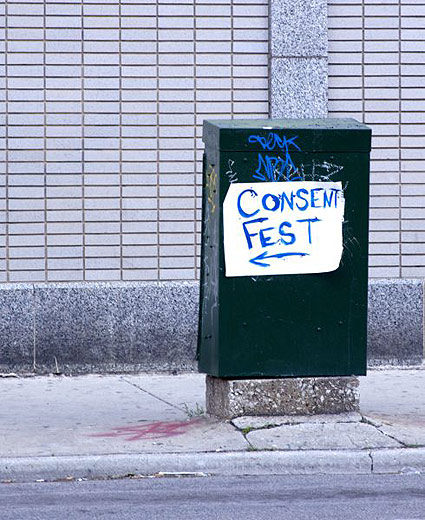
Consent Fest sign
Photo by Lauri Apple/Chicago Reader

This photo showed up this week in the Chicago Reader.  Out of context, the sign seems a little strange, but perhaps that strangeness speaks to how consent isn’t always a part of the way we talk about sexuality.

The lonely, hand rendered sign doesn’t really reveal the work and consideration that fest organizers Otter Irene and Ben put into Midwest Consent Fest.  They both said it was the most involved event they had helped organize.

The event went down on May 21 and consisted of an afternoon of workshops, a  a pitch-in meal and a show featuring punk and hardcore bands, solo acoustic performers and poets.

In the week before the fest, I talked with Ben and Otter Irene about what motivated them to organize the fest and the consciousness they hoped the event would forefront.  I also stopped by the fest for some of the workshops and part of the show.

Watch an audio slideshow of the interview and photos of the fest:

Additional audio:

  • Otter Irene talks about sexism in the DIY/radical scene [audio:http://blogs.terrorware.com/geoff/files/2010/06/otter_irene-internalized_patriarchy.mp3|titles=Otter Irene talks about sexism in the DIY/radical scene]
  • Ben talks about how sex education doesn’t usually address consent [audio:http://blogs.terrorware.com/geoff/files/2010/06/ben-sex_ed.mp3]

I didn’t take any photos of the workshops because the ones I attended involved people speaking really directly about very intimate and often painful parts of their life.  There aren’t a lot of places where people can speak candidly about mental health or substance abuse and I got the strong feeling that, even if people consented to be photographed, it would still mediate the discussions.  The ability for people to get something helpful or meaningful from the event was more important than me documenting it.

Union leaders and alderman among 32 arrested at immigration rally

It all went as planned.

After warning protesters who were sitting in front of the doors of the U.S. Immigration and Customs Enforcement offices three times, an officer told the activists to stand and that they were being arrested.

Thirty-two protesters who represented unions and immigration rights groups were lined up and led inside the building for processing.

The staged act of civil disobedience, with planned arrests, camera crews and trash bags emblazoned with dollar signs meant to symbolize the cost of current immigration policy, stood in stark contrast to the tangible fear of deportation of those in the U.S. without documents.

“We need comprehensive immigration reform,” said Keith Kelleher, president of Service Employees International Union Health Care Illinois-Indiana, and one of those arrested, as he was being led into the building.

“Our brothers and sisters in our unions and in the community are being deported every day and we need to stop it. That’s why I’m getting arrested.”

The arrests followed a rally at Federal Plaza and a march from the plaza to the ICE offices. The event was organized by the Labor Committee on Immigrant Worker Rights, an organization that represents a number of unions throughout the Chicago area.

Kelleher said employers who take advantage of immigrant labor by lowering wages cause lower wages for all workers.

“We cannot fix this economy as long as 12 million workers are forced to live in the shadows and subject to exploitation,” Eliseo Medina, executive vice president of SEIU, said. “All workers deserve to have the same rights and responsibilities.”

Medina called on Republican lawmakers to join efforts to craft comprehensive immigration reform legislation.

Jean Cusack came to the protest from Milwaukee with a group named Voces de La Frontera.

On her back was a photograph of Omar Damian Ortega, a Milwaukee man Cusack said was an undocumented worker detained and facing deportation after he tried to seek worker’s compensation for an on-the-job back injury.

Cusack said she wants to see immigration reform that allows a path to legalization for workers.  “The process is impossible,” Cusack said.

Among the arrested was Ald. George Cardenas(12th). In a speech at the rally, Cardenas said there needed to be unity between Americans across immigration status.

“We will not have tranquility in this nation unless we are all united, unless we are all allowed to pursue liberty and happiness,” he said.

Cardenas, himself an immigrant, said immigrants and other Americans were tied by a common bond.

“We share your values, we share your work ethic, we share your self reliance,” he said. “Your dream is our dream and your future is our future.”

This story was originally published May 25, 2010 on Medill Reports Chicago.

New Kid on the Block: Ramsey Beyer

Ramsey Beyer is a zine writer, illustrator and all around maker (she took the photos used in the video) who lives in Chicago. She was involved in organizing the Chicago Zine Fest in March and helps compile the monthly Chicago DIY calendar and she works as a nanny.

I had crossed paths with Ramsey a couple of time over the years.  Years ago, I stayed at her house in Baltimore while on tour with a band.  When I moved to Chicago, I found out that she happened to be the nanny for the woman whose job I was taking over.  A few months ago, I found that she had written an essay that was published in the same zine about children and radical communities as my roommate.

The essay is pretty amazing and describes a really unique relationship that Ramsey and her housemates had with the kids in their Baltimore neighborhood.  Moving to Chicago with kids, I had been thinking a lot about kids, childcare and punk.  This week, I finally got to sit down with Ramsey and talk with her about her essay and the changing role of kids in her life in Baltimore and Chicago and as a neighbor and nanny.

Check out Ramsey’s essay, “New Kids on the Block” below:

New Kids on the Block