Ahleuchatistas, Planets, Basilica, Impure Jazz @ Art Hospital. 8p. $4.

June 19,

Art Hospital

8:00 P.M.

$4


Ahleuchatistas

Planets

Basilica

Impure Jazz


On June 19th, the Art Hospital will host four instrumental groups who transcend their complexity throughout their high-energy performances.


From Asheville, N.C., Ahleuchatistas (it’s the name of a Charlie Parker tune and it sounds like it’s spelled) is a trio that writes slick, memorable jazz licks, then hammers them out with grinding drums, whirlwind guitar, and rock-solid bass.  “And while Ahleuchatistas could be grouped in with punk or with metal or with some sort of avant-jazz, they aren’t exactly any of those things. They are simply a tight three-piece making their own noise and cranking out great albums nearly every year.” — Pop Matters


Napa, California’s Planets .  Their explosive duo represents the new standard in high-energy music, made famous by Lightning Bolt and Hella.


Basilica’s wild compositions for two violins, two guitars, drums, bass, and video projections continue to make a bold, radiant impression on Bloomingon.  They will be performing an almost entirely new set.


Impure Jazz is a trio building on a solid base of rock music.  They find tasty licks, then decorate them with snappy rhythms and bright harmonies. 


www.myspace.com/ahleuchatistas

www.myspace.com/planetsplanetsplanets

www.myspace.com/basilicaproject

www.myspace.com/impurejazz

Published
Categorized as Lets Go

Oxford Collapse; Everything, Now!; Knifey Spoonie @ Bear’s Place. 10p. $7. 21+

Oxford Collapse (Sub Pop Records)
Everything, Now! (Indianapolis)
Knifey Spoonie (Bloomington)
@ Bear’s Place
Wednesday, June 11
10pm
$7

OXFORD COLLAPSE
http://www.myspace.com/theoxfordcollapse
They have a new album coming out on Sub Pop in August, so you will be
some of the first to hear some new material from this uber-fun
indie-pop band! And they will probably play some of your old
favorites too… if you ask nicely and buy them some chicken wings.

Everything, Now!
http://www.myspace.com/everythingnow
The Indianapolis powerhouse that you know and love is coming back to
Bloomington for your listening and viewing enjoyment.

Knifey Spoonie
http://www.myspace.com/knifeyspoonie
I see you’ve played Knifey Spoonie before… This new Bloomington band
definitely deserves to be seen and heard by you and yours.

Published
Categorized as Lets Go

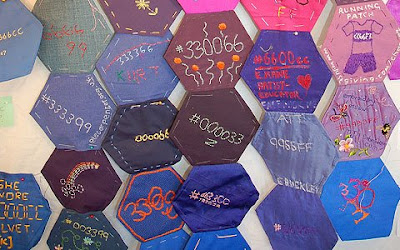
craft, code, gender, and computing

Embroidery is constructed (mostly by women) in hundreds of tiny stitches which are visible on the front of the fabric. The system of the stitches is revealed on the back of the material. Some embrioderers seal the back of the fabric, preventing others from seeing the underlying structure of the pattern. Others leave the back open for those who want to take a peek. A few integrate the backend process into the front of the fabric. The patterns are shared amongst friends in knitting and embroidery ‘ciricles’.

Software is constructed (mostly by men) in hundreds of tiny pieces of code, which form the hidden structure of the programme or interface. Open Source software allows you to look at the back of the fabric, and understand the structure of your software, modify it and distribute it. The code is shared amongst friends through online networks. However the stitches or code only make sense to those who are familiar with the language or patterns.

-Else Carpenter

I’ve been reading a book about gender and computing that looks to point to gender as a feature of the digital divide.  What is more interesting is that the authors, psychologists, seem to look at how computers are presented in an educational setting as a contributing factor to why boys and girls have different levels of comfort with computers and end up using them differently.

So, it was interesting to come across the blog post Open Source Embroidery: an interview with Ele Carpenter today because it seems to talk about the idea of technology at a very meta-level, drawing parallels between disciplines (craft and engineering) and media (embroidery and code).  I started knitting, and I guess part of the interest was that it was this gender-transgressive activity, but I also quickly saw the parallels to computer programming.  You can build things from scratch or from patterns (even the language is paralleled with pattern in software engineering referring to an algorithm for a reusable approach to a commonly repeated task in code) or a combination of the two.  Similarly, coming from an interest in FLOSS and the approaches that underly that kind of software and computing environments, I saw parallels in knitting in the multiple approaches that can be taken to reach a similar result.  Though there are many more parallels that can be drawn, the final one that was apparent to me was the vast amount of online documentation that I found for knitting and how it ranged from educational howto sites, to sparser patterns designed for an audience of similarly advanced skill level, to sites showing off the knitter’s prowess.

For better and worse, I think that I approach knitting in a very gendered way as I have a bag full of half-finished knitting projects in my closet.  This reminds me of the trainer who taught the secure programming class that I took earlier this week talking about his tendency to stop projects half-way through and how that had lead him to pursue consulting rather than development.  He ended this anecdote by saying, “for the ladies in the audience, I’m sure that you know what I’m talking about”, referring to the idea that their husbands also frequently started projects that they wouldn’t finish (which assumed that the women in the class were both straight and married which is a a whole ‘nother deal).

Ultimately,  I think that this discussion of software and craft is important because they show how similar skills, analysis, and culture has been constructed across a pretty vast gender divide.  To me, this is evidence that technical (or craft) ability is not tied to a particular gender and that the overall absence of women from computing (and in particular FLOSS) or men from crafting has less to do with the way their brains work and more to do with social construction.

Dual Headed X11 setup with GeForece 8400 GS on Debian lenny/sid

Having a job at the university means that I have access to hardware that I can’t afford to buy for myself.  My coworker was getting a new video card for his workstation and they just ordered me one too.  The card is an Nvidia GeForce 8400 GS PCI Express card manufactured by Chaintech.

Downloading the Driver

I have zero experience with post AGP video cards or dual head setups, so I just went off of my corworkers recommendation that I use the non-free Nvidia driver.  I downloaded it from this page:

http://www.nvidia.com/object/linux_display_ia32_169.12.html

Installing the Driver

I ran the driver installer with the command:

sh NVIDIA-Linux-x86-169.12-pkg1.run

and it told me that it needed to be run as root and after X was shut down, so I had to switch to a console, kill X and su to root.

The installer told me that it couldn’t find any precompiled drivers for my kernel, so I would have to build them.

The installer also told me that the compiler that it found (gcc-4.2) was different than the one used to build my running kernel (gcc-4.1), so I had to set my CC environment variable to /usr/bin/gcc-4.1:

export CC=/usr/bin/gcc-4.1

It then told me that it couldn’t find the kernel source or kernel headers for my kernel (at the time 2.6.24-1).  To get the headers, I followed some of the directions for building out-of-tree kernel modules:

apt-get install linux-headers-2.6.24-2-686

Finally, I reran the driver installer, specifying the location of my kernel headers:

sh NVIDIA-Linux-x86-169.12-pkg1.run –kernel-source-path=/usr/src/linux-headers-2.6.24-1-686/

and the installation completed without a hitch.

Configuring X (for this card with dual heads)

This was the easy part because my coworker kicked me this config file:

# xorg.conf (X.Org X Window System server configuration file)
#
# This file was generated by failsafeDexconf, using
# values from the debconf database and some overrides to use vesa mode.
#
# You should use dexconf or another such tool for creating a "real" xorg.conf
# For example:
#   sudo dpkg-reconfigure -phigh xserver-xorg

Section "ServerFlags"
    Option "DefaultServerLayout" "layout0"
#    Option "Xinerama" "True"
EndSection

Section "InputDevice"
	Identifier	"keyboard0"
	Driver		"kbd"
	Option		"XkbRules"	"xorg"
	Option		"XkbModel"	"pc105"
	Option		"XkbLayout"	"us"
EndSection

Section "InputDevice"
	Identifier	"mouse0"
	Driver		"mouse"
EndSection

Section "Device"
	Identifier	"nvidia0"
	Boardname	"GeForce 8400 GS"
	Busid		"PCI:1:0:0"
	Driver		"nvidia"
	Screen	0
#    Option "Monitor-" "monitor0"
#    Option		"NoLogo"	"True"
EndSection

Section "Monitor"
	Identifier	"monitor0"
	Vendorname	"Plug 'n' Play"
	Modelname	"Plug 'n' Play"
EndSection

Section "Screen"
	Identifier	"screen0"
	Device		"nvidia0"
	Monitor		"monitor0"
	Defaultdepth	24
	SubSection "Display"
		Depth	24
	EndSubSection
EndSection

Section "Device"
	Identifier	"nvidia1"
	Boardname	"GeForce 8400 GS"
	Busid		"PCI:1:0:0"
	Driver		"nvidia"
	Screen	1
#    Option "Monitor-" "monitor0"
EndSection

Section "Monitor"
	Identifier	"monitor1"
	Vendorname	"Plug 'n' Play"
	Modelname	"Plug 'n' Play"
EndSection

Section "Screen"
	Identifier	"screen1"
	Device		"nvidia1"
	Monitor		"monitor1"
	Defaultdepth	24
	SubSection "Display"
		Depth	24
	EndSubSection
EndSection

Section "ServerLayout"
	Identifier	"layout0"
    Screen 0 "screen0" 0 0
    Screen 1 "screen1" RightOf "screen0"
    Option "CoreKeyboard" "keyboard0"
    Option "CorePointer" "mouse0"
EndSection

Section "Module"
	Load		"glx"
	Load		"v4l"
EndSection

Section "DRI"
    Mode 0667
EndSection
reading notes on radical equations and other recent readings

I’ve been reading Radical Equations, a book of stories of the civil rights movement during the 60s and of Bob Moses’ work with the Algebra Project and the threads that connect those movements. The stories of civil rights organizing in Mississippi is a history that I knew little about, so it was enlightening and hearing it told first-hand as a story of experience rather than removed history is pretty powerful. I also started reading a paper about stories, ownership, empowerment, and exploitation, The Story Economy that articulates the importance of the story for social justice movements nicely:

Storytelling is both simple and powerful, and these two characteristics make it a valuable tool in the struggle for social justice: everyone understands stories and everyone as a story. Indeed, there is a macabre inverse correlation between abject circumstances nd narrative. Absolute poverty, for example, can only be the result of a tragic narrative. Such stories have an undeniable quality that enables them to be persuasive arguments for change. The civil rights movement of the sixties proved that when narratives of injustice gain traction in the minds of policy makers, those stories can result in progress. A woman too tired to relinquish her bus seat to a white passenger, a small group of black men who refused to leave a lunch counter – these and other actions were catalysts for change that ruptured the fabric of the status quo, and were turning points in the narrative of white privilege. Stories, therefore, can be a resource for people when other resources are scarce.

In the same article, the author quotes Castelloe and Gamble to provide a clear definition of popular education (I wish I would have had that when I was writing the press release for the I Want to Do This All Day tour stop in Bloomington):

[a] popular educator can be considered someone who helps groups of people in low-wealth and marginalized communities learn to use reflections on their daily experiences to analyze the social, political, and economic systems in which their communities are embedded. Popular educators also assume that the skills and knowledge that people have gained through their life experiences can provide the foundation for creating significant community change. (2005, p. 262)

primary voting

Joanne (who has been working at the polls) says:

You can vote in your polling place on Tuesday from 6am-6pm or you can vote in the Curry Bldg. downtown (7th and Morton) Saturday from 8am-6pm, Sunday 12-4pm, Monday 8am-12pm.  Bring an Indiana ID (driver’s license, state issued id from DMV or an IU id) or a Federal ID (military or passport.) And bring a book, lines are long now. Don’t complain about the long lines, early voting happens for 30 days prior to an election. You could have voted weeks ago and chatted
with me.

On a side note, if you’re interested in issues around the jail, some folks have published a voting guide showing the positions of various county candidates:

technology and activism

Here are two new instances of technology (both via boingboing) that seem to really aid social justice movements.

Cause Caller is a VOIP tool that lets you define a cause and contacts related to that cause (for instance, congressional representatives on a panel investigating a particular issue).  Users can then enter their phone number and the application will call them back and connect them with the different contacts.

ICED (I Can End Deportation) is a video game made by the human rights group Breakthrough that, according to Breakthrough’s website:

puts you in the shoes of an immigrant to illustrate how unfair immigration laws deny due process and violate human rights. These laws affect all immigrants: legal residents, those fleeing persecution, students and undocumented people.