DIY Medill business cards

I finally realized that I needed business cards for my reporting at Medill, but I didn’t want to shell out dozens of dollars for hundreds of cards that I probably wouldn’t use.  I wanted to pay a few dollars for a few dozen cards and have the option of printing more.

So, I created my own using the open-source illustration program Inkscape.  My template is based on an excellent Inkscape business card tutorial.  The design is meant to be printed in black and white on colored cardstock, making the text colored and the background black.

It took me a while to figure out (and obtain) the font for the Medill Logo, but according to What the Font, it’s PF Din Text Pro Thin.  I converted the “Medill” text to a path in the template so you shouldn’t have to have the font in order to use the template.

If you want to get really slick, you can generate a QR code with your contact information in vCard format and print it on the back.

Download:

Bookmarklet to generate Flickr image attribution text and link

This is a jQuery bookmarklet to extract an attribution string and link from a Flickr photo page.

To use the bookmarklet bookmark this link or drag it to your browser’s bookmarks bar: Flickr Attribution

The code is available at github.

At the time that I wrote this bookmarklet, I was using the the Monochrome Author theme (similar to the Monochrome Pro theme) by Graph Paper Press. It requires that you have an image associated with each post, so I frequently grab Creative Commons licensed photos for posts where I didn’t take a photo. I got tired of building the photo attribution string and link back to the photo by hand, so I made the bookmarklet to generate it with one click.

This is my first attempt at writing a bookmarklet and using jQuery.

I make use of the very helpful jQuery Bookmarklet by Brett Barros with modifications by Paul Irish as well as the zeroclipboard library for copying the text to the system clipboard.

There are probably some bugs with this code as well as lots of room for improvement. In particular, it would be nice to have the z-index of the bar displayed by the widget set so it covers all the FLickr page elements, but I couldn’t set a high z-index without messing up the zeroclipboard functionality.

When “humanizing” leads to judgement

Children facing food insecurity
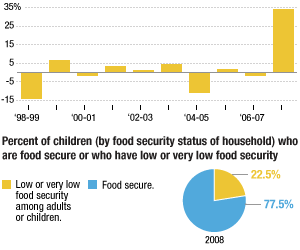
Percent change per year of children in households facing food insecurity from "A Daily Fight to Find Food: One Family's Story".

Data can give important insight into what’s happening in the world, but charts and numbers alone aren’t always resonant.  One way that reporters ground the numbers in a story is by finding people whose experience matches the trend.  This was the case with “A Daily Fight To Find Food: One Family’s Story,” a report that was aired on National Public Radio’s “All Things Considered.”  The story profiles the Williamson family of Carlisle, PA as an example of the growing number of families who struggle to meet their nutritional needs.  The Williamson family, the report said, “is among those who struggle for food. They’ve been in and out of poverty for years.”  The report goes on to describe a family whose experience includes limited education, teen pregnancy and joblessness due to health issues.

While the report tells the challenges facing the family and the mechanics of how they use a combination of government support and social services to meet their food needs, it doesn’t go very deep into the connections between the different elements of poverty beyond statements like this one from a woman who runs a food pantry in the Williamsons’ community: “But Livas, of the local food pantry, says a good diet is especially important for the poor, as a first step toward addressing their other problems, with things like work, health care and education. She says it’s hard to make good decisions when you’re hungry.” Unfortunately, this left a lot of room for listeners to speculate.

Devon Mann was one of the people who questioned the food the family bought and how they used it:

“Am I the only one that has a hard time believing that you can’t feed 5 people healthy home-made meals with $600/month in food stamps? I know exactly how much I spend on groceries (food only) each month–I buy local produce when available & strictly organic meats. I buy very little canned and essentially no processed/prepared foods. What exactly are these people cooking & eating? Why is there chocolate or pop & ice pops to choose from? We choose water in our home, & yes, we often add lemon to my toddler’s delight. I’m troubled by the ignorance and waste.”

Katherine Bittner made a similar observation that was also echoed in letters responding to story that were read on the air:

“I do not fill [sic] sorry for these people. I think the story would have benefitted [sic] from finding another family where people are really struggling to with food. $600 a month is a lot of money. My family makes six figures and we don’t buy juice (water is free), rarely buy brand name products, and junk food or sweets. We stick to generic store brand food at the local supermarket and clip coupons. Maybe instead of looking for the lean cuts of meat go for the cheaper cuts of meat that you can stretch out to make stews or for less than $20 you can buy 20 pounds of rice. It’s cheaper to buy a whole chicken or whole fish. You can make more meals out of them.”

These comments are judgmental, but also show listeners struggling to understand questions left unanswered by the story.  Did the reporter fall short of an obligation to the listeners and the Williamsons to address these questions?  By anticipating some of the listener responses, the  reporter could have gotten the family’s perspective on the perceived contradictions described in the story such as growing vegetables in a household while giving their thirsty child soda or having a full refrigerator yet sometimes needing to rely on a soup kitchen for meals.  This inquiry may have offered a deeper look into the problem of hunger, not just as a gap in food resources, but also in information and lifestyle.  Asking questions about this could have helped explain this situation instead of letting comments make assumptions about these dynamics.  Given, the emotional tone of some of the comments, it is easy to see how comments can steal focus away from the initial report.

Kathryn Geiszler, another commenter, exposed another challenge with using a single example to depict broader trends:

“I am surprised they need so much food. And, I agree with another commentor [sic] that if she is able to spend so much energy driving around with her food gathering routine, how come she can’t work? I am a single mother of two kids. We get by usually on $50 per week on food. We have no TV servie [sic], no HDTV, old video game consoles, ripped clothes, and taking the car anywhere depends if the gas gauge is near the bottom or half full. My little boy has Autism, so I stay home to school him. Not much luck even if I was a PhD looking for a job. 20% unemployment in my rural county. Moving to a better area would require thousands of dollars I don’t have. Therefore – I make do with the situation I’m in. It would be nice to get government help, but for some reason, I don’t.”

One role of the news is to help  the person reading or listening place herself within the events of the day.  From Geiszler’s description of her experience, her children may be very well be counted in the 17 million children living in households where getting enough food was a challenge.  However, because the report was framed in the Williamsons’ story, she may not feel the Obama administration’s request to Congress for $10 billion in additional spending on child nutrition programs, also mentioned in the report, as something she should engage in, either as a supporter, critic or inquirer.    Listeners may have been better served if the story was told through the lives of more families with different experiences with food insecurity to make it easier for listeners to identify with the issues instead of differentiate their experience from that of the Williamsons.

However, comments like Geiszler’s makes it easy for the reporter to talk to additional sources to get a deeper understanding of a complex issue like poverty.  While it may be unrealistic for reporters to get framings right the first time, it would be unfortunate to fail to take advantage of opportunities to report the stories or nuances that were missed.

Photo by Pam Fessler/NPR.

Memo for the week of July 18

This has been a busy and productive week for my independent study.

On Tuesday, I interviewed Gordan Walek and Patrick Barry, who are involved with the Chicago Neighborhood News Bureau, a project of  Local Initiatives Support Corporation (LISC)/Chicago’s New Communities Program.  The program promotes development in 14 low-to-moderate-income communities in Chicago andnews bureau website aggregates news from these 14 communities as well as Chicago-wide news that intersects with community development issues.  Talking to Walek and Barry, I learned that the site is a visible face to reporting that has been ongoing since the start of the New Communities Program.

Our conversation surfaced the nuanced role of news produced by or in conjunction with community organizations instead of news organizations.  The news produced by lead agencies working with LISC/Chicago and by writers working for LISC/Chicago has the dual purpose of informing community members about the development projects happening in their neighborhoods and reporting the progress of these efforts to funders and the broader community interested in neighborhood development.  I thought it was interesting how Walek and Barry spoke about trying to factually report what was going on in the neighborhoods even when the stories are meant to serve specific goals.  As a result, this reporting produced some of the first web content about the communities in the New Communities Program and for communities affected by problems such as violence, some of the only stories about community response or resilience in the face of problems.

During the interview, Barry told me that he and other reporters try to use the language of  neighborhood residents to describe what’s happening there and how spending a considerable amount of time in the communities that they cover gives them a much deeper understanding of community issues and dynamics than reporters covering only the occasional story and even agency program managers.

I thought their initiative showed an interesting example of journalistic practice being applied outside of traditional media institutions and being able to serve information needs and provide insights into communities that don’t always get sustained engagement from the media.

On Thursday, I spoke with four reporters at the Tribune who wrote stories as part of the Seeking Safe Passage project.  They challenged my assumption that the Tribune would automatically cover youth violence in the wake of the street brawl that resulted in Derrion Albert’s death.  Instead, they felt that the Tribune made a very intentional decision to devote resources to in-depth, solutions-oriented reporting on youth violence in the city.

The reporters told me how they were conscious that the audience of the stories they wrote would be read by Chicago residents very far from areas most affected by youth violence and made a point to identify threads in their subject’s stories that the reporters felt were more universally resonant.  They also spoke of being very conscious of the language they used to describe youth and in being sure to describe violence in terms of the actions of the youth rather than being an innate quality of the youth.  As with the writers working with LISC/Chicago, the Tribune reporters also said they tried to use the language used by community members when writing about those communities.

Another thread of conversation in the interview that I found interesting was that most of the reporters said they could identify with some aspects of the experiences of the youth they interviewed but that other aspects were completely foreign.  I wonder if this offers the best possible perspective for a reporter, where someone is able to connect at a human level with the communities they’re covering but also able to maintain a critical perspective.  Deborah Shelton, one of the Tribune reporters, sent me a link to “Cross Cultural Reporting: Pairing Mainstream and Ethnic Media for Better Health Stories”, which describes how a collaboration between two reporters writing about mental health in immigrant communities used the different orientations of the reporters around the story to produce a nuanced story.

Finally, the Tribune reporters, a multi-racial team gave me a really interesting and nuanced account of how race mediates their reporting experience.  They said that a good reporter can get the story independent of racial barriers but that race did play a clear role their experiences reporting.  They also described how being able to spend considerable time reporting in a community gave them the opportunity to learn what they had missed in previous stories.

Preparing for next week, I e-mailed Cliff Kelley about an interview.  In particular, I’m interested in talking to him about cross-media collaborations like the Tribune-sponsored Seeking Safe Passage community forum which Kelley moderated along with his general perspective on his radio show’s role in meeting community information needs.  I also took a peek at the New News report by the Chicago Community Trust.  This report is from last summer, but a new version should be available soon.  It gives a good overview of innovators in the online media space, some of which I’ve already spoken with and some that I should follow up with.  Finally, I plan to get in touch with the coordinators of the youth reporters in the Community TV Network program to shadow the youth as they do their reporting.

Photo by Calsidyrose via Flickr.

Global hotkeys for VLC

For reporting, I often need to fill in my notes with a recording I made of an interview.  This means I need global hotkeys so I can start/stop the player while I’m in my word processor or note-taking program (tomboy or zotero).

VLC has native support for global hotkeys, but for whatever reason, I couldn’t get them to work to map <ctrl>+<alt>+<space> to play/pause with Ubuntu 9.10.

My workaround is based on VLC global hotkeys in Ubuntu with Compiz. But, I use VLC’s remote control interface to control the player instead of the HTTP interface as suggested in the howto.

  • Make sure netcat is installed. We’ll use this to send controls to the remote control interface of VLC.
    $ sudo apt-get install netcat
  • Open up the CompizConfig:
    $ ccsm 
  • Click the checkbox next to Commands and then click on Commands
  • In the Commands tab, type echo “pause” | nc localhost 7777 -q 1 in the Command line 0 field (or the first available field if you have other commands). This command tells the play to toggle pausing the playback.
  • In the Commands tab, type echo “rewind” | nc localhost 7777 -q 1 in the Command line 1 field (or the first available field if you have other commands). This causes the player to rewind playback a few seconds.
  • In the Key Bindings tab, click the Disabled button in the row labeled Run command 0 (or whatever command you specified in the previous steps) and set the hotkey to whatever you want (I use <ctrl>+<alt>+<space>).
  • Repeat the previous step for the rewind command (I used <ctrl>+<super>+<left> because <ctrl>+<alt>+<left> was a hotkey used by another program).
  • Close CompizConfig.

Then, if I run VLC with both the normal and remote control  control interfaces, setting up the remote control interface on port 7777 on my local machine, my global hotkey will work:

$ vlc --extraintf rc --rc-host localhost:7777

You might want to create an alias for running vlc with these options by editing ~/.bash_aliases or ~/.bashrc:

...
alias vlctranscribe='vlc --extraintf rc --rc-host localhost:7777'
...

I’m not quite sure how all the remote control commands work.  For instance, I thought the rewind command would play backwards at the maximum rate, but instead it jumps playback back a few seconds.  I thought the fastforward command would do the opposite of rewind, but instead it slows down playback incrementally.  So, for now, I just have play/pause and jump backwards hotkeys, but that’s enough to make transcribing interview recordings much, much easier.

Putting neighborhood change on the radar of the Pitchfork set

On face, “Who is Logan Square?”, which appears in this weeks Chicago Reader is a nice piece of arts reporting.  Rather than just informing readers about and promoting  the Milwaukee Avenue Arts Festival, it describes conflict between event organizers over how the event represents Logan Square’s diversity.  But, it’s the context of the article within the particular issue of the Chicago Reader that makes it really interesting.

The story quotes artist Victor Montañez over his concerns about the geography of the fest:

And he really dislikes the way the fest map and program divide the approximately three dozen exhibition spaces into two groupings, south and north. “Art should bring people together,” Montañez says. The arrangement looks to him like a “divisive strategy” to create a Wicker Park-esque hipster scene in one area while concentrating people of color in the other. The list of curators and artists showing in the north section is heavier on Hispanic names.

Montañez is also critical of I AM Logan Square, a public-relations centered nonprofit-organization started by Ald. Rey Colón (35th) that was granted the key role in organizing this year’s fest.  In the story, Montañez said the organization’s leadership, from outside of Logan Square, contributed to organizing an event that doesn’t equally reflect different neighborhood demographics.  “This year we got I AM Logan Square – which is a studpid name because there’s no such thing, it’s we are Logan Square,” Montañez said.

Criticism by Montañez is balanced with quotes from the alderman and a volunteer who organized shows on the main stage who both say fest organizers took great steps to prioritize diversity in the event.

While reporting on gentrification and changing neighborhood demographics is done regularly in various Chicago publications, it’s really interesting that it was run in this particular issue of the Reader.  Since the event is next weekend, the article could have still previewed the event had it been run next week.  However, the story appears in the same issue as “The Reader’s Guide to the Pitchfork Music Festival.”

While writer Deanna Isaacs uses the phrase “alleged Pitchforkification” to describe Montañez’ concerns that Latino artists and musicians are downplayed in the Logan Square events lineup, the story clearly appears in a publication that includes readers who are interested in this weekend’s Pitchfork Music Festival and may be attracted to similar aspects of the Milwaukee Avenue Arts Festival.  This confluence of a story about neighborhood conflict and interest in a certain kind of art and culture puts information in front of readers who may attend the Milwaukee Avenue Arts Festival without examining it through a critical gaze.  It is unclear, however, whether this framing reinforces or challenges the idea that Latino residents of Logan Square and people who enjoy Pitchfork-style programming are mutually exclusive.

Whether or not Montañez is right about his concerns over the arts festival’s organizing, Logan Square is a neighborhood undergoing demographic change and the accompanying identity crisis that often comes with these changes.  The Reader’s reporting and editing do a good job of helping residents and visitors see how this struggle to define neighborhood identity can be reflected in events and entertainment.

Photos via the Chicago Reader.

Drinking the Kool-Aid

I had to read Googled: The End of the World As We Know It for one of my classes. The book frequently explains how Google’s AdWords and AdSense programs changed the way that media advertising works. To understand a little better how these things work from a content producer’s standpoint, I’ve added a few ads to this blog as an experiment.

So far, I’ve been disappointed that the ads aren’t very relevant or informative. I’m looking forward to see how NowSpots (Brad Flora’s local ad platform) shapes up.

Photo by adamknits via Flickr.

Ignoring the hyperlocalness of an issue

Full disclosure: I love libraries and they been a big part of my life through childhood. So, it’s hard for me not to find fault in Fox News Chicago’s story “Are Libraries Necessary, or a Waste of Tax Money?” simply on the grounds that it questions the relevance of libraries.

Both the state and many Chicago-area municipalities are facing severe budget problems, so it’s a legitimate role of the press to ask tough questions about how the government spends its money, even though there seems to be some issues with the framing and the balance between information and provocation in this particular report. In the context of this independent study, however, I want to look at how this report fails to acknowledge that libraries (in function and to a lesser extent funding) are local institutions and that what libraries look like and whether their benefits outweigh their costs may vary dramatically between communities.  Given that structure, it’s important to report on libraries as a more local issue or take great caution when reporting about them more generally.

“With cash-strapped states behind on so many bills, it’s quietly, and not so quietly, being debated,” the report begins.  The web version of the story identifies it as part of a special report on the Illinois Budget Crisis.  The story goes on to explain that 2.5 percent of property taxes go to fund libraries, but perhaps makes the assumption that all the viewers understand that property taxes fund local government infrastructure like libraries or public schools and that these funds are largely independent of state money.

The Chicago Public Library 2009 annual report shows that over $92 million of the library’s revenue came from the City of Chicago while around $8.4 million came from the State of Illinois.  Illinois Governor Pat Quinn’s proposed fiscal year 2011 budget recommends about $19.5 million in general fund grants for libraries, down from over $27 million in fiscal year 2009.  So, the elimination of libraries has a much more profound direct impact on local budgets than the state budget.  So, a more appropriate framing for the story would be whether a given municipality should reduce funding for their library system.  Or, the report should draw any link between reducing local budget expenditures to reducing state budget expenditures.

The report included a debate with Jim Tobin, president of National Taxpayers United of Illinois, weighing in on the side of reducing library funding, at least through property taxes.  One of his arguments for de-funding libraries is that new technologies (first lower-cost paperback books and now the Internet) are making libraries obsolete.  Again, the framing of the story doesn’t acknowledge that the role and value of libraries may differ, not just from library system to library system but from neighborhood to neighborhood.

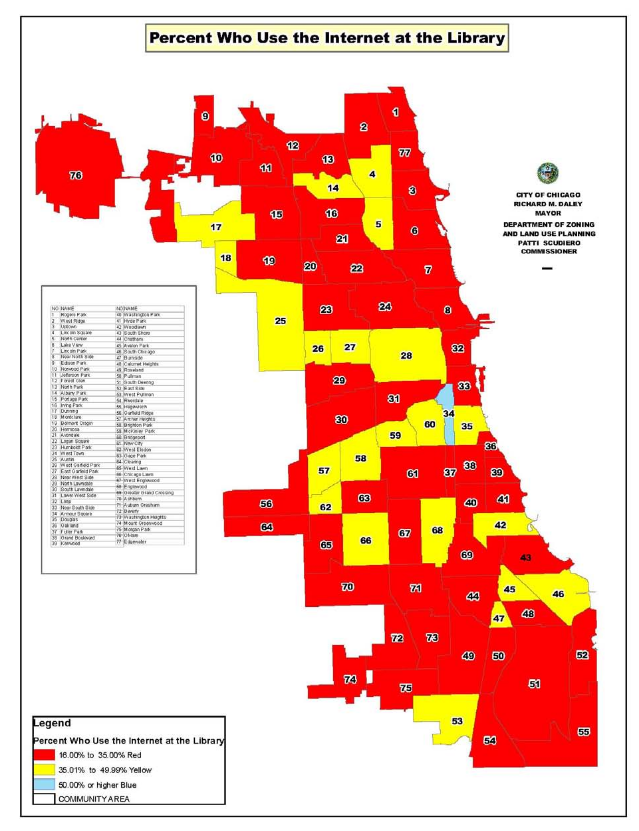
According to a report released in July 2009 by the City of Chicago Department of Innovation and Technology, one-third of Chicago residents used Internet access at a public library.  The same report cited that one-third of these users cited lack of computer at home as a reason for accessing it at a library.  However, library Internet use is not distributed evenly across Chicago’s population.  Young people and African Americans are more likely to use the Internet at a public library.  Furthermore, as this map from the report shows,  residents of some areas are more likely to use the Internet at the library than others.

Library Internet Use by Chicago Community Area from Digital Excellence in Chicago: A Citywide View of Technology Use.

So, while the rise of the Internet as an information source may make libraries less relevent (and funding-worthy) in some communities, it may make their relevence greater for others.  I feel a more useful framing of the story, taking into account this and other differences in the role of library resources for  different communities, could be to ask, “does this neighborhood need a public library?”  or “how do we  best use library funds?”

More questions: inevitable constraints of journalism?

Last week I spoke with WBEZ’s Torey Malatia about the station’s Pritzker Fellowship program whose first two fellows, nominated by community organizations, will soon begin intensive practice at the station.  Malatia said one of his hopes for the program was to counteract a dynamic where reporters would hit up the same sources again and again for recent developments in areas of ongoing coverage such as CHA tenant issues.  Perhaps, he said, bringing in reporters from different communities or without the training and mentality that comes with a j-school education, would lead to more varied sourcing or different ways of approaching, framing or identifying a story.

One thing that I thought was particularly interesting about Malatia’s analysis of the shortcomings of WBEZ’s reporting was that tight deadlines led reporters to go to the database for sources rather than finding new sources or framings for the story.  This led me to two questions: is there a way to alleviate some of the pressures of deadlines or is this an inevitable constraint of journalism?  Do newsrooms have to make a trade-off between timely coverage of news and in-depth reporting?  How much time does it take to prepare a segment on a show like 848 anyway?  Could someone develop a database that helped avoid using the same sources over and over or helped reporters find the most relevant sources?

Photo by tronixstuff via Flickr.

Journalism software stack

This is what I use and this is what I want. And its a work in progress.

OS

  • Ubuntu Studio 9.10
  • Windows 7 (Mostly just to run Adobe stuff now)

Hacking

  • Eclipse + PyDev + EGit
  • GeoDjango + PostGIS
  • gvim – For the times when Eclipse is to heavy, particularly when hacking on my netbook.

Multimedia

  • Adobe Premier Pro CS4
  • Adobe Photoshop Lightroom – Haven’t really tried other photo management software.  I like the way this handles metadata and has exporting presets which are good for Medill’s finicky CMS.

Writing:

Communications:

  • Google Voice – I forward a Google Voice number to my mobile dumb phone, my newsroom desk phone, and a Skype number.  This works great because I can give out one number to sources and be able to get their call anywhere.  Google Voice is also indispensable because I can easily record the call by pressing 4 any time during the call.  This is a really helpful feature for when I get a call back from a tough-to-reach source and I’m not in a place to take notes on paper or laptop.
  • Skype – I use this in conjunction with Skype Call Recorder (by far the best and most intuitive Skype recording software I’ve used) to record outgoing calls.  I configured my Skype account to show my Google Voice number in caller ID so sources don’t get confused about how to call me.  I like Skype Call Recorder because it starts recording immediately, but then reminds you to ask for permission and whether you want to keep recording or delete the file.  So, you never have to worry about accidentally turning recording off.  Also, it just stores the recordings as MP3s in a simple and intuitive file/folder hierarchy.
  • Tweetdeck

Information/Notes

  • Tomboy – really useful notetaking program that lets me move bits and pieces of information around fast.  I use my Dropbox to sync up my notes across computers. Become a Friend of GNOME
  • Dropbox
  • Zotero – I use this for storing and annotating web research and PDF reports.  I’m going to try storing audio recordings of interviews in here too.

Sources

  • Delicious – I use this to quickly consume my web research.  I like it because there are extensions for both Firefox and Chrome that make tagging really easy.
  • Google Contacts – Google Contacts is not awesome, but it is a central location for contacts and integrates with Gmail, Google Voice and Thunderbird which I use for contacting sources.

Wishlist

  • More useful Google Contacts – I would really love a short URL for contacts that I could easily drag into my Tomboy notes or word docs so I can easily link to contact info when I mention sources but not have to pepper my notes with a million phone numbers.  It would be even more awesome to have a better Google Contacts API so someone could write plugins for Tomboy/Open Office to quickly/automatically link mentions of names to their contact record.  The current Google Contacts API really only seems useful for syncing client apps with online contacts.  I’d also like a quick-add that parses out contact information copied from web sites.

Photo by jm3 via Flickr