PHP cheatsheet

This post is for PHP stuff that I needed to use, but couldn’t easily find on the web

‘pass’ in PHP

Maybe it’s bad to start using conventions from other languages, but I find that sometimes the code is more readable if you write an if statement so that nothing happens if the conditon is true and then put the code that will get run often in the else block.  In python, if you don’t want anything to happen in a block, you use the pass statement.  In PHP, you can just leave the block empty:


if ( $condition == true) {
// do nothing. note that other than the comment
// there are no statements in this block
}
else {
// do stuff

}

Feedback for sexual assault prevention in indiana

Reposted from Chiara:

i know i am kind of a broken record because i talk about the same things all the time, but here is the deal:
indiana is finally trying to implement a broad sexual asssault prevention plan, and insted of having random “professionals” decide what is best, they are asking hoosiers to fill out this survey to get an idea of what really affects people in their life and how to push for positive change.

it’s all online at : http://www. in. gov/isdh/23820. htm

even if you fill out a couple of questions it’s still helpful///

ok, hope to see ya all soon!
chiara

Perfunctory Healthcare

Since getting some semblance of health insurance, I’ve felt like the doctors I’ve dealt with have been competent, but curt, and I felt like my primary physician is just a dispatcher to a specialist.  Last night, I heard a story on All Things Considered that suggested that I wasn’t alone in my experience and that there are reasons (of course) why the care I get is the way that it is.

“You have someone on your hands with five separate medical problems, 15 minutes to see them. If you spend the extra half hour, you don’t get paid for it, so the pressure is to refer them to a subspecialist,” Levy explains. “It takes a lot of the pleasure and fun out of doing medicine.”

Check out the rest of Mass. Health Care Reform Reveals Doctor Shortage.

cash rules everything around me

I’m soliciting funds again.  This time, to support a project that I work closely with called the Midwest Pages to Prisoners Project (http://pagestoprisoners.org)  We send free reading material to people incarcerated in juvenile facilities, prisons, and jails throughout the Midwest, Florida, and Arizona.  Our primary means of support is  through the donation of books and money to cover buying books and the ever-rising cost of postage.  To put things in perspective, it costs between $3-7 to send one package of free books to an incarcerated person.  With each biweekly mailing, we send 100-200 packages, so the expenses grow quickly.  Though this might seem like a costly and not-so-efficient way to get reading material to people, it is often the only access to information, ideas, and mental stimulation that many incarcerated people have.  This Saturday, I will be bowling in a Bowl-A-Thon fundraiser and I would appreciate your sponsorship.  You can read more about the event at http://pagestoprisoners.org/bowl-a-thon and donate via PayPal by visiting https://www.paypal.com/cgi-bin/webscr?cmd=_s-xclick&hosted_button_id=1545159

Thanks for your support,
Geoff

CR10 decompression

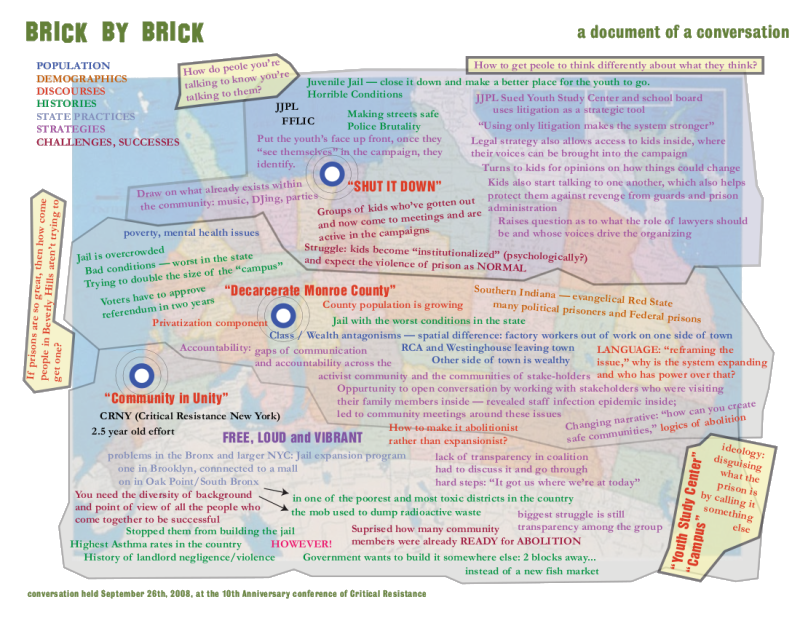
This has been sitting in my drafts for way too long.  Just going to post it and maybe add to it later.  Besides, I wanted to post the conversation map which I think is pretty interesting …

I got back from the CR10 conference in Oakland yesterday and still fill sleep deprived and like my head is exploding, not only with the head cold I picked up, but with thoughts, ideas, critiques, and questions.  I’m going to try really hard to give myself a rundown of everything that was on my mind throughout the conference as clearly, and with as much sane organization as I can.

Local Jail Resistance

Brick By Brick

Brick By Brick (PDF)

The primary reason that I went to CR10 was to be part of the Decarcerate Monroe County posse that was participating along, with two other groups, in a workshop titled “Taking it Down, Brick by Brick: Local Anti-Jail Campaigns”.  We shared the workshop with Community in Unity from NYC who successfully defeated a proposal to build a jail in the Bronx and is now struggling against the construction of that jail in a new location, and Juvenile Justice Project of Louisiana, a group that is trying to shut down an infamous juvenile jail in NOLA.  The format was a “fishbowl” conversation, with a facilitator asking the groups different questions and representatives from the 3 groups providing answers.  One cool addition to the workshop was videographer Ashley Hunt doing a real time visual map of some of the ideas that were brought up during the discussion.

Different communities, same story when it comes to jails

One would never think of the Bronx, New Orleans and Bloomington as having very much in common, but when it comes to the rhetoric of jail expansion, these places have a lot in common.  Both proposed sites in the Bronx for the jail (Oak Point and Hunts Point) were in poor areas of the city and both were very environmentally toxic and in close proximity to things like waste management facilities and power plants.  Environmentally-related health problems like asthma were more frequent in the community where they wanted to build the jail.  One of the proposed sites for Bloomington’s new jail is on the south side of town, near a primarily working-class residential neighborhood.  It would also be on the site of a closed industrial manufacturing facility, though I’m not sure if the environmental implications of the industrial site have been studied yet.

A similar parallel can be seen in the euphemisms used for jails.  In Bloomington, the proposal was for a “Justice Campus”.  In NOLA, the youth jail, where spoiled milk at meals and rat infestations were reported as common, is called the “Youth Study Center.”

Finally, improved conditions and easier access to visitation, both of which are used to rationalize jail and juvenile detention center construction in Bloomington, were also used as rationalizations for jail expansion in the Bronx.  Proponents of the jail argued that people housed in the new jail would be closer to their communities, though the change in proximity would be marginal according to CIU folks.  Also, jail advocates claimed that it would allow some incarcerated people to be moved from the notoriously bad Riker’s Island facility.  What seemed different from Bloomington is the fact that such arguments seemed to have much less traction in NYC than in Bloomington.  I don’t know why this is, though I think that many in Bloomington have fewer connections with incarceration so may be more trustful of the possibility of a kinder, gentler jail.  For people directly affected by incarceration in Monroe County, their marginilization from political and cultural power in the community and the lack of a history of political organizing with the leadership of poor people or people of color may make people feel like they have to cut their losses and hope that a new jail would provide some improvement in the conditions for their loved ones.

Still, the workshop definitely made me look beyond my mapping of power in the community.  I think it’s easy to see forces like the University as privileged, marginalizing, and moreover, homogeneous.  The moderator pointed out that, within the University, their may be many people from backgrounds of poverty or first-generation scholars for whom the politics of jail resistance may resonate strongly.  I had always been wary of having organizing against jail expansion involve the university too much because of tensions between university students and other community members and because of the different experiences of people affected by the jail and many student activists, but there are probably groups of people at the university who have experiences with incarceration for whom resistance to the jail would resonate.

Strategies

JJPL had strategic considerations that followed from part of their efforts involving a lawsuit about the conditions at the youth facility.  While the results of this lawsuit essentially only result from building a better jail rather than movement toward alternatives to jails, the lawsuit facilitated direct access to youth in the facility.  JJPL workers were allowed to interview youth as part of the lawsuit which allowed the gathering of information for both investigation and advocacy.  When talking to youth in the facility, JJPL noted that it was important to involve a large number of youth to prevent a baclash against youth who spoke out.  JJPL warned that while working with lawyers, it was important to have an equal flow of information and leverage in decision making in both the areas of media/organizing and litigation.

JJPL also used a lot of strategies to connect with youth who had been incarcerated or who were from neighborhoods where a lot of youth were incarcerated.  These included cookout events with DJs that doubled as planning events for the campaign.  One of the people with JJPL ran a record label and used hip hop music as part of his organizing.  JJPL also made efforts to keep in touch with youth they  had met doing interviews while the youth were incarcerated so that they could be involved in organizing once they were released.  One issue with working with incarcerated youth was that some were described as being “institutionalized”, or having difficulty examining the youth facility critically.  However, JJPL said that one youth’s comment that he didn’t think the facility should be closed sparked a long and constructive conversation about their organizing.  I wish I would have heard the content of that conversation.

CIU involved affected people by working with a therepeutic community called La Casita to organize speak outs about incarceration.  They also used a variety of media strategies to try to encourage opposition to the jail.  These included making maps that showed the human geography (economic background, race, environmental factors) of the sites for the proposed jail, a list of 50 other ways to spend the money on the jail, and a lot of emphasis on questioning why new jails were only planned to be constructed in poor communities.  They also tried to create media events that put decision makers face to face with formerly incarcerated people.

random post travel ideas

I always feel like I get this burst of inspiration from travel.

Rawny != Geoff Press Conference

After the youtube video where a commentor wondered if the band was my side project (because Rawny was playing in it) and being mistaken for me by the waitress at Wee Willies, I think it would be an interesting statement to have a press conference (and website, pamphlet, other mirrors of public education campaigns?) to “publicize” that Rawny and I are not the same person.

Questions

  • What’s the medium for this – youtube? ksm? an actual live event?
  • Who should ask the questions?  Should they be preformated, or try to get actual ones?

Defiance, Ohio tour show and tell

Get proposals from people in all the cities where there are tour dates for 5 minute presentations that could be something they’ve made, a skill they’re sharing, info about a community project, sharing an idea, presenting a question to a group of people …

wal-mart deaths and critical analysis

By now this is old news:

A stampede of shoppers in a Valley Stream Wal-Mart on Friday morning left one worker dead and at least three patrons injured after an impatient crowd broke down the store doors and trampled the seasonal employee, Nassau police said.  Jdimytai Damour of Jamaica, Queens, was pushed to the ground by the 2,000-plus crowd just before 5 a.m. as management was preparing to open the store, which is located across from the main Green Acres Mall building. Hundreds stepped over, around and on the 34-year-old worker as they rushed into the store.

You can see this as so symbolic in terms of the effect that caplitalism has on workers and people of color, but sometimes it’s exhausting and almost feels disrespectful to disect everything that way.  Are there better ways to die than others?  It seems like such a waste of life in any case.  In the part of The Accidental American that I read before I had to return it to ILL, the authors talked about the importance of people and immigrants in particular being able to have work and a life that was interesting and dignified.   This just seems like an example of how far we have to go – this makes me think of the horrific, but seems devoid of any interesst or dignity.

Take Back The Tech

Take Back the Tech: take action – online and off – to end violence against women

Whether its through community radio, posters, sms, emails, audiocasts or websites, creative and informed use of information and communication technologies (ICTs) helps get the word out on violence against women (VAW). We have to know about technology to best use it for our activism, we have to understand it to protect ourselves and others, and to keep shaping an internet for all. From 25 November to 10 December it’s time once again to “Take Back the Tech!” and use ICTs to end violence against women.

Women around the world are increasingly using ICTs to strategise, protest and mobilise: an SMS message brought together hundreds of women to protest their right to choose in the UK in a “flashmob”; an online petition in a social networking community attracted signatures against the stoning of women in Kurdistan from corners of the world previously unimaginable; mobile phones allow for quick snapshots to document abuse; blogs in dozens of languages decry VAW. At the same time, perpetrators of VAW also take advantage of technology: a husband switches his wife’s SIM card to spy on her mobile phone callers in Free State, South Africa; the Iranian government repeatedly blocks access within Iran to a website calling for an end to discriminatory laws against Iranian women.

For 16 days of activism against VAW, the APC Women’s Programme (APC WNSP) calls on all ICT users to stretch and hone internet skills and strategies for activism to ensure women’s safety online and off.

What is the campaign about?

Take Back the Tech is a collaborative campaign by internet users, advocates,collectives and organisations that take issue with the prevalence of VAW in our diverse realities. Initiated by APC WNSP in 2006, the campaign is part of the 16 Days of Activism Against Gender-based Violence initiative.

It is our right to shape, define, participate, use and share knowledge,information and technology, and to create digital spaces that protect everyone’s right to interact freely without harassment or threat to safety. Take Back the Tech calls on all users of ICTs – especially grrls and women – to take control of technology and consciously use it to disrupt unequal power relations.

How can you Take Back the Tech?

DAILY ACTIONS
Throughout the 16 days, daily actions using the internet to fight against VAW aim to stretch skills and knowledge around ICTs and VAW. It’s an opportunity to take time to play with technology for a purpose – exploring mapping, editing audio, transforming photos, sending mass SMS through the internet – to take action with new tools or apply the tools you use every day in a different way. Simply visit the campaign website at http://www.takebackthetech.net to check out the latest daily action.

CAMPAIGN SPOTLIGHT
Local campaigners have embraced Take Back the Tech in different ways: training women’s organisations in web 2.0 tools to help get the word out in Mexico and Uruguay; putting resources in local languages such as Khmer in Cambodia; building computers – and learning how to sew – in Brazil. Campaigners are organising online protest petitions and audiocasting public forums. Every other day a new campaign will be featured on the Take Back the Tech website. Check out a campaign spotlight, learn about the local reality of violence women face and challenge, and help their cause from afar.

LOCAL INITIATIVES
Start your own Take Back The Tech campaign. Every year, independent and creative initiatives to Take Back The Tech have taken off in different parts of the world, translating content and action to address local needs and priorities. Use the campaign website to highlight your action, find useful tools and tips, and adapt images and graphics to your needs. You can even create your own page on the site, just email us to let us know how we can support your action.

ka-BLOG!
Deepen the debate around violence against women by joining the 16 day blogathon. New to blogging? This is the perfect reason to start your own, or at least, click that ‘comment’ button to have your say. Daily topics will be posted on the campaign site to stir conversation, as well as instructions on how to set up a blog.

DIGITAL STORIES, AUDIOCASTS & MORE
Learn by listening to the experience and stories of women and men affected by VAW. The campaign website will feature digital stories, audiocasts, video clips and postcards. If you have something you would like to share, just log on to the campaign site and submit your story.

SUGGEST AN ACTION
Help shape the campaign by sharing your experience and ideas. Submit your thoughts at the campaign website, and make it part of the campaign.

Check the www.takebackthetech.net daily from 25 November to 10 December, and take action. Reclaim technology to end violence against women.

For more information, consult the FAQ at http://takebackthetech.net/about/campaign or send an email to ideas@takebackthetech.net

If you say it enough times …

From my pretty removed perspective, I know that there is homophobia in some Black communities.  This dynamic has been getting a lot of attention lately due to reports, which I wrote about earlier, that Black voters in California were instrumental in the state’s electorate passing Proposition 8.  While I believe that homophobia is a complicated problem, one that draws on competing narratives of sexuality, gender, and yes, race; and that all kinds of people suffer from and perpetuate homophobia, I didn’t really question the reports of the role of Black people and the success of proposition 8.

Luckily, some did, including this statistical analysis of voting demographics and proposition 8 which comes to the conclusion that “There Were So Many More White, Latino and Asian Votes in Favor of Proposition 8 That Blaming Black Folks is Both Bad Math and Racist Scapegoating of the Highest Order”.  Ultimately, though, the point isn’t who is responsible for Prop 8’s success, it’s the fact that it passed in the first place.  Reporting that simplifies incredibly nuanced issues and the scapegoating that follows masks the fact that there is so much that we all need to do, whether it’s addressing homophobia in the Black community, or in the culture at large, or racism within mainstream queer political groups or racism in the culture at large.

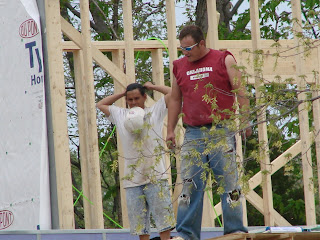
Today, as I was driving to work, I heard a crazy advertisement for a Burger King chicken sandwich on te radio.  The story in the advertisement was a conversation between two construction workers.  The younger worker whistled or said “hey baby” or something like that.  He was reprimanded by the older worker because he wasn’t hollering at a woman.  The younger worker replied that he was hollering at the chicken sandwich because it was so hot.  The older construction worker corrected him, telling him in the future, that he should only make catcalls at women and not sandwiches because construction workers “have a reputation to uphold”.

So this is one of those jaw droppers where you can’t even begin to pick it apart and you’re just kind of in this “damn, that’s sexist” stupor.   What really bothers me about the commercial is that it makes street harassment something that construction workers do instead of something that happens throughout our culture.

If you look through websites like Holla Back NYC that document street harassment, you’ll find plenty of reports of being harassed by construction workers.  I worry that, even in doing the important work of problematizing street harassment, we end up problematizing it only in the context of something construction workers do.  This is certainly easier, because we can just add sexism to all the other race and class stereotypes that are easy to apply to certain types of workers.  But, does it change anything?  Even if, by some statistical analsysis, we were able to determine that construction workers harass people on the street more than other groups of people, it’s not just something that happens.  Street harassment, as is the case with other assertions of or attacks on gender, is affected by forces that span our culture and history, and that affects us all.   Affirming, “construction workers harass women”, doesn’t do very much to change these cultural forces.

Growing up in a, at least supericially, politicaly conservative, monoculural place, sexism and homphobia weren’t abstract, but imagining the realities for women and queer people, if you weren’t either, was incredibly difficult.  Still, I knew many men and straight people who lived differently from the sexism and homophobia that could have easily been considered the norm, whether they had the benefit of a culture that made them critical thinkers or not.  The danger of the media analysis of Black people and Prop 8 or ads featuring sexist construction workers is that it makes it so much more difficult for people who defy the stereotypes.  If you’ve never really thought about it, it’s just so much easier to go along with the expectation that people of your racial group are homophobic or that people who do your kind of work holler at women, then trying to think about these things criically from multiple directions.  If you already have to confront so many stereotypes, it seems like it would suck to have to prove that you’re not homophobic or not sexist instead of just being an ally to queer folks and women.

Ultimately, I’m disappointed that we find it so easy to find a scapegoat instead of starting to do the work, and having the conversations, that need to happen now, as much as ever.

multiple thunderbird profiles at once

I kept getting logjammed checking my personal e-mail at work, so I made separate profiles in Thunderbird for each.  However, every once in a while, I want to open both at once to monitor incoming e-mail from both my personal and work accounts.  In order to do this, you need to provide the -no-remote switch to Thunderbird.

I updated my launcher like this:

 icedove -no-remote -ProfileManager %u