ghing@silvertongue:~/.mozilla/firefox/imtysl65.default/Cache$ ls -lh `find . -size +1M | file -f - | grep Flash | awk -F ':' '{ printf "%s ", $1; }'`
prop 8, race, Obama, and the need to have tough conversations
The Obama campaign, due in no small part to grassroots volunteer power, did an incredible job of hitting the streets and talking to people about what Barack Obama was all about, even in areas that have been traditionally seen as hostile to Democrats (and in places, people of color). Were opponents of prop. 8 as successful? I’ve been reading Men Speak Out, a book about gender violence an masculinities and a few essays talk about the schism between many queer people of color and the mainstream LGBTQI political community. I think the dynamic reported in the article below shows the need for all our civil rights and social justice movements to hit the streets and start talking about our experience with politics, even with folks with whom we expect to be at odds with. Whether it’s queer folks or food stamp recipients, people who are often stereotyped and stigmatized, and their experiences, remain faceless and abstract, and totally unreal to neighbors and decision-makers alike. This has got to change.
McClatchy Washington Bureau | 11/07/2008 | Black turnout for Obama doomed gay marriage in Calif.:
African Americans, energized by Barack Obama’s presidential bid, boosted their numbers at the polls this year to 10 percent of the state’s electorate, up from 6 percent in 2004.
“The Obama people were thrilled to turn out high percentages of African Americans, but (Proposition 8) literally wouldn’t have passed without those voters,” said Gary Dietrich, president of Citizen Voice, a nonpartisan voter awareness organization.
election reflection
I want to try to draw some cohesive analysis from the election results, but it’s so difficult. I’m just going to post some things that come across my radar that I responded to.
Folks talking about voting for McKinney/Clemente made me think long and hard about third party candidates. I was so sick of hearing people talk about how Green Party voters were spoilers in the 2000 election, and am glad that I felt good about a major party candidate this time around. Still, it leaves me asking, would it be better to have a presdent whose ideas I feel better about, or a president whose ideas I can largely identify with (though strongly disagree with also) and lots of other people can feel secure and energized by, thus creating a different context to the work I want to do to see the world change towards a more just place?
Lots of people who aren’t in the U.S. seem stoked about the Obama victory. Chiara’s mom stayed up late across time zones to follow the election and was excited at the end. I saw this message on a community informatics mailing list that I subscribe to:
I want to try to draw some cohesive analysis from the election results, but it’s so difficult. I’m just going to post some things that come across my radar that I responded to.
Folks talking about voting for McKinney/Clemente made me think long and hard about third party candidates. I was so sick of hearing people talk about how Green Party voters were spoilers in the 2000 election, and am glad that I felt good about a major party candidate this time around. Still, it leaves me asking, would it be better to have a presdent whose ideas I feel better about, or a president whose ideas I can largely identify with (though strongly disagree with also) and lots of other people can feel secure and energized by, thus creating a different context to the work I want to do to see the world change towards a more just place?
Lots of people who aren’t in the U.S. seem stoked about the Obama victory. Chiara’s mom stayed up late across time zones to follow the election and was excited at the end. I saw this message on a community informatics mailing list that I subscribe to:
Dear Global colleagues
This is an excellent idea. Obama is no more just the President of America. He is the nucleus of hopes for the global citizens. I feel he can give a very nice shape to the whole world – a place for living for everybody. Technology has has brought the globe on his palm and he
will surely utilize his knowledge, wisedom, talents, expertise, experience and skills for the people of the world (who love him)
irrespetive of sex, race and color.We also enjoyed the election from here in-Bangladesh in south Asia. We expect that Obama will create a better and peaceful world forcus.
Lutfor
Bangladesh
I too am excited that a U.S. leader is talking about global cooperation and collaboration and support instead of just confrontation. We’ve seen capital become globalized, maybe there’s hope for globalized accountability.
Finally, the local elections have implications too. Lauren Taylor wrote this about the implications of the county government races for the proposed new jail:
So in case y’all didn’t hear or see it already, the Democrats swept
the local elections, with more than a little help from Obama
supporters who turned out in record numbers. In relation to the jail
and juvenile facility issues, that means that:County Commissioners (the three person triumvirate that serves as the
executive branch of the county, implements policy)
Two of the three commissioner seats were up for election, the third
seat stays with Republican Pat Stoffers (R).
– Iris Kiesling (D) is a big supporter of a new jail and juvenile
facility. She was re-elected with 61.4% of the vote.
– and Mark Stoops (D) opposes the expansion of the jail though
supports a juvenile treatment facility. Won with 62% of the vote.County Council (holds the purse, decides whether or not to fund things)
Three at large seats were up for grabs. There are seven total council
members at any given time.
– Julie Thomas (D) got the most votes, and will join the council. She
opposes the jail and supports a juvenile treatment facility.
– Warren Henegar (D) was second, and was re-elected to the county
council. He supports both the jail and juvenile facility.
– Geoff McKim (D) was third, and will also join the council. He
conditionally supports the jail – wants only more space for
programming and improved conditions, NOT for more beds. Also supports
a juvenile facility.so yeah, best possible results from local elections, i believe.
~lauren
The World Bank on FLOSS
From e-Development – Live Webcast:
Support and training are recurrent costs that constitute two of the three largest costs in the total cost of ownership model. They are greater than hardware costs and much higher than software fees.
Ultra-low cost computers and Linux-based solutions are relatively equal in cost to traditional hardware and proprietary software solutions because they require higher labor and replacement costs over a five-year period.
The subject of this talk, the cost of technology in schools seemed interesting, but it’s also the world bank, who are notoriously whack. This quote seemed really different than the speaker at IU’s Linuxfest who called Linux the great equalizer for developing technology/information-based economies. My totally unquantifiable analysis is that the dichotomy between Ultra-low cost computers / Linux and traditional hardware and proprietary software is false. Certainly IU’s Cyberinfrastructure is a good example of traditional hardware and Linux/other FLOSS infrastructure (granted IU does run RHEL, a commercial Linux package on a lot of its Big Iron). More importantly though, I doubt the TCO calculations take into account the education that can come when student users have to learn how to support their own machines (which I believe was part of the ideas driving the early iterations of the OLPC project) and the culture of propogating learning that already exists around FLOSS.
the stigma of socialism in historical context
What’s old is new, apparently, especially with electoral fear-mongering. I had heard that the label of “socialist” had been used to try to mar the political policies of many past presidents, but it was nice to find it in print.
Then, as is now, we don’t end up talking about actual policies – the effect of taxation on different groups of people and the effect of that on the economy, the amount of government oversight of industry, the role of the government in providing services and support for people in the U.S. Instead, important policy decisions get framed in a vague and inaccurately applied label. Awesome.
From “Most of his policies are in strict harmony with Socialist principles” | Observationalism:
Moreover, most of the Rooseveltian policies – the arid land reclamation schemes, the National forests, the leasing of coal and mineral rights, the renting of grazing lands, the construction of the Panama Canal by direct employment, the development of water powers under public ownership and control – are in strict harmony with Socialist principles?.The faith of our forefathers in the sacred principle of competition as the self-acting force which yielded ideal justice and rendered to every man according to his deserts, has departed as surely as the belief in witchcraft. [Socialists] can?t threaten me worse than Theodore Roosevelt does with his inheritance and income tax schemes and the social workers of New York with their ever-increasing demands on the city budget.
[tags]election, socialism, mccain[/tags]
sexual assault statistics
I recently started co-presenting the Middleway House‘s Building Healthy Relationships workshops in local schools. This is going to be an ongoing list of statistics about sexual assault so I can remember them, check that they’re still current, and get the context.
- Only 6% of people accused of rape go to prison
- 60% of assaults happen in the survivor’s own neighborhood
radical votes

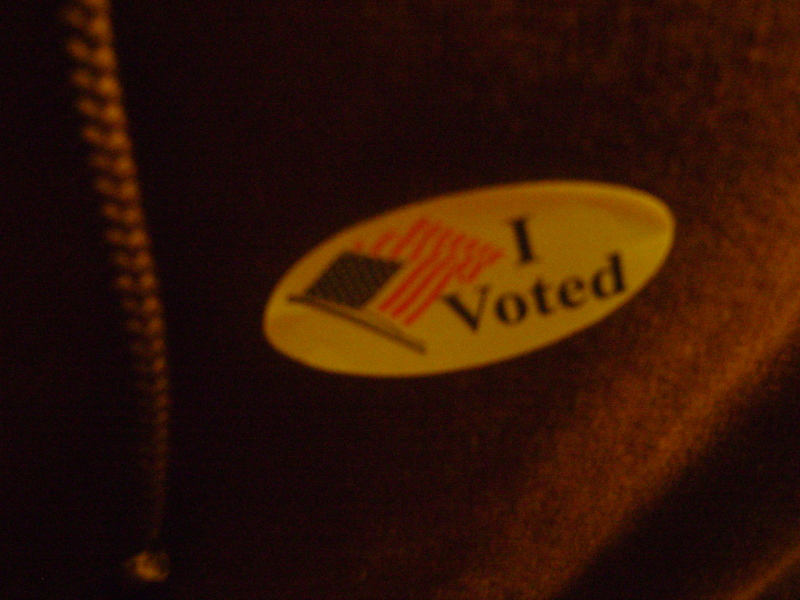
Two days ago, I voted early in Bloomington, Indiana. It took me around forty minutes and was a pretty great experience. I want to encourage everyone who is registered to vote, to do so, but even if you aren’t registered to vote, can’t vote, or choose not to, please go to a polling place on an early voting day, or election day, just to see what it looks like. For me, the early voting location in Bloomington provided me with a great vision for what I want the things that I do to look like. For all its limitations, the electoral process, for a moment, had engaged a multiracial, multigenerational group of people who spanned classes and backgrounds, thus involving a far more complicated mixture of people than my community’s power structure and the cultural and political projects that I am a part of. I want the things I do to involve and be accountable to people in this broad and complicated way.
I voted for Barack Obama in the presidential race and for a number of other candidates in state and local races who I believed reflected my ideas and values in a way that was substantially stronger than their opponents. I ask you to do the same. If you are registered to vote, please take the time this week to vote for Barack Obama and any other candidates who might create a better context for the cultural and political work that many of us are doing. If you are registered to vote, but are not convinced that you should take the time to vote, please read on.
I am under no illusion that this election, or any election, can bring the kind of radical societal change that I ultimately want to see. Moreover, I see how the electoral process can oversimplify, distort, and silence a vibrant set of beliefs and proposals and reduce them to vague generalizations or culture war. I shudder at the way in which the candidates change their ideas to appeal, not to the needs and concerns of real people, but to amorphous demographics. Watching the presidential race, I cringe every time Senator Obama talks about hunting down and killing Osama Bin Laden or changing the focus of U.S. military intervention from Iraq to Afghanistan. Even more, I am sickened by the way that Senator McCain has changed his rhetoric and selected a running mate to appeal to a bigoted and narrow-perspectived brand of conservative that was once his adversary. And, even though I am glad that Senator Obama’s fundraising might help him win the presidency, I am disgusted when I think of what could have been done with that money other than winning an election. Despite all of this, I feel good about voting for Barack Obama for president, as one part of all the commitments I hope to make towards building a different world. I can’t pretend to believe that I can convince anyone about why *they* should vote as I have. All I can do is try to explain why I have chosen to vote in the hopes that some of these things may resonate with some of the things that those reading this are feeling.
Context Matters
Radical community organizing, making independent art and music, direct action – these strategies of change happen in a cultural context that plays a huge role in the success or failure of these pursuits. As I stated earlier, I do not believe that any president can bring about the kind of change that I want to see, but I do feel like Barack Obama would, as president, set a powerful and positive context for my work towards that change. I see this election, not as a battle of competing policies, but as a referendum on very different views of the world and how one can engage in it.
What is Experience?
I think grassroots community organizing is extremely important. I think it can bring about the kind of changes in communities that politicians can’t. My vote for Barack Obama is an affirmation of this. His work as a community organizer in Chicago has obviously informed his politics and vision. I want to express that this kind of work, and not just military service or a political career, commands power and respect. Moreover, the Obama campaign itself is an affirmation of grassroots organizing. In the past, I advised people to vote, but not to let the campaign distract them from the work they were already doing. I now question the soundness of this advice. I have heard so many stories of people, working on the ground for the Obama campaign, having the really tough, soul-wrenching conversations in their communities about race and class that are so needed everywhere. In trying to convince others of something, they have had to think, and really think, about why they are themselves so committed. This is in stark contrast to the dangerous tendency I see in myself and many of my friends to settle with being right about something rather than engaging others to actually change things. For many, it is the first political movement to which they have ever given sweat or monetary resources. If the unpaid work and small monetary donations of so many can win an election, I can’t wait to see what else it can do. I hope that those who committed themselves to this one type of political involvement will continue to apply their passion and resources throughout their lives, regardless of the outcome of the election, but I feel that an Obama victory would do much to ensure this.
Experience with Race
During the election season, NPR has had a great series of stories where they talked to voters in York, Pennsylvania (not too far from where I grew up!) about race and the election. What NPR got very, very right is that they framed the conversation, not in terms of the race of the candidates, but in how the voters’ *experiences* with race affected their perspective on the election. To me, what is most paradigm shifting about Barack Obama’s candidacy is not the fact that he is multiracial, but that he has been able to reflect on and articulate how his complicated experience with race has shaped his life and informs his worldview and political ideas. In the NPR stories, a white woman said that she didn’t have much experience with race. As a multiracial person, I find this sentiment to be one of the most offensive and harmful examples of white privilege. It is, I believe, the reason I have heard, over and over, the misconception that people of color cannot be themselves racist, or that some white people fear reprisal if a black man is elected president. The United States is a multiracial country with an often shameful multiracial history. The assumption that only people who are not white have experiences with race is simply not true.
John McCain has experience with race. He is the adoptive father of a child who is not white. In fact, this was the subject of an ugly rumor, designed to hurt his chances in a Republican primary, that his daughter was actually his child from an affair with a non-white woman. The way that John McCain is perceived and the expectations, prejudices, and way of moving through the world that he has experienced will be profoundly different from his daughter. This is a challenge that many cross-cultural adoptive parents must struggle with, but McCain’s experience with this has not been part of the campaign. John McCain fought in a war that pitted him against people of a different race. He was captured, and tortured by some of them. In the not-so-distant past, McCain continued to refer to some groups of Asian people with the derogatory term “gook.†Again, coming to terms with the racism, xenophobia, and dehumanization that comes with war is a part of many peoples’, in particular soldiers’ experiences. Yet, the loudest commentary on race that has come from the McCain campaign has been from a small number of his most bigoted supporters.
If we, as a society, are going to get real about ending racism, if we are going to get real about coming to terms with the reality of a multi-racial United States – past, present, and future, then we need to be able to reflect on, and talk about our experiences with race. This needs to happen in our neighborhoods, and among the most visible representatives of our culture.
Culture Wars
I grew up in a part of Pennsylvania that is getting a lot of news coverage as the election comes to a close. John McCain believes it to be a stronghold of the kind of conservative base that will allow him to win the state, and the election. Right now, I live in Bloomington, Indiana where, just outside of the city limits, many would believe the same unyielding conservatism is represented. If there is one thing that has been disappointing about Obama supporters, it is that so many are willing to accept the line in the sand between cosmopolitan liberals and “ignorant rednecks.†I think this perspective is offensive and narrow. Many studies suggest that the rural vote is every bit as divided as most other places. As I drove, this past weekend, from Bloomington through the countryside to another town, I saw as many Obama signs as McCain ones. Growing up in a staunchly conservative area, I know that these beliefs are powerful. I know that bigotry is real. I know that these things come with the weight of history, traditions, and culture. But I also know that there are some, who come from those same places, from the same culture, through the same history, who come to very different conclusions in their life. Belief that we are born into red states or blue states, enlightenment or ignorance sells us all short. It absolves us from the responsibility of examining who we are and where we come from. I think that Barack Obama’s candidacy has consistently challenged this. John McCain, and especially his running mate Sarah Palin, are, quite cynically, suggesting that people should vote their race, class, and geography rather than their ideas, beliefs, hopes, and vision.
There are many other reasons why I felt good voting for Barack Obama, but the ones I’ve mentioned: that context matters and that we need to fundamentally challenge our ideas about where power comes from, how we think about race, and whether we view our world as a set of clashing monolithic blocks or a confluence of people with complicated interests and experiences, are the ones that mean the most. For the first time in my political life, they have made voting feel radical, in the original sense of the word, in the Ella Baker sense of the word, because I feel like, through this election, we could be that much closer to getting at the root causes of all the things in this world that we will change.
Love,
Geoff
Voting and CommUNITY
From Georgia early voting: Prada wearers, discount devotees together:
There, overlooking an Office Depot and, in the distance, a Wendy?s and a McDonald?s, an anymore rare public coming together of the classes has been congregating on recent weekdays to exercise an all-American right: the right to stand in line.
Voters decked out in everything from Prada to Family Dollar have been queuing up for weeks now. The other day, a priest stood shoulder-to-shoulder with some lunchroom ladies, in front of a man in full camo, a uniformed school-crossing guard, a local TV weather guy, a woman in a Dave Matthews Band T-shirt and a fellow in a half-zipped-up blue hoodie with nothing underneath but his bare, hairy chest.
This was also my experience early voting yesterday in Bloomington. I thought it was great. I also loved the number of parents and young people voting together, though I hope that each had the mobility to make up their own minds, with input from each other.
[tags]politics, bloomington, 47401, election[/tags]
Early Voting and Sample Ballots
One of the ways to ensure your vote gets counted is to vote as early as possible. You may be able to vote but there may be complications with your registration (you’ve moved for instance) that might complicate things and could delay your voting or just make for an uncomfortable situation on election day.
Early voting in Bloomington will be available at the Curry Building weekdays 8:30-4 through Nov. 2 and 8:30-noon on Nov. 3 as well as 8:30-4 (I think) on Saturdays Oct. 25 and November 1.
The Herald Times has information about the election and sample ballots on their website.
Update: Information on the state judges who are up for retention.
Update: Information on state judges up for retention with regards to abortion rights issues This site is put up by an anti-choice organization, but the information provided should give anyone an idea of the decisions of some of the supreme court judges with regard to rights to have access to abortions.  The site mentions two key decisions with Theodore Boehm being the only justice up for retention who seems to have decided in favor of preserving access to abortions for Indiana women.
From the site:
Dissented against an opinion upholding Indiana’s 18-hour waiting period before an abortion could be done, stating, “Article I, section 1 of the Indiana Bill of Rights includes the right of a woman to choose for herself whether to terminate her pregnancy.” Clinic for Women v. Brizzi, 837 N.E.2d 973, 994 (Ind. 2005).
Concurred with an opinion that expanded taxpayer funding for abortions through Medicaid in Indiana, stating, “denial of benefits to indigent women for medically necessary abortions is a violation of their state constitution.â€Â Humphreys v. Clinic for Women, 796 N.E.2d 247, 795 (Ind. 2003)
Getting list of places on a map created with Google MyMaps
So I made a map using Google MyMaps of venues for events in Bloomington. Crystal added a ton of content and made it look pretty. The hard part is figuring out how to provide a listing of event locations with the map. You can get the map data for the map that you created in MyMaps as KML or GeoRSS. Then you can load it and parse it using part of the Google Maps API a la this code snippet I found at http://www.easypagez.com/maps/phpsqlinfo.html:
// Read the data from example.xml function readData() { var request = GXmlHttp.create(); request.open("GET", "http://www.easypagez.com/maps/phpsqlinfo_result.php", true); request.onreadystatechange = function() { if (request.readyState == 4) { var xmlDoc = GXml.parse(request.responseText); // obtain the array of markers and loop through it i=[0]; markers=[0]; map.getInfoWindow().hide(); gmarkers = []; map.clearOverlays(); side_bar_html = ""; var markers = xmlDoc.documentElement.getElementsByTagName("marker"); for (var i = 0; i < markers.length; i++) { // obtain the attribues of each marker var lat = parseFloat(markers[i].getAttribute("lat")); var lng = parseFloat(markers[i].getAttribute("lng")); var point = new GLatLng(lat,lng); var label = markers[i].getAttribute("name"); var address = markers[i].getAttribute("address"); var type = markers[i].getAttribute("type"); var html = label + '<br />' + address + '<br />' + type; // create the marker var marker = createMarker(point,label,html); map.addOverlay(marker); } // put the assembled side_bar_html contents into the side_bar div document.getElementById("side_bar2").innerHTML = side_bar_html; } } request.send(null); } readData(); }
You can also load KML and display it on a map you create using the Maps API.Â