Embedded in a neighborhood

The Chicago Neighborhood News Bureau features a depth of coverage of many communities and issues that isn’t always accessible. Over the summer I spoke with Gordon Walek and Patrick Barry about the site. Our conversation quickly shifted from online news to the way reporting can be used in service to communities and organizations working with communities and some of the challenges posed by this model.

The Chicago Neighborhood News Bureau looks like an elegant aggregation of news from local news organizations, neighborhood groups and nonprofit organizations – which it is. But it’s just one face of the relationship between reporting and community development for neighborhoods throughout the city.

The idea for the site came from the overwhelming amount of information available on the web, said Patrick Barry, a contractor with Local Initiatives Support Corporation Chicago, or LISC/Chicago, the organization that sponsors the site. The organization brings together financial and technical resources to support community-building groups to develop infrastructure, housing, employment and other assets in Chicago neighborhoods.

The Neighborhood News Bureau site aggregates news from organizations supported by LISC/Chicago, ones reporting on neighborhoods where LISC/Chicago sponsors programs, and news outlets covering issues related to community development. Barry said he had used aggregator sites that help collect and filter online news, but there were no such sites that focused on news for low-and-moderate-income communities.

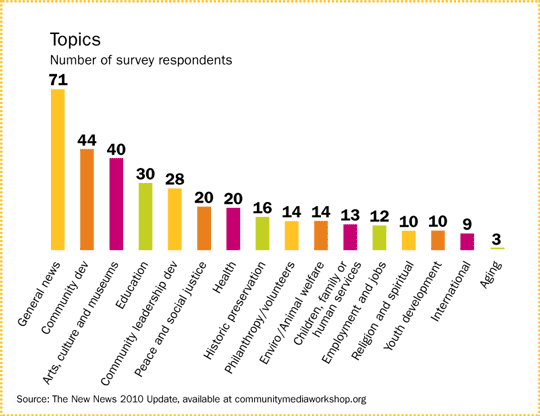
Topics in Chicago's News Ecosystem
The need for aggregation. A recently released study of Chicago's local news ecosystem found that community development was the second most covered topic by local online news sites. However, many of these sites may be small, new or otherwise unknown to a broad audience.

“Our thrust is to identify interesting stories in the neighborhoods where we work,” Gordon Walek said.

Walek is the communications manager at LISC/Chicago and manages the neighborhood news aggregator. He said the kind of urban affairs coverage collected by the site has been largely abandoned by the city’s newspapers. Even in the heydey of daily newspapers, Walek said, many of the communities and issues covered in stories aggregated by the site lacked coverage.

Barry said the site’s audience was interested in the process or neighborhood development and issues affecting developing neighborhoods like affordable housing or violence and includes professors of community development and urban studies, reporters, developers and bankers. Former community residents can also use the site to stay informed about their old neighborhood, he said.

While the site continues to suck in news feeds from a range of Chicago sites, further development of the Neighborhood News Bureau site has been limited by a lack of funds, Barry said. But the news site is just one part of LISC/Chicago’s ongoing use of reporting in the community development process.

Walek said LISC/Chicago’s involvement in reporting came out of a need to make the development process transparent to the communities where development projects were happening. The development corporation hired journalists to report on community meetings about development projects. Rather than simply take minutes of the meetings, Walek said, the journalists were tasked with writing stories about the implementation of development plans and how the plans were received by community members.

“Straight journalism can be a very powerful tool to inform people about community development,” Barry said.

Reporters covering neighborhood development plans for LISC/Chicago are known as “scribes.” Barry, the organization’s first scribe, said the name implies a role as a servant to the community rather than being independent from the community. Barry said that while a traditional reporter might attend a community meeting about development plans in search of a good story, a scribe’s goal is to reflect the issues that were surfaced at the meetings in a way that is useful to community residents in understanding what was happening or planned to happen. Scribes were also tasked with contributing to quality of life reports that helped drive neighborhood development projects. Because the scribes listened closely to voices from the neighborhood, “writing as an insider using the voice of a neighborhood,” Barry said, neighborhood residents felt ownership of the development plans.

In order to write with the voice of the neighborhood, scribes, who mostly live outside of the neighborhoods they report on, had to rethink their impression of the neighborhoods and the language they used to write about those places, Barry said. While a reporter’s impression of a neighborhood may be of a “bombed-out ghetto,” Barry said, the reporter had to quickly learn that residents didn’t appreciate that description. More importantly, it wasn’t how they thought of their neighborhood. LISC/Chicago reporters, he said, have learned a lot from neighborhood residents about how to talk about places.

Barry said working to document development projects with LISC/Chicago has given many reporters a deeper perspective of neighborhood dynamics than when they covered neighborhood issues for traditional media. Traditional reporting only allows journalists to perceive a neighborhood through controlled interactions such as a public meeting or a scheduled interview with a key stakeholder, Barry said. Spending more time in the community allows journalists working for LISC/Chicago to see a more nuanced and often more difficult view of community decision making. Barry said being embedded in the community gives reporters access to the egos or duplicity of neighborhood figures, internal squabbling, friction over gentrification and ethnic tensions. Often, Walek said, scribes are able to see such aspects of the neighborhood in a way that managers of programs operating in the neighborhoods can’t.

While LISC/Chicago scribes have a long-term relationship with neighborhoods, sometimes spanning eight years, and get a comprehensive view of the communities, they must balance their access to unflattering aspects of the neighborhood with the needs of the community. Scribes may write about internal conflict in the neighborhood, Barry said, but only if it’s constructive.

Scribes must also balance covering problems facing the neighborhood while recognizing that crime reports dominate traditional media coverage in some areas such as Englewood or North Lawndale where LISC/Chicago supports programs. Walek said crime is an “800 pound gorilla” when reporting on these communities because it is present, but the organization wants to offer a more diverse view of the neighborhood. Walek said reporters for his organization might cover community events like street fairs, neighborhood sports programs or programs that integrate teen health and education needs.

A video slideshow about the “B-Ball on the Block” sports program shows how LISC/Chicago’s reports acknowledge problems like violence and segregation, but ultimately focus on community-based responses. Walek said reports forefront “innovative solutions to what seems like an insurmountable problem.”

“There’s a lot of human capacity in these neighborhoods,” Barry said.

While stories tend to have a positive focus and highlight LISC/Chicago-supported programs or partners, they also give considerable space and agency to neighborhood residents or neighborhood dynamics that aren’t usually addressed in the media, such as conflict between Latino and African-American communities in Humboldt Park, the subject of a recent story. The focus on supported programs is in part to offer program funders a way to evaluate programs in a way that is more engaging than a traditional report, Walek said. Stories, photographs and multimedia can sometimes better record the impact of a program’s work and how it was received by the community.

Photographs are also important for giving readers outside of profiled communities a more nuanced idea of the neighborhoods that emphasizes similarities between diverse communities, Barry said. He cited how photos of well-maintained houses in Little Village might challenge outside perceptions of the neighborhood.

Over time, Walek said, LISC/Chicago reporting has created an unintentional record of how some neighborhoods have evolved. However, like many new models for reporting, LISC/Chicago is dependent on foundations to pay journalists, Walek said, and he’s not sure how reporting will get funded after foundation money runs out.

(De)Segregatr

Evanston Total Population 18 & over - Black

This weekend is the Independent Media Mobile Hackathon in Chicago, an event sponsored by The Media Consortium and Hacks/Hackers.  A few of the Knight Scholars taking the  Community Media Innovation Project at Medill were brainstorming ideas for the hackathon.  We talked about collecting public feedback using mobile devices to do citizen’s agenda style reporting of the upcoming Chicago Mayoral race and using Ushahidi to report and track neighborhood safety concerns.

But the idea I’m most excited about is one that comes from looking at interviews with Evanston residents for the innovation project class.  One theme that comes up consistently when talking to people about Evanston is that the community is diverse, with the public schools being a frequently-cited reflection of the community’s diversity.  However, a number of people interviewed also said the community is economically and racially segregated.

I want to build a mobile app that forefronts the integration or segregation of different spaces in the community.  Users of the app would “check in” to different spaces along with a quick numeric assessment of the racial, gender and/or age integration of the space where they are.  One of the most difficult problems would be to develop this metric, a sort of folk dissimilarity index, and make a widget that would make providing this assessment easy and fun.  Users could then get a weekly/monthly aggregation of the integration of the places where they spend the most time.  They could also see the most popular, integrated and segregated places in their community and see how the integration of places might change over time or be different at different times of day.

In many ways, this is a racially (or more broadly, demographically) aware Foursquare.  But Andrew Paley pointed out an important distinction: while most social apps help users build and share their own idea of their identity (in Foursquare by aligning themselves with certain businesses that likely reflect their lifestyle), this app would compel users to be introspective about their lives rather than expressive.  It would help users be conscious of the segregation or integration of their lives and challenge how values and belief about race and integration match up with their daily routines.  This app could be one example in a broader problem space of introspective apps.

New address, same concerns

I contributed a bit of reporting to this story written by Ian Fullerton.  It was originally published in Skyline on September 29, 2010.  I covered the closing of the original location of Pie Hole Pizza Joint for the Medill News Service in May 2010.

New address, same concerns
Pie Hole Pizza Joint gets chilly welcome from new neighbors
09/29/2010 10:00 PM
By IAN FULLERTON, Contributing Reporter

LAKEVIEW

Doug Brandt never expected that his pizza shop would become a refuge for the city’s gay black youth. But now that it has, he’d like to keep it that way, despite the protests of some Boystown residents and local businesses.

Brandt is the owner of the Pie Hole Pizza Joint, a popular Lakeview restaurant soon to be reopened at 3477 N. Broadway.

Pie Hole previously had sat for years at the corner of Roscoe and Halsted, in the lesbian, gay, bisexual, transgender and queer mecca known as Boystown. Brandt, a 39-year-old marketing major from Iowa with experience in sales, bought the struggling pizza joint in early 2007, with the hopes of revitalizing the shop through smart, often sexually charged advertising and innovations such as “drag delivery,” which is exactly what it sounds like.

Tired of catering to the late night set, Brandt looked to target the early evening dinner crowd, the not-yet-too-drunk demographic that seemed a better fit for the 15-seat restaurant. And so Pie Hole started running a weekly karaoke night, which caught on. Soon after, the shop started hosting open mic nights, aptly titled “Soul at the Hole.”

The events quickly attracted a younger following — vocalists, spoken-word artists, musicians and a variety of other performers, mostly high school and college-age youth from all parts the city — who flocked to Pie Hole once a week to take to the stage.

“It wasn’t a huge money maker,” said Brandt. “It was just a really cool, chill night with amazing talent.”

And while the open mic and karaoke drew a wide array of participants and spectators, it soon became clear that Pie Hole’s customer-base was rooted in the cluster of LGBTQ African-American youth who came from around the city to Boystown.

Population estimates compiled by the Metro Chicago Information Center, based on data from EASI, Inc., a demographic research company, show that African Americans make up only about 5 percent of the population of Lake View, the community area that includes Boystown.

These same statistics show 12- to 17-year-olds make up the smallest age segment. Together with 18 to 24 year olds, they make up about 17 percent of the community area’s population, which is still less than half of the percentage of 25 to 34 year-olds, the group that dominates the neighborhood.

These numbers may come as a surprise to anyone strolling on the main drag of Boystown around Halsted and Belmont, where African-American youths gather in droves, not in the bars and clubs, but on the streets.

The city’s young LBGTQ African-American population from elsewhere in the city is attracted to Boystown in part because of the protection that the neighborhood provides, said Ryan Erickson, a community relations and outreach manager at the Center on Halsted.

“It’s one of the most prominent places in the city where you don’t have to really worry about how you’re sexual orientation is going to be received,” he said. “I think that certainly offers a degree of security.”

A few months after opening Pie Hole, Brandt had started to volunteer at the recently opened Center on Halsted, a community center for LGBTQ persons based in Boystown. At the Center, Brandt took a training course and was assigned to the youth program, where he mentored a young man.

“It felt kind of cool,” said Brandt. “It kind of clicked that this could be the cause for Pie Hole; this could be the thing where we could say ‘yes, we give back to the community.’”

The restaurant began donating pizzas to youth organizations such as the Broadway Youth Center and the South Side-based Youth Pride Services, while inviting kids from the programs to hang out at the shop.

“It quickly became apparent that a lot of the kids didn’t have a place to go,” he said.

As the popularity of the performances at Pie Hole grew, so too did the crowds. The atmosphere at times shifted from a sit-down pizza joint to that of a standing-room club, with groups sometimes pouring out on to the sidewalk in front of the restaurant.

What followed was inevitable. Nearby residents, businesses — and sometimes Brandt himself — began calling 911 to complain of noise disturbances, loitering and fights outside the shop and in the neighboring alley.

Brandt hired some of the teens to act as security guards at the events, a service that further drained his pockets, but the performance nights became more financially unfeasible, as most of the audience wasn’t buying anything.

“It got to the point where I was paying $400 or $500 to have karaoke night, but I wasn’t making that back,” he said. Eventually Brandt had to shut down the karaoke, a decision that came down hard on the teens who frequented the event.

In May 2009, Brandt’s lease on the property expired, without an option to renew.

To memorialize the closing of the hangout, teens from the Youth Pride Services program put on a drum-line performance outside of the shop, a final hurrah that drew sneers from a few neighbors who didn’t appreciate the evening procession, Brandt said.

But while he realized he couldn’t keep the shop at Roscoe and Halsted, Brandt knew that he wanted to keep Pie Hole alive somewhere. He started to look for a new location, preferably one with a layout that would allow him to better supervise the audiences and keep out non-paying customers. The location on Broadway fit that need, he said.

Situated between a Save Rite pharmacy and a laundromat, the space, though only a few blocks away from the old shop, is in a markedly different environment.

Brandt learned this the hard way when, two weeks ago, he received an e-mail — not sent to him directly, but on which he was copied — regarding the reopening of his business in the more residential part of Boystown.

The e-mail, sent by the resident group Belmont Harbor Neighbors to Alderman Helen Shiller (46th), described community concerns that the relocation of Pie Hole to its new location might be an unsettling prospect, referencing the 911 calls made at the Roscoe spot.

“Belmont Harbor neighbors believes that behaviors should be confronted or stopped,” the letter read, “not shifted away from the Halsted entertainment strip to a more residential strip within the BHN boundaries.”

The author urged to Shiller to invite Brandt and the building’s landlord to appear before the group’s board of directors to present a business plan for the new Pie Hole, and to discuss how they intended “to prevent a recurrence of problems as experienced at the previous location.”

The following week, Brandt made his presentation to a group of about 20 people, mostly business owners. Among other questions, he said, they asked him what he would do if lines of customers formed outside of his shop.

“I hope I have a line down the block and around the corner 24 hours a day,” Brandt said, recalling the meeting.

A few days later, Brandt received another e-mail — again, not addressing him directly — from the president of a homeowner’s association at a nearby building.

“We don’t need or want bad actors in our residential area,” the letter read. “We are sure that our neighbors, including business owners feel the same.”

Brandt said he understood that people would have concerns about a late-night establishment, but recognized that a few vocal opponents made up a small minority of the neighborhood.

“We’re in a position to reopen, which is good for the economy and good for the neighborhood,” he said. “We’re employing people, putting out a product and giving options to the neighborhood.”

Brandt said he expected Pie Hole to retain its clientele, and promised that the open mic nights would also return, though not immediately.

The shop’s Facebook page, which boasts 1,763 followers, displays daily comments from friends and residents hailing the shops return.

“I think we’re going to pick up right where we left off,” said Brandt.

The reopening of Pie Hole Pizza Joint at 3477 N. Broadway is slated for Oct. 1.

Week in review

What I’ve been doing this week – on and offline.

Getting older

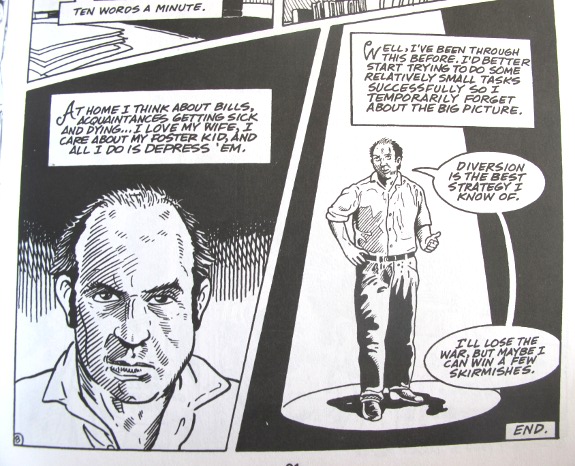
Frames from "The Terminal Year" by Harvey Pekar and Gary Dumm. Copyright 1999 by Harvey Pekar.

I went to see Paul Baribeau this week.  It was one of the more crowded house shows I’ve been to in Chicago.  The feeling between Baribeau and the audience as pretty strange.  He writes songs that are explicitly personal, so it’s strange to hear a whole room singing along (not to mention singing along slightly off-time and off-key).  Maybe it speaks to the real need that people have to understand or process the kind of things Baribeau writes about: relationships and growing into adulthood.  There was this one guy in front who kept demanding certain songs and he and Baribeau got into this kind of weird, mostly-joking but strangely confrontational back-and-forth.  Though I love the participatory aspect of DIY punk, it’s frustrating when it seems like the show means more about you singing along to a song you love than listening to what someone else has to say or how he says it.  At best, I think it’s a compromise between these things, a perfect balance arrived upon organically by the performer and the crowd.  But, there’s a distinct difference between having a collective experience with music and a room full of individual experiences.  Maybe the show felt like more of the latter because people didn’t really know each other. It seemed like the crowd was a mixture of people from Chicago, the suburbs and folks from out of town and people from the suburbs.  Everyone seemed pretty young which might have contributed to the dynamic as well.  Chiara referenced research about “millenials” being more selfish than past generations.

Being off of school (mostly, I’ve still got some loose ends to tie up with my independent study) is great.  For one, I finally had time to go to the library.  I picked up Harvey Pekar’s Best of American Splendor and I feel like I have a different reading of it a few years after the last time I read some of Pekar’s comics.  Pekar writes about his life making underground media in a really unglamorous way, which is refreshing.  You can’t dispute that he loves what he does or makes compelling and at times really beautiful work, but there’s nothing glamorous about working for decades as a file clerk or the anxiety of failing health or trying to figure out how to make ends meet.  As I get older, I’m less interested in finding optimistic ideas to buoy me through tough times and more interested in how people persist, even through tough questions or challenges.

Pekar is also pretty unapologetic about his mercenary intentions with his art, which is also refreshing.  DIY punk spends so much time demonizing making money, or rationalizing it, but doesn’t provide a lot of examples of working-class people finding complex, sustainable lives while still basing what they do on some core values.  A few weeks ago I read an interview I liked with the hip hop group Das Racist that touched on authenticity, punk and class:

Suri: That’s the whole thing. Punk bands have never had the question of authenticity because authenticity was about how broke you were. The whole break between punk and hip-hop in the 80s was because hip-hop kids were like, I will rap about having money because I grew up with none of it. White kids were like, I will not sing songs about having money.

Vazquez: I think it’s complicated in both circles. There was like broke punk kids and rich kids and broke rappers and rich rappers.

Suri: But a lot of punk kids choose to be broke and rap kids, we don’t choose to be broke. I grew up wanting to make money at every opportunity to. I wouldn’t shun my money. I’d buy a $200 pair of sneakers.

Kondabolu: And my mom wouldn’t let me go to vintage clothing stores. She’d be like, “Why are you going to buy someone’s old clothes?”

Vazquez: It’s also easier—you know, the idea of rejecting privilege comes with the fact that you have it in the first place.

I also went to Quimby’s, the first time I made it there since I’ve been a Chicago resident, and in a total impulse buy, I picked up Please Don’t Bomb the Suburbs: A Midterm Report on My Generation and the Future of Our Super Movement Again, as I get older, I’m interested in how people iterate their ideas and reconcile them with new experiences.

Gentrification

Gentrification

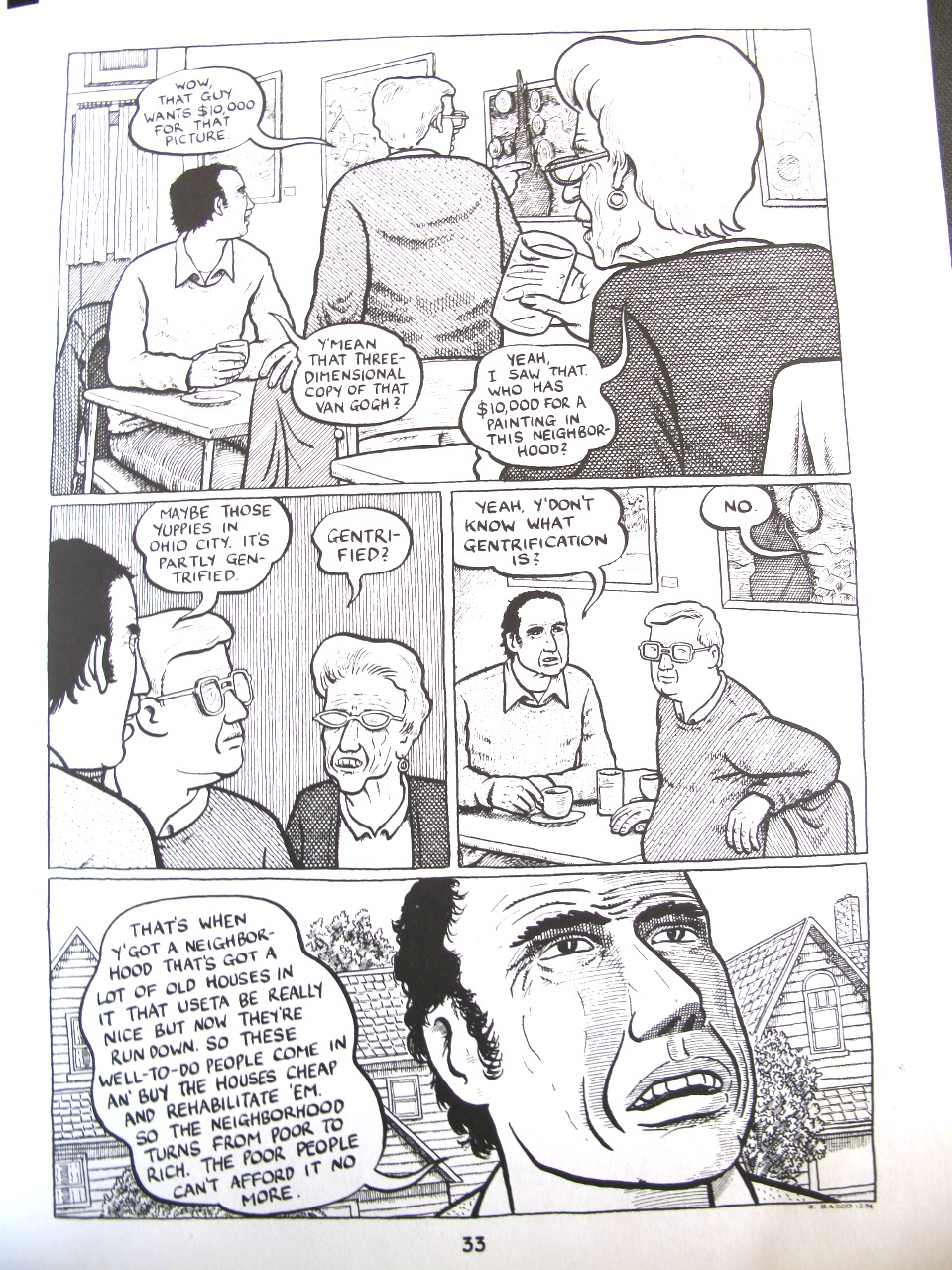
Pekar and Joe Sacco also have a nice comic about gentrification in the American Splendor compilation. I like how, in just a few frames it captures the ambivalence around neighborhood change. There’s the fear of people getting pushed out, some hope for seeing resources come into a neglected neighborhood and folks just having other concerns.

I went to dinner one night this week at a good, but slightly fancy place in Logan Square. Driving north on Kedzie from Humboldt Park, you could see a demarcation between different neighborhood residents as we got closer to the square.  Teenage Latino girls with these fabulous neon hoop earrings gave way to 20-30-year-old white people walking their dogs.  The restaurant was pretty terrific, but the patrons didn’t look like the neighborhood as a whole, which is always a little disarming.  It’s a good reality check though, to recognize where I stand, despite a consciousness of issues that affect communities in Chicago.

Restoring dialog

The “Restoring Honor” Rally was big news and a big site for meta-analysis this week.  I heard this segment on WBEZ’s Worldview and thought commentator Frank Schaeffer did a pretty good job of pinpointing the way that some Americans responded in the wake of Obama’s election.  They looked around and realized the country they lived in and realized it wasn’t the country they thought it was and freaked out.  But Schaeffer also articulates a certain contempt for people who react fearfully to a changing country and to feelings of using power in the culture.  I’d like to see someone speak frankly about this fear and across the divide of those who feel more comfortable in a country perceived as less homogeneous and those who fear it.  I felt like some of this was going on during Obama’s campaign, but once he was elected it sort of dropped off and we’re all left with crazy polarization and taking potshots across the divide.  I don’t agree with the rhetoric or the values of those like Glenn Beck but I think the fear they exploit is a pretty human response that has to be taken seriously and acknowledged, even while trying to move away from that fear.

Fixed width layout widths

I’ve been working on a cleaner version of The Max Levine Ensemble website and a basic theme for Toby Foster’s website.  Because of the artwork that David and Nick gave me, I have to use a fixed-width design.  I was curious what a good width for modern browsers/users should be, and the best example I found was in this  2-Column, Center-aligned Fixed Width Layout with CSS tutorial.  The tutorial author says:

I’m adding a wrapper division around the entire body html we have so far, and in the CSS, I’m giving this wrapper division a background color just for demonstration purposes – and a width. The width is based on current trends per W3Schools Browser Trends. According to this information, the vast majority of all surfers views at resolutions of 1280 or higher, so I’ll shoot for 1280px. To allow room for the scroll bar and a bit of the (white) body background to show, I’ll set the width of my wrapper at 1200px.

Mike Gibson of Love Has No Logic had this to say:

I usually work with a 960 grid. And set up the following column groupings inside it that’ll float around and shift.
3 columns of 300 px with 30 px padding between them.
2 columns of 465 px with 30 px padding (sometimes I’ll altar this to 450 px columns with 60 px padding to let the larger columns breathe)
3 columns with the outer columns both being 200px and the inner column being 500px, 30 px padding, though this is also nice with 45 px padding between each and a 470px middle column
4 columns of 140px with 40px padding
With those basic column constructs I can pretty much start working with any sort of modular design I need.

Music

I’ve been listening to a lot of the bands we’ll be playing with on the upcoming Defiance, Ohio tour.  In particular, I’ve been into The Sidekicks from Cleveland who play melodic punk in the vein of Built to Spill.  I also gave Shellshag a good listen for the first time and I love how they’re poppy but also noisy and weird.

I feel like as I have less time to practice with Defiance, Ohio, I’m more self-conscious about how well we play.  I feel like how comfortable we are playing really effects the quality of the performance, so I decided to get my guitar set up.  I’ve always played acoustic guitars with pretty high action, but after playing Theo’s hollow-body electric guitar and realizing how much more easy and fun it is to play an instrument with lower action, I took it to a guitar tech.  He told me something interesting about acoustic guitars and action:  instrument makers usually leave the action high from the factory because they’re worried about the neck shifting, creating fret buzz in the showroom.

WordPress file uploads

I was setting up a new WordPress instance for Ryan Woods’ painting website, ryanwoods.org and he was having problems uploading files, getting a cryptic error message.  It turns out that the Network upload size limits were set to only 300 KB.  It took a while to find this limit, but it’s at Super Admin > Options in the left hand menus in the administration pages.  Then scroll all the way down and look for the Upload Settings section.

Cooking as consensus

Florence and Sushi

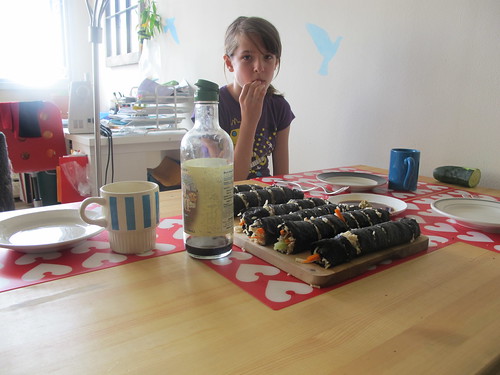
I’ve spent this week hanging out with Florence and Oona since Chiara had school and work all week and they don’t start school until next week.  One of the hardest things has been building consensus about how we’re going to spend our day.  Oona’s down to play music, but Florence doesn’t want to.  Florence likes the idea of riding bikes to the zoo, but Oona neither wants to ride bikes or go to the zoo.  Flash games on the internet seem mutually captivating, but the end-of-the-summer weather is too nice to spend completely indoors.  The consensus activity today was to think of something we want to eat, walk to the store to get the ingredients and make it.  We ended up making sushi and Dora-yaki (red bean pancakes), though the pancakes came out a little weird.

Link Roundup

GAMBIT Summer 2010 Prototype Games – I’ve disliked video games since I was young and didn’t have a console and had to spend hours watching other people play after I died quickly.  But some people are really doing some interesting things with games right now.  I was out of town playing a show when the 3G Summit went down, but from what I learned about it when I wrote a preview piece in the spring, it seemed pretty awesome.  These game prototypes from the Singapore-MIT Gambit Game Lab are all pretty interesting and have some interesting mechanics, visuals or ways of conveying information about the real world.

The Tummy Project – I only met Jamie recently when she offered to give me a ride back from Milwaukee that I ended up not needing, but I found out she has a blog that uses reader-contributed photos of tummies to think about body image.

2009 Illinois School Report Cards – The Tribune Apps Team made this useful news app to navigate Chicago schools and compare them by features like class size, ISAT scores and percent of students who receive free or reduced lunch.

How to Solder – If tour is a good way to lose equipment, playing individual shows is an even better way for me to lose stuff.  At least it gave me the impetus to fix a bunch of old instrument cables I had lying around.  I solder so infrequently that I didn’t realize I wasn’t tinning my wires properly.  This video helped.  Also, the number one tip I have for soldering things is to make a jig.  This video has one simple example, but I often just tape the wires to my desk so everything gets held where I need it.

Acoustic Guitar Amplification – This is the guide I’ve always been looking for.

44th Ward Electronics Recycling

I use a lot of technology and end up having a lot of unused or broken electronics and I have to figure out what to do with them.  The 44th Ward is having a electronics recycling pickup day on September 11, 2010.  This is what the alderman had to say about it in an e-mail blast:

On Saturday, September 11, our office, in conjunction with PC Rebuilders and Recyclers, will be conducting an electronic recycling pickup day. Anytime before 8am, residents can place electronic equipment in front of their homes to be picked up and taken to a recycling facility. Items to be collected include computers and computer equipment, TVs, DVD Players, VCRs, MP3 players, video equipment, and mobile phones. Additionally, residents can drop off electronic recyclables on this date between the hours of 8am and noon at the 44th Ward Streets and Sanitation office (1501 W. School St.).

I go to school at Northwestern University who also has an e-waste recycling program for students.  The city also has a drop-off facility at 1150 N. North Branch Street.  But, if you have functioning computers, I think the best place to donate them would be FreeGeek Chicago, a “not-for-profit community organization that recycles used computers and parts to provide functional computers, education, internet access and job skills training to those who want them.”

While it’s probably better to recycle computers than to send them to the landfill, I just saw a photo essay in the New York Times Magazine that showed the reality of what happens to e-waste at one site in Ghana.

Additional information

Photo by Mosman Council via Flickr using a CC-BY-NC-ND license.

Memo for the week of August 22: Coffee shop newsrooms and name games with mosques and SEO

Me this week

Last week, I talked with Rhonda Jones-Gillespie, news editor at the Chicago Defender and I feel like I need to follow up with her.  It wasn’t until after our conversation that I realized why there seemed to be a disconnect around some of my questions.  While the Defender does report about African-American communities in Chicago, a big part of what they do, and what I didn’t really get, is ground city and national news stories in the African American experience in Chicago.  While I’ve been most interested in looking at how a story local to one community might connect with a broader audience, I’ve overlooked the opposite, but equally important, trajectory.  It’s one that journalists have been doing for a long time (though perhaps less so as news organizations become more resource bound) – taking a story and picking out the most important aspects for a local audience or looking at a broader policy’s impact on a particular community.

This week, I  was finally able to sit down with Icoi Johnson and Samuel Vega, the recipients of WBEZ’s Prizker Fellowship, which I had written about previously.  I found the fellows’ backgrounds and  outlooks to be pretty different, which was interesting and probably a good thing for WBEZ.  Vega, who is from Humboldt Park and seemed pretty involved in the community offered some interesting insight into WBEZ’s bureau in the neighborhood.  Vega said he  had noticed the storefront bureau, but had never been inside it until he toured it as part of his training for the fellowship.  He said it often appeared closed and that he was more familiar with the reporter who runs the bureau because of his coverage of events in Humboldt Park.  Vega’s anecdote indicates that connecting with different news  communities may be a little more complicated than simply setting up shop.

Coffee shop newsrooms – a cool idea but you have to pick the right shop

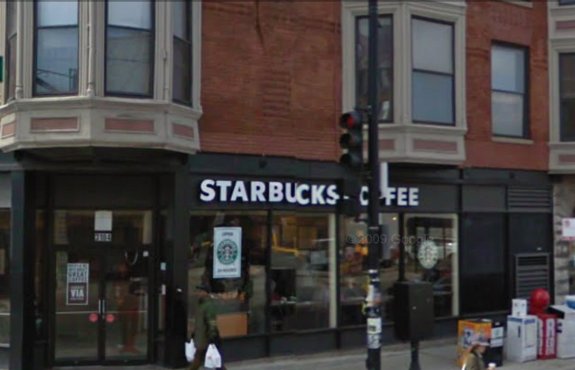
Setting up "bureaus" in coffee shops could help reporters connect with communities. But they have to pick the right one. GOOGLE STREET VIEW

Perhaps a better approach might be the coffee shop newsroom experiments that Poynter wrote about extensively at the beginning of this month.  Placing a reporter in an already trafficked space like a coffee shop may make reporters more accessible to the general public than a space exclusive to the news organization.  Some of the benefits of putting reporters or “newsrooms” in coffee shops seem pretty cool: more transparency/accountability, more audience understanding of the reporting process, developing new sources, getting new framings for stories or new dimensions for stories of which the reporter is already aware and recruiting citizen journalists.

This week I had my own experience with reporting and coffee shops.  I often work in coffee shops because I find them more convenient, and often less distracting than heading down to the Medill Newsroom.  While I use them primarily for convenience, they can still be a good way to connect with sources.  However, you have to go to the right coffee shop.  In reporting a story about LGBTQA youth of color in Boystown and a parking policy proposed by some residents designed to deter the youth, I did a lot of writing in Lakeview coffee shops.  I usually went to one close to my house a little east of Boystown or one close to Boystown but seemingly catering to a more particular customer demographic.  I liked the coffee shops I chose because they were locally owned and independent, there was interesting art on the wall and employees sometimes seemed like they were hanging out with friends or family as much as they were serving customers, creating a casual, comfortable atmosphere.

But, because they were somewhat more expensive and closed around 10 p.m., they didn’t really attract customers who were young people of color coming to hang out in the neighborhood.  The night I spent writing at the Starbucks at the corner of Belmont Avenue and Clark Street, a wide range of customers came in, including folks who could have been sources for my story.  While I could have gone out on the streets searching for people who could tell me their experience of coming to the neighborhood, a common thread in what youth I had interviewed told me is that they often feel profiled by police and neighborhood residents.  Both residents and youth described sidewalk confrontations that escalated and didn’t lead to a productive dialog.  As a reporter, I didn’t want to contribute to these dynamics. Spaces like coffee shops are important for reporting across dynamics like the ones in Boystown because they’re more neutral.  People from a variety of backgrounds can be on equal footing in the coffee shop as patrons and engaged in the same activities, like working on a laptop.  Had I spent the entire quarter working at that Starbucks, I might have been able to meet some sources with a good insight into the dynamic in a way that developed out of a more organic conversation, over music or helping someone reach a power outlet) rather than cornering people on the street.  Also, the public nature of the coffee shop could have attracted other people into the conversation, adding multiple perspectives to the reporting and perhaps even bridging the resident/visitor divide.

My experience with diversity and neighborhood coffee shops may be more universal.  Kim Feller, author of “Wrestling With Starbucks: Conscience, Capital, Cappuccino“, wrote about diversity and coffee shop clientèle on the Colorlines website:

While there are still funky independents eking out a living on the retail margins, most coffeehouses and designer roasters are niche markets, like purveyors of artisan cheeses, hand-painted T-shirts and limited-edition sneakers. They appeal to those on the trendy, cutting edge and survive by exclusivity—by pleasing a small, loyal and financially privileged. Starbucks, on the other hand, has been able to risk expansion from urban business cores and upscale suburbs into more modest settings, where it often provides the only meeting place that is neither a noisy fast-food restaurant nor a bar and that is often surprisingly multiracial.

Mosques and SEO

In terms of stories that sit across a cultural divide, nothing’s been bigger, or representative of journalism’s struggles to bridge those gaps, than reporting about the controversy over plans for a Muslim community center near the site of the World Trade Center towers destroyed in the September 11, 2001 attacks.  One idea that’s likely inflamed the debate is the use of the phrase “ground zero mosque” in the media, which suggests, incorrectly, that the community center is being constructed at the site of the former towers.  Mark Coddington at Nieman Labs has a good rundown of what a number of media critics have been saying about the use of this term.  While some blame cable news, others point to SEO.  As a term gains traction with the public, online news websites have to choose between using an incorrect term or making their content more difficult to find.  Coddington wrote:

Poynter ethicist Kelly McBride zeroed in on that idea of search-engine optimization, noting that the AP is being punished for their stand against the term “ground zero mosque” by not appearing very highly on the all-important news searches for that phrase. In order to stay relevant to search engines, news organizations have to continue using an inaccurate term once it’s taken hold, she concluded. In response, McBride suggested pre-emptively using factchecking resources to nip misconceptions in the bud. “Now that Google makes it impossible to move beyond our distortions — even when we know better — we should be prepared,” she said.

Coddington also pointed out that Online Journalism Review’s Brian McDermott pinpointed our news consumption patterns as the culprit for the proliferation of incorrect terms for things.  As we move more quickly from media to media, terms like “ground zero mosque” have more sticking power than Park51 or the Cordoba Center.

The tough choice of deciding between content discovery and accuracy is the same one I wrote about regarding the phrase “sissy bounce” and New Orleans artists’ distaste for the term.  In a pretty interesting, but unrelated thread, Anthony Neal, a scholar who studies Black popular culture, posted some tracks from New Orleans in the 1960s that refer to a dance called “The Sophisticated Cissy.”  Still, even if the term “sissy” may have some interesting connections to New Orleans musical history, it’s important to remember that contemporary artists don’t use the term to identify their work.

Reporting beyond the familiar

In the first of a two-part report about Chicago Public Radio’s Pritzker Fellowship, President and Chief Executive Officer Torey Malatia describes the limitations of niche broadcasting, the journalism challenges that motivated the fellowships and his hopes for how the fellows will change WBEZ’s newsroom. In the second part, I plan to explore the perspectives of nominating community organizations and the fellows on reporting across boundaries.

Icoi Johnson, Torey Malatia, Samuel Vega
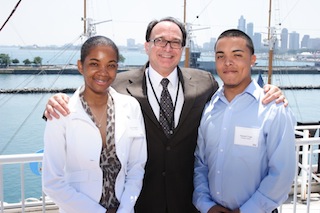
Pritzker Fellows Icoi Johnson (left) and Samuel Vega (right) with Chicago Public Radio President and Chief Executive Officer Torey Malatia. DONTE DEMONE TATUM

Reporting public affairs stories across a city as large and diverse as Chicago is no easy task, but new initiatives at Chicago Public Radio aim to meet this challenge.

President and Chief Executive Officer Torey Malatia said the station has established neighborhood bureaus and is providing journalism training to citizen journalists to both expand the station’s news coverage and audience and change the way its journalists report.

As a broadcaster, the station has always been tasked with serving its coverage area, Malatia said, but given the size and broad interests of this population, the station has chosen to target listeners who are active in their communities, grounded in the region and seeking information about what is happening around them. Even with this focus, the station’s potential audience spans a wide spatial and social geography, though its measured audience doesn’t necessarily reflect this.

“If you look at the makeup of our audience, it leans just dramatically towards white,” around 83 percent, Malatia said, “which the city does not reflect.”

While the information needs for other groups in the city could be served by media targeting ethnic or geographic audiences, Malatia said super-serving such niche audiences has drawbacks. “They tend to reinforce the particular views of the audience that they’re attracting,” Malatia said of specialized media coverage or politics and public affairs issues. While specialized media often provides complex, nuanced coverage of issues within a community, he said, coverage of issues crossing communities, or placing them in conflict, becomes over-simplified.

“People then perceive issues as confrontational, us versus them or difficulties that can’t be bridged,

Malatia said. “You have to somehow find a way to be a broadcaster that is offering a much more inclusive discourse.”

While the station has recognized this need and seeks diversity in its board of directors, management, staff and story selection, inclusive reporting hasn’t always been successful. Trying to understand its audience, the station hired a research firm to talk to people who fit the station’s profile of grounded and community-engaged, but didn’t listen. A frequent response, Malatia said, was that non-listeners found the station’s coverage to be problematic.

“They hit the heart of it right away by just saying we really didn’t know what we were talking about,” Malatia said, explaining that some non-listeners said even award-winning reporting only scratched the surface or didn’t reflect a community’s understanding of an issue.

“There’s nothing worse you can hear from an audience member than you’re just hitting kind of like the Cliff Notes of a story,” Malatia said, “You don’t want that.”

Malatia said this problem stems from a combination of human nature and the parameters of reporting.

“We’re coming from the assumption that, as human beings, we tend to know what is familiar,” Malatia said. “As professionals who are in journalism – which has a kind of rhythm and a kind of process to writing and delivering stories, deadlines, things like that – we tend to also lean towards those techniques that have yielded success in the past.”

As an example of this tendency, Malatia explained that a reporter covering a new story on a topic that the station has covered extensively in the past, such as public housing, may be inclined to contact the same official and expert sources that have been used for past stories.

“If you actually are thinking about it, there’s probably a hundred different ways to cover that story that you’re not going to think about when you’re under pressure to get something done,” Malatia said.

One strategy to break out of reporting patterns is storefront neighborhood bureaus in Englewood, Humboldt Park, West Ridge and Northwest Indiana. Malatia said by starting and ending their days at the neighborhood bureaus, reporters can more easily build relationships with the communities they’re covering.

Just as the station has moved to create a more accessible presence for its reporters in Chicago’s neighborhoods, it is also trying to bring community members into its newsroom. Starting at the beginning of July, Icoi Johnson and Samuel Vega began an intensive mentorship with an experienced reporter. Johnson and Vega are the first recipients of the Pritzker Fellowship, which is offered to those interested in reporting but who have no formal journalism training or experience. The recipients of the fellowship were selected from a pool of people nominated by Chicago-area nonprofit organizations. “Everybody was very excited about the pool of candidates,” Malatia said. Chicago Public Media plans to begin accepting nominations for the next group of fellows in March 2011.

Working toward producing a long-form, in-depth report, the Pritzker Fellows report stories and work with editors in a similar manner to interns from journalism schools, but at a faster pace, Malatia said. While one goal of the fellowship is to offer journalism training to future reporters, he said, he also hopes the fellows will change practices in the newsroom.

“We’ll not only be building journalists who have a very different perspective of how to handle a story, approach a story and what is worthy to be a story. We will also learn from them and expand our horizons about that too,” Malatia said. Journalists from diverse backgrounds, Malatia said, may know of key sources in their communities that a reporter from outside the community would overlook.

Malatia acknowledges that these efforts are an experiment. “We don’t know if it’s going to make a difference, but we just felt we needed to try,” he said. The station will evaluate the impact of the fellowship program by looking for audience demographic changes and polling non-listeners to see if their perceptions of the station have changed.

But evaluating the impact of journalism on communities is difficult, Malatia said. “Can you prove that journalism, even well-done, really makes a more informed citizenry that’s making better decisions? Only history can tell you whether the decisions are good or not. But I believe that and I think a lot of people do.”

Related links:

low-rent gobo projection

I’ve always wanted to know how to project “stencils” on walls or sidewalks, as a lot of clubs or businesses have started to do.  After a lot of knowledge from the Chicago New Media list, I found out that these projectors are called gobo projectors.  I also found out that IKEA sold an inexpensive version of such a projector called Isbrytare.  Jim Dennewill has a good rundown of the projector.

My impression is that IKEA no longer makes this product.  I’m wondering if there are any other ~$40 projectors that are currently in production.

Photo by Jim via Flickr.

Memo for weeks of August 1 and August 8

The last two weeks haven’t been very productive for my independent study as I’ve had stories or projects due for other classes.  Though I was too late to shadow youth reporters covering teen depression as part of a Community TV Network summer program, I was able to watch the youth film their introduction sequences, get a sense of the group dynamic and talk to some of the youth who produced this summer’s report.

This week, I plan to follow up with the community organizations who nominated people for WBEZ’s Pritzker Fellowship and finish synthesizing and writing stories based on the reporting that I’ve already done.  I still need to connect with news organizations focused on African-American communities such as WVON, the Defender and/or some south-side bloggers writing about community news.

On the topic of African-American news coverage, I took a look at a Pew Research Center report titled Media, Race and Obama’s First Year, which analyzed media coverage of African Americans during the past year.

Events and Individuals Dominate African American News Coverage

This graph shows the way African Americans were covered in the media, “as a group, African Americans attracted relatively little attention in the U.S. mainstream news media during the first year of Barack Obama’s presidency — and what coverage there was tended to focus more on specific episodes than on examining how broader issues and trends affected the lives of blacks generally.”

According to the study, African-American angles to broad national stories were covered as part of reporting on health care reform and the economy, though these topics made up less than 10 percent of coverage focused on African Americans.

The Pew Research Center also did analysis on coverage of Gates’ arrest in the African-American press.  According to Pew’s analysis:

the discussion and columns offered here took a starkly different angle than the commentary in the mainstream press. While the mainstream media largely assessed political implications for President Obama, the commentary in the black press considered the broader question of race relations in the U.S.  It was also evident that these papers saw themselves as a voice of the black community.  Even within the opinion columns, there was a clear sense of providing an African American perspective to the story. The tone, however, in many cases, came across as less “us” versus “them” and more of an assessment of steps needed from all sides.

This report gives me some background context for asking about coverage of Chicago stories, such as the slaying of Derrion Albert and how it was covered in different media.  I would love to see similar media analysis just for Chicago, but I think that’s beyond the scope of what I’m able to do.

On Tavis Smiley’s radio show this week, Smiley and CBS correspondent Byron Pitts discuss the need for more diverse news coverage.  Pitts said he was optimistic that the changing demographics of the U.S. would compel news organizations to have more diverse coverage and reporters that reflect the country’s diversity.  When I talked to a team of Tribune reporters, they offered a very nuanced account of race in the newsroom that I’m excited to write up.  The Tribune reporters said that race sometimes mediated their reporting but that a good reporter should be able to navigate racial boundaries on her beat.  Having a similar experience with race, the reporters said, could help connect with sources, but experiences with class could still be dramatically different, and were sometimes masked by assumptions about experiences tied to race.  One reporter said she still found a lack of economic diversity in the newsroom.

On a final race and reporting note, Colorlines analyzed some data about mentions of race in the news and argue that conservative publications explicitly mention race with greater frequency than other news organizations.  The data suggests that race gets mentioned across the media and Colorlines seems to think that controversy over, rather than experience with race gets the most coverage.  It makes me want to take a second look at how or if race was addressed in the Tribune’s reporting on youth violence.

Whose line is it?

Over the last few weeks I’ve spoken to a number of reporters about reporting outside of their neighborhoods or experience.  One common theme that I’ve heard is the importance of using people’s own language to describe places and institutions in their communities.  Patrick Barry, a senior scribe working with LISC/Chicago, said journalists documenting community development projects had to rethink their use of language when reporting on the low-to-middle-income communities that were the focus of the organization’s New Communities Program.  Even if a reporter’s impression of a neighborhood was that it was a “bombed out ghetto,” Barry said, they needed to be aware that neighborhood residents didn’t use that language to describe their neighborhood and didn’t necessarily think of their community with such an exclusively negative framing.  “We have learned a lot from neighborhood people about how to talk about places,” Barry said.

The New York Times Magazine recently ran a story about New Orleans rappers Big Freedia and Katey Red.  The print version of the story about Freedia ran under the clever headline like “Neither Straight Nor Out of Compton” (I can’t find my copy of the magazine to confirm the exact title).   However, the web version uses the (apparently) search-engine-optimized title “Sissy Bounce, New Orleans’ Gender-Bending Rap” in the title of the web page (the text that shows at the top of one’s browser window) and “New Orleans’ Gender-Bending Rap” on the page itself.  These different versions of the title reflect, perhaps, reflect the contentious use of the term “sissy bounce” to describe the music of Big Freedia and other gay, transgender, lesbian or bisexual rappers who perform New Orleans’ signature hip-hop style of “bounce.”

Jonathan Dee, the story’s author describes bounce like this:

Bounce itself has been around for about 20 years. Like most hip-hop varietals, it’s rap delivered over a sampled dance beat, but it has a few characteristics that give it a distinctively regional sound: it’s strictly party music, its beat is relentlessly fast and its rap quotient tends much less toward introspection or pure braggadocio than toward a call-and-response relationship with its audience, a dynamic borrowed in equal measure from Mardi Gras Indian chants and from the dawn of hip-hop itself. Many, if not most, bounce records announce their allegiance by sampling from one of just two sources: either Derek B.’s “Rock the Beat” or an infectious hook known as the “Triggaman,” from a 1986 Showboys record called “Drag Rap.” (That’s “drag” not as in cross-dressing but as in the theme to the old TV show “Dragnet.”)

Katey Red is quick to point out that LGBT artists in New Orleans are part of the larger bounce music culture, not a separate genre.  “Ain’t no such thing as ‘sissy bounce,’ ” she said. “It’s bounce music. It’s just sissies that are doing it.”  In this video interview from Fader Magazine, Freedia expresses a similar sentiment:

Bounce music generally is just bounce music in New Orleans and you may have a gay rapper that does bounce music and you have straight rappers as well.  So I just really want to clarify that bounce music is not sissy bounce it’s bounce generally and you have some sissies that represent bounce music, you know, like myself, Sissy Nobby, Katey Red .  You know, there’s a few more.  It’s not called sissy bounce at home, it’s called bounce music.

The story does explain that most artists object to the phrase.  “They have no desire to be typed within, or set apart from, bounce culture; and indeed, within New Orleans itself, they mostly are not,” Dee wrote.  And it also explains the origin of the label “sissy bounce,” New Orleans music writer Alison Fensterstock.  Still, the nuanced perspective of how the artists view gender and sexuality as part of their identities and the identity of their musical community falls under a web page title that acknowledges “their bookings elsewhere in the country are founded increasingly on the novelty of their sexual identities.”  Even if the artists eschew the term “sissy bounce,” the Times seems aware that people may search for information about this music using this term, and they want to make sure that people can find the article.

This forefronts a challenge for journalists when choosing words in their stories – should one use the language of those most involved in or affected by a story or terminology that may be more widely used?  Does using the popular language for something legitimize language that doesn’t accurately frame an idea?    The best approach is probably the one Dee took in the story about New Orleans rap, to explain disputed language, its origins and how it reflects the nuance of the subject.  This is possible, and even adds depth to a longer article, but can a writer do the same thing in a daily news article?

Being aware of and taking the time to explain complicated stories behind language are important obligations for journalists that will only become more difficult in the age of online news.  As more and more people seek news and information on the web and find it through search rather than visiting the news organization’s web site directly, there is greater pressure for journalists to include widely-used language in stories to make the stories discoverable.  One solution may be to link phrases in the story to pages that describe the origin of the phrases.  The New York Times website already allows users to access definitions of words in articles by clicking on the word.  Linking such functionality to user-contributed content, like urban dictionary, may give added insight into the origin of language used in stories, though it could make it more convoluted.

Photo by Incase via Flickr. It’s captioned as a photo of Big Freedia, but the performer more closely resembles Katey Red.