The first class for the forgotten class
The first day of class isn’t usually in May, the average age of students isn’t 46 and class doesn’t usually involve a personal call for feedback from the mayor.
But this was the case for 175 Chicagoans who were the first to begin the six-month Chicago Career Tech program Monday.
“What can we do for the forgotten class?” Mayor Richard M. Daley asked the students, “That’s you. You worked hard, you went to school, you worked, you paid your taxes. … But you don’t fit into all the poverty programs. You don’t fit into all the rich programs.”
To qualify for the program, which retrains workers in technology skills, participants must be receiving or have exhausted unemployment benefits, have made between $25,000 and $75,000 annually in a previous job, be a Chicago resident and have at least a high school diploma or GED.
Robert LaLonde, a professor at the University of Chicago’s Harris School of Public Policy whose research includes workforce education and training, said targeting these workers sounds like a good idea. “Those are people who are likely to be employable afterwards and they’ve already demonstrated that they’re trainable,” he said. But researchers have very little data to evaluate programs that target previously employed workers receiving retraining, LaLonde said.
Every week, program participants will get two days of classroom training, two days of job shadowing at a business and two days of service learning at a not-for-profit or government organization. During the program, participants will receive a weekly stipend of about $400 in addition to any unemployment benefits.
Kelly O’Brien, vice president of marketing and communications at the United Way of Metropolitan Chicago, the organization coordinating the service learning portion of the program, said technology skills from program participants would be an asset to the partner organizations. However, she said, organizations were required to provide projects that had a teaching component that would also benefit students.
Service learning projects from dozens of partner organizations may teach skills including web development, database management and working with social media.
Amanda Luther, acting director of marketing and recruiting for Chicago Career Tech, said participants will receive training in areas including health-care information technology, digital media, project management and technical certifications. “We wanted to give them the skill set to go out to be placed into a new position in an industry that is hiring,” Luther said.
Over the next three years the city will provide $25 million in funding from its Parking Meter Human Infrastructure Fund, Luther said, with additional funds coming from foundations and the private sector.
Chicago Career Tech is accepting applications for the second group of students, which is expected to begin the program in late October with 325 available spaces. Potential students can apply for the program by filling out a screening application on the initiative’s website.
Related Links
Photo by Brooke Collins/City of Chicago
This was originally published on Medill Reports Chicago on May 19, 2010. It was published in the Chicago Journal as First Class for the Middle Class on May 26, 2010
Rogers Park family fights to ward off eviction
Carol Vialdores and her children really need to not get evicted.
“If I’m out of here, I’m going to be struggling,” Vialdores said this week.
On Thursday Vialdores is scheduled to appear in eviction court where a jury is expected to decide whether her family will be able to stay in their Rogers Park apartment. If the court rules that she should be evicted, Vialdores’ housing options will be severely limited.
“Evictions are incredibly disruptive, catastrophic events in people’s lives,” Keeanga Taylor, a Northwestern University graduate student working with the Chicago Anti-Eviction Campaign, said at a rally Monday. “Your kids are uprooted from their school. An eviction goes on your record, which makes it almost impossible or at least very difficult to find alternative housing.”
Vialdores and the other residents of Northpoint Apartments, which comprises more than 100 units across multiple buildings, have some or all of their market-rate rent paid through a U.S. Department of Housing and Urban Development program. If Vialdores is evicted, she said, she will be ineligible for other subsidized housing.
At the rally, Vialdores said she would likely have to stay in a shelter if she was evicted.
Vialdores’ eviction is not over unpaid rent. Northpoint’s management declined to comment about the eviction. Their parent company AIMCO, a Denver real estate investment company, provided a statement citing several reasons for terminating Vialdores’ lease: non-leaseholders living in the apartment, verbal abuse and threats by Vialdores against staff, and leaving one of her children unattended, leading to a fire in the apartment.
Vialdores said only she and her children have lived in the apartment, though the father of two of her children had sometimes stayed at the apartment to help with childcare. Vialdores acknowledged arguing with a Northpoint employee but said she did not threaten her. As for the fire, Vialdores said her young son accidentally started it, but the child was not unattended. His father was with him in the apartment at the time of the fire, she said.
Trying to prevent Vialdores’ eviction and raise awareness of other Northpoint tenants’ concerns, Vialdores, neighbors, and anti-eviction advocates converged at HUD’s Chicago office for a rally and to deliver several hundred petition signatures calling for Edward Hinsberger, a Chicago HUD director, to halt the eviction.
“It went about as well as we could have expected,” Holly Krig, an anti-eviction campaign volunteer said of a 25-minute meeting with Vialdores and Hinsberger. Krig said Hinsberger agreed to convince Illinois Housing Development Authority officials to meet with Northpoint’s management to discuss tenant concerns, but made no commitments to intervene in Vialdores’ eviction. IHDA is an organization that finances and oversees affordable housing development, including Northpoint.
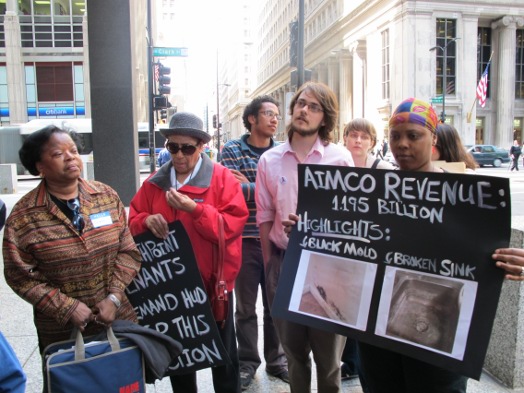
Monday was not the first time that activists sought to get HUD to halt the eviction of a Northpoint tenant. Last year activists were able to compel the department to prevent the eviction of Erica Bledsoe.
Bledsoe had moved to Northpoint to help care for her nephew and nieces when Bledsoe’s mother, the children’s custodial grandmother, fell ill and later died. Although Bledsoe’s mother and the children were on the Northpoint lease, Erica was not and the apartment management tried to evict her.
After HUD’s intervention, Erica was able to sign a lease and remain in the apartment. Erica’s victory, in part, convinced Vialdores to challenge her own eviction.
In the Vialdores case, conflict with Northpoint’s management began over maintenance issues. “I don’t want to tell them something’s wrong because there’s always an argument,” she said.
At Monday’s rally, Northpoint residents said their rocky relationship with management makes them feel particularly vulnerable to eviction. “I think it’s shocking how little accountability there is in this situation,” Krig, the anti-eviction campaign volunteer, said in an interview after the rally. “Private management companies have a lot of power over whether or not people have a home or whether they can have a home in the future.”
This was originally published as “Being thrown out of your home is almost the least-worst part of being evicted at Medill Reports Chicago” on May 5, 2010.
Taking the hard out of hardware: Project works to connect people to the internet
Update 7/2/2010: Free Geek Chicago’s training classes have started. See their education page for details.
Education has always been an important part of FreeGeek Chicago’s mission, but the project hasn’t had a systematic teaching program. Until now. Volunteers are converting part of the project’s Logan Square basement workshop into a classroom in preparation for classes focusing on practical computing.
This story was originally published on April 28, 2010 on Medill Reports Chicago.
DIY spaces and gentrification
About the map
This is a map of Chicago community areas, the number of DIY spaces in each area, and the socioeconomic state of the neighborhood based on an index developed by researchers at the University of Illinois at Chicago. The index used statistical changes in factors like median family income, percentage of families below the poverty level, median house value, percent owner-occupied housing, race/ethnicity, percent of school age children, percent of workers who are managers and professionals and percent of adults with a college education to describe how Chicago neighborhoods had changed over time.
The numbers in the markers represent the number of DIY spaces in the community area.
The shading of the community areas represents the socioeconomic status of the neighborhood:
| Dark Gray | Moderate decline |
| Light Gray | Mild decline |
| Green | Gentrification |
| Purple | Poverty |
| Mint Green | Positive Change |
DIY punk and gentrification
DIY punk spaces are often located in less resourced neighborhoods. These neighborhoods offer less expensive rent that is affordable even with income from sporadic part-time work or odd jobs, housing stock that might accommodate many roommates or unused warehouse space that can be converted to a music venue and living space. Neighborhoods housing DIY spaces may feature lower density housing which makes it easier to have band practice or shows without disturbing neighbors or empty lots that could be utilized for projects like community gardens. In some cases, people participating in the DIY punk subculture may fetishize less resourced neighborhoods, or neighborhoods with a large population of people from racial or ethnic minority groups as a reaction to white, suburban culture or a more affluent urban (“yuppie”) culture.
Daniel Traber’s article, “L.A.’s “White Minority”: Punk and the Contradictions of Self-Marginalization”, describes the fetishizing of poverty in the early days of American punk and hardcore culture in Los Angeles. Contemporary DIY culture complicates this dynamic. With community and social justice as core values of the subculture, middle-class DIY subcultural participants may create institutions in their neighborhood for their friends that are also available assets for the community at large. Punks may create a neighborhood community garden, a collective bicycle workshop or an arts space with free events for neighborhood children. However, these institutions, and even the presence of white, middle-class residents, may also make the neighborhood more appealing to other middle-class people and to developers creating housing speculating that more affluent residents will move to the neighborhood. Over time, both the punks and the neighborhood’s original residents may be priced out of the neighborhood. Furthermore, the conversion of industrial or warehouse space to housing, art studios, or gallery and performance spaces removes light industrial infrastructure that could create needed jobs in a neighborhood.
Where are DIY spaces located in Chicago?
I mapped all music venues that held events listed on the DIY Chicago calendar from the calendar’s inception in January 2010 to April 2010. These spaces were located in neighborhoods such as Logan Square, Humboldt Park and Bridgeport. I mapped the community areas, boundaries used to aggregate census data, containing DIY spaces as well as the number of spaces in each area.
Do Chicago DIY spaces follow trajectories of gentrification?
In 2003, researchers at the University of Illinois at Chicago created an index of neighborhood change based on census data from the decennial census from 1970-2000. The index looked at a number of factors such as total population, the percentage of population of different racial groups, median family income and percentage of the population with different educational levels. Based on how these factors changed in neighborhoods relative to the city as a whole, the researchers labeled the neighborhoods as experiencing dynamics such as poverty, mild decline, gentrification and positive change.
Neighborhoods with DIY spaces tended to be in neighborhoods that were gentrifying or in decline. While the research is based on data from the 2000 census, 2010 projections from EASI, provided by the Metro Chicago Information Center show that the median family incomes in all of the community areas are likely to increase from 2000-2010. This suggests that trajectories of gentrification detected in 2000 are likely to have continued or neighborhoods may be starting to gentrify.
What does this mean?
It is difficult to assess whether the effect of DIY punk spaces and residents on a neighborhood is positive or negative.
A recent National Public Radio story about a low rate of census return in a gentrified Brooklyn neighborhood sparked debate about whether or not the young, itinerant creative-class residents felt less connected to the neighborhood and were thus less likely to return their census forms. If this is the case, neighborhoods could be deprived of valuable federal funding for community resources.
On the other hand, the Chicago’s 49th Ward which includes the Rogers Park neighborhood, home to one long-time house that has shows in its basement, recently conducted a participatory budgeting process where all residents of the ward, aged 16 and older, could vote on how around $1 million in city menu money could be spent. Many of the proposed projects reflected grassroots, creative culture in the neighborhood. The process offers one model where DIY priorities might be institutionalized and still effect the culture of the neighborhood, even as demographics change.
Ultimately, it may be whether or not DIY spaces and the people who inhabit them stay in the neighborhood that decides their impact as the neighborhood changes.
Universe – Memory Foam
Universe performs the song “Memory Foam” at The Moving Castle on April 17.
Toby Foster at Ball Hall
Toby Foster peforming a song at Ball Hall on April 9.
Foundation, politicians support housing proposals at Rogers Park meeting
Community members filled the pews at Rogers Park Presbyterian Church Sunday, but not for a worship service, though people passing by the church might not have been able to tell the difference.
“If you are moved to say ‘Amen’ or to clap, please don’t hold back,” said the Rev. Debbie Paton, pastor of the church. “Do not sit on your hands. They were made for celebration and that is the first rule of this meeting.”
She chaired a meeting about proposals aimed at combating the loss of affordable rental housing in Rogers Park and the impact of foreclosure on neighborhoods. The meeting was sponsored by two community organizations and brought together residents, clergy, politicians and foundation representatives to build support for the proposals.
“I can’t begin to tell you,” Rogers Park resident Arletha Gary, who attended the meeting, said when asked about the number of people she knew who had moved from Rogers Park because of disappearing affordable housing.
Gary said that in the more than 20 years she had lived in the neighborhood, she has seen housing costs rise and subsidized apartments turned into condominiums, forcing many neighborhood residents to move to the west and north and even as far as Englewood.
Speaking from the pulpit in support of a proposed rental improvement fund, Brian White, executive director of Lakeside CDC, expressed similar concerns: “Simply put, we need affordable rental housing in our community.”
“Amen,” the audience replied.
White said the neighborhood lost more than 3,600 rental units during the peak of the recent housing boom.
“Families were uprooted and pushed from one spot to another or else pushed out of the community altogether,” White said. “Much of the remaining affordable rental housing is in buildings which need repair to make them livable and cost-effective.”
The rental improvement fund proposal would establish a new TIF district–where a portion of property taxes are diverted to fund grants for landlords to make improvements to multi-family rental housing. Landlords would receive grants of up to $350,000 on the condition that they maintain rents at affordable levels for 10 years.
The next step for the proposal is an eligibility study, required by the state law before establishing a new TIF district. While the city has sanctioned the study, White said, outside funding is necessary.
Mijo Vodopic, program officer for the John D. and Catherine T. MacArthur Foundation, said the foundation was interested in a continued dialogue about the rental improvement fund, but stopped short of committing funds to move the proposal forward.
“We were very encouraged to have the rental improvement fund brought to our attention,” Vodopic said, noting that the idea originated from community organizations with an understanding of the neighborhood’s housing needs.
Vodopic said the foundation looks forward to a full proposal from the improvement fund’s organizers.
“What happens when a couple of homes on just one block go into foreclosure?” Pam Riedy, a Northside POWER leader who spoke at the meeting, asked. “We see our community struggle to maintain their roots while we are forced to uproot and transition into a new neighborhood.”
“Do you ever get the feeling that banks got bailed out and we got sold out?” Riedy asked the the audience.
“Banks got bailed out, we got sold out!” voices responsed.
After the meeting, Riedy linked foreclosure and affordable housing, saying that owners of smaller rental properties offering affordable rents are much more vulnerable to factors such as the loss of a tenant. If these factors lead to the landlord entering foreclosure, affordable housing could be lost.
Supporters of measures designed to alleviate the impact of foreclosure on communities found support from Illinois State Senator Heather Steans and Cook County Commissioner Larry Suffredin at the meeting. Both politicians said they would support state legislation that provided for foreclosure outreach, mediation and vacant property maintenance.
The proposed foreclosure legislation includes a $1,000 fee, paid by the seller of a foreclosed property, that would fund outreach and mediation programs similar to a Cook County program that started April 12. Authorization of local governments to hold owners, trustees, and mortgage-holders responsible for maintaining and securing vacant properties is also a part of the proposed legislation.
Riedy said lawmakers in Springfield are circulating drafts of legislation containing the provisions supported by Northside POWER, but to her knowledge, none had been introduced.
Even if legislators don’t get to the foreclosure proposals until the fall, Riedy said, supporters would still push for the legislation. “We are going to be knocking on doors all summer,” she said.
Read more about the Proposed 49th Ward Rental Improvement Fund.
Originally published April 20, 2010 as “Foundation, politicians support housing proposals at Rogers Park meeting” at Medill Reports.
An Experiment: Nate Powell
Nate Powell has performed in bands like Soophie Nun Squad and now sings in the melodic hardcore/metal band Universe. He also draws comics and illustrations with his graphic novel “Swallow Me Whole” winning the 2009 Eisner Award for Best Graphic Novel.
Nate was in Chicago this weekend on a mini-tour with Universe scheduled around the C2E2 comic book convention. During a break from signing books and talking to comic-book enthusiasts, Nate talked to me about the weekend and balancing passions and obligations in his life.
Visit Nate’s website, See My Brother Dance, to see some of his work or visit Universe’s MySpace page for upcoming shows and to hear some songs.
Asian-American groups weigh in on state redistricting process
Asian-American groups are pleased with Illinois Senate approval of a constitutional amendment to change a redistricting process that has split the community’s political power. But they haven’t stopped their advocacy yet.
Group representatives had testified Monday in Springfield before the State Senate Redistricting Committee, which passed the proposed measure Monday, and the full Senate approved the amendment Wednesday.
CW Chan, chairman of the Coalition for a Better Chinese American Community who testified before the committee, said he endorsed the measure, championed by State Sen. Kwame Raoul (D-Chicago), because it included language protecting the interests of minority communities.
The amendment, if approved by state referendum, would “provide racial and language minorities who constitute less than a voting-age majority of a district with an opportunity to control or substantially influence the outcome of an election.”
Chan said the expanding Chinese-American community that now includes 59 contiguous precincts on the city’s Near South Side has been particularly hard hit by past redistricting. While community organizing efforts increased the number of registered voters from 2,000 to 6,000 in the past 10 years, Chan said, the political power of these voters has been diluted by redistricting.
“We’re scattered all over the place,” Chan said, “We would like all of these voters to be included in the same district.”
Rebecca Shi, a community organizer with the Chinese American Service League, said the Chinese-American community in the Chinatown, Bridgeport and McKinley Park neighborhoods is split between four city wards, four state representative districts, three state senate districts and three U.S. congressional districts. As a result, Shi said, elected officials can’t be held accountable.
“Any problem that we face, we have to go to multiple legislators,” Chan said. He cited an overcrowded public library, a shortage of recreational facilities and long waiting lists for subsidized housing as community concerns that had been neglected by elected officials.
Ami Gandhi, legal director of the Asian American Institute, also testified about her concerns with the current redistricting process and its impact on Chicago’s Asian-American community. The process, Gandhi said, “lends itself to politicians picking their voters rather than voters picking their representatives.”
While the institute is still evaluating the ramifications of the Senate measure, Gandhi said, “It is definitely a step in the right direction for minority voting rights.”
Gandhi said the institute is advocating for redistricting reforms that would include greater protection for minority communities that make up less than 50 percent of an area to elect the candidate of their choice. The institute would also like to see more hearings about proposed maps to allow more community input on the redistricting process, Gandhi said. Removing a requirement that two state house districts be nested in a senate district would give map drawers greater flexibility to reflect the needs of communities, she said.
Gandhi said the institute was working with non-Asian-American communities to ensure that redistricting changes that would benefit Asian-Americans would not harm other communities. Still, she said, Asian-American communities may have different needs than other groups who share political districts, citing the need for multilingual and culturally relevant social services as an example.
Chan said a meeting with Illinois House Speaker Michael Madigan was planned for Saturday to encourage House passage. Chan said his goal was to help the legislature know about his community’s situation: “Recognizing the problem is the first step to rectifying it.”
Read the text of the state redistricting amendment
Originally published April 15, 2010 as “Asian-American groups weigh in on state redistricting process” at Medill Reports.