There was a pretty good article in the Redeye this morning about the confusion surrounding the names of neighborhoods in Chicago. Living at the cusp, or at least what some bar owners want to convince people is the cusp of Lakeview and Wrigleyville (or is Wrigleyville part of Lakeview?), I feel this for sure. Just as real-estate developers and realtors can create new names and changing populations can provide the momentum to change the name of a neighborhood, I think its also possible for names to be totally out of whack with the reality of the neighborhood. 2 weeks ago, I went to the Little Italy neighborhood with Chiara, and she was disappointed by the few remnants of Italian or Italian American culture that remained in the neighborhood. Googling after we got home, she found out that the Italian American community there was largely displaced by gentrification cased by the expansion of the UIC campus. I had remembered reading Florence Scala’s obituary in the paper, and though it was sad to see the changes that had affected her community, it was awesome to see the concrete reality of the place where she passionately worked to hold together a community. I found out about Scala from a Wikipedia entry which quoted interviews that she did with Studs Terkel. It seemed like such a great combination of old and new media. I don’t know if I would have come across Scala’s story without Wikipedia, but Terkel’s interview added such richness to the telling of her story.
Reconsidering MySpace
Update July, 21 2010: danah boyd added this framing to her inquiry into race and social networking. Regardless of the current demographics of social networks, people (teens in the case of the focus of boyd’s work) still speak about them with racialized/racist language that follows how people talk about physical spaces.
Since the subculture-centered Make Out Club, to Friendster, and through MySpace, and Facebook, I’ve always had social networking website accounts. However, I always shyed away from them for the bands that I was on. Putting music on sites like MySpace used to mean granting them broad license for your content and I didn’t like the idea of arbitrary advertising being pumped alongside somehting that was deeply important and thought over by me and my bandmates. This past weekend, however, someone mentioned to me the stark demographic differences in terms of race and age between MySpace and Facebook, claiming that Facebook users tend to be older and whiter than their MySpace counterparts. Does a prohibition from MySpace mean that we’re cutting ourselves off from a more diverse audience and precisely the one that the socio-economic factors supporting DIY punk has already marginalized? This sounds a little like marketing, but I feel like music can be one of those rare sites where people can connect across vastly different experiences. I don’t want to squander the opportunity that I have as a public music maker to break through the geographic and socio-economic segregation that has mediated my life for a long time.
AMC Reflection
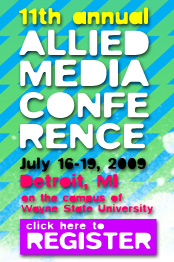 I got back from the Allied Media Conference yesterday. It has been helpful to have gone out of town on the weekends, even though it has also been an impediment to feeling like I’m getting more familiar with the city outside of the default of my routine. Going away and coming back has reoriented my sense of home from Bloomington to Chicago in a way that probably would have taken much longer otherwise. As Chiara mentioned as we were coming into the city, the ideas and projects that represent at the AMC seem much more present and possible in Chicago.
This year, as was the case with the conference last year, I came back ambivalent, which is, perhaps the way it should be – that narrow space that is simulatenously “this is amazing and awesome” and ” this is a huge problem that we’re completely ignoring”. I spent most of my weekend in the Media Lab working on the Supercomputer Build. The best thing about this was meeting many different people who had visions and ideas for the technology or who identified as “geeks” but didn’t fit into every part of that stereotype. The only full session that I went to discussed how broadband stimulus funds could be and leveraged in a way that was useful and accountable to communities. Building computers from parts and installing free/libre/open source software on them felt like the micro version of broader efforts to increase access to technological infrastructure. The people with the vision were the ones building the machines, and hopefully, with cases off and free software, the platform seemed malleable and responsive to that vision.
My friend Josh said that he felt like more space was made for print media at this year’s conference, but being surrounded by technology it was hard for me to assess that. There was ample evidence that we were all struggling to make the technology responsive to our activities and human networks rather than the other way around. The Voces Moviles project is very awesome, giving immigrant workers in LA, many with limited internet acess, access for their stories on a blogging platform via their mobile phones. However, I was disappointed that, given the limited time in the keynote, they chose to exhbit the platform rather than the stories. This culminated in a projected IRC channel with tweets, vozmob texts, and IRC chats that ended up seeming very distracting to me. Also, juxtaposing the vozmob technology with something like twitter is useful for explaining it, but reinforces the idea that FLOSS and community technology hackers are simply trying to recreate commercial technologies instead of trying the address their missing functionality for communities. Ultimately, the stream of txts and tweets just didn’t seem very articulate. Detroit MCs Invincible and Sterling had planned to drop freestyle verses being prompted by people’s projected messages in response to the question “what are you ready for?” Unfortunately, most of the messages were things like “The AMC is so awesome”. It is hard to condense complicated feelings and ideas into 140 characters on the spot and the nature of the messages just showed that there’s a great need to assert collective experience and excitement, even when sitting in the same auditorium. I sat next to some older ladies who proved that snark needn’t be exclusive to my generation. They were particularly incensed by the projected messages. Maybe the technology seemed cryptic to them, or maybe it didn’t meet their needs at that moment. The nice thing about the AMC is that this kind of counterpoint remains present at the conference.
A more successful public use of technology at the keynote was a Skype video chat with an artist/organizer in South Africa. The connection was shaky at times and it was difficult for the moderator to speak into the PA mic, so the audience could hear it, and also into the computer mic without everything feeding back like crazy. Still, I think it demonstrated how you can make technology do things it wasn’t exactly designed to do, that doing this doesn’t always go smoothly, but ultimately people can come together to use tools to do cool, useful things.
I’m so glad that I got to be a part of this year’s conference. Ultimately, the greatest value to me comes not from the session content but from all the people you meet and the threads of conversastion that bring together and blanket the session topics. Even holed away in the Media Lab I got such a strong sense of that.
Masculinity and Sexual Assault Awareness Month
This is a first draft of an op-ed for a group called ManUp! that I’m working with in Bloomington. I’d appreciate any comments or feedback:
April, sexual assault awareness month makes me tired. I am tired of seeing women that I respect and care about exhausted as they do the challenging, important, but also extremely difficult work of supporting survivors of rape, sexual assault, and domestic violence and working to raise consciousness which might prevent future violence. Many of these remarkable friends have experienced violence in their lives and started doing the work that they do because of the lack of support that they experienced. Their efforts are remarkable and brave yet ultimately they shoulder the weight of their pasts as well as the weight of the survivors that they support and the confused, indifferent, or even hostile voices they encounter doing prevention work.
I am tired of feeling trapped in the same tired discussion in the rare cases that men’s violence and men’s violence against women comes to the surface, whether it is in the lives of celebrities such as Chris Brown or the lives of men in my social circles. I can try to excuse the violence, weakly dismissing it as stress or substance abuse or as an isolated incident. Or, I can pat myself on the back, satisfied that at least I am not one of “those men†who chooses to be violent, to harass and intimidate those passing by on the street, who touches someone’s body without their permission, who pressures someone to consume too much alcohol or drugs in the hope of getting lucky, or who seeks to belittle and control intimate partners. In either case, I can’t find the imagination to think of a world where perpetrating and experiencing violence is not a part of manhood – mine, my friends, or Chris Brown’s.
I am tired of a man’s strength being defined by his ability to suppress painful experiences and to downplay the experiences of others rather than crying out and reaching out and working in the hopes that others might be spared those painful experiences.  I am tired of the gentleman’s agreement that we will not speak of our fear of violence from other men or the fear of the violence we have committed or might commit.
Finally, I am tired of the myth that violence against women doesn’t matter to men and that it is not men’s work to end this violence. It is a myth that I have found comfort in because it excuses my own inaction. If this myth rings true to me or other men, I fear it is only because we have spent so much energy convincing ourselves that it is true.  When I think of all the effort spent changing the subject to avoid seeming vulnerable, laughing along or remaining silent when a friend tells a cruel, demeaning joke, or convincing myself that it’s not my place to say or do something when I witness or hear about violence it seems like such a waste. All that energy could have gone into dealing with the violence that men have witnessed or experienced in our lives to make sure that we don’t repeat it. It could go to defining manhood by our best, most noble qualities instead of the worst of our choices. It could go towards working earnestly as allies with women to prevent violence that hurts us all. Sexual assault awareness month is not just a chance to be aware that violence is terrible, that it happens too frequently, or even that it hurts both women and men. It is also an opportunity to be aware that we can make a different, less violent world.
Graffiti Panic
This is a letter to the editor that I just submitted in response to an editorial in today’s H-T, Graffiti not art; it is vandalism:
I was disappointed by today’s editorial condemning graffiti. Rather than fostering a nuanced and frank dialog about complicated issues like the state of public and private spaces in Bloomington, the editorial’s intention seemed only to attempt to induce panic. Why even mention the specter of gang violence when the police department confirms that graffiti in Bloomington has no relation to such violence? Furthermore, I am disappointed by the brief mention of the “broken windows theory” and other studies outside of the context of a broader body of research. This theory, like many sociological theories, is still being widely debated. For instance, one study by researchers Robert J. Sampson of Harvard University and Stephen W. Raudenbush of the University of Michigan suggests that rather than being inherently problematic to the well-being of a neighborhood, graffiti (among other things) invokes deep-rooted anxieties and prejudices that people have about changing class and race dynamics of a community. Ultimately, I am far more concerned about the high costs of renting spaces, barriers to starting businesses, and difficulty finding employment in Bloomington. If we do not address these factors, graffiti may be the only way that many can participate in Bloomington’s downtown.
Django: Querying data from the Python shell
I needed to get some stats for some research that we’re doing and was happy to see that you can use Django and the python shell to query testament data in a way that’s database independent. It’s a little unintuitive if you’re thinking in SQL mode, but it is usable and super-helpful. I wanted to share it with ya’ll in case you needed to quickly pull stats or examine info.
Helpful reference Django docs:
- http://docs.djangoproject.com/en/dev/topics/db/queries/#making-queries
- http://docs.djangoproject.com/en/dev/ref/models/querysets/#queryset-api-reference
Print the prison name, city, and state of all prisons that received a package sent by the Midwest Pages to Prisones Project from 2009-01-01 to 2009-03-22
geoff@btp:/var/www/testament/testament_trunk/btp$ python manage.py shell
>>> import datetime
>>> from core.models import Prison, Package
>>> start_date = datetime.date(2009, 1, 1)
>>> end_date = datetime.date(2009, 3, 22)
>>> prisons = Prison.objects.filter(package__sent_on__range=(start_date, end_date), package__group__username__exact='mwpp').distinct()
>>> for prison in prisons:
>>>    print "%s %s, %s" % (prison.name, prison.city, prison.state)
Defiance, Ohio Northwest Tour Day 1
I’m going to try to write about tour this time. It comes and goes so fast that sometimes all I feel is left are these “remember when …” snippets that come up between people I’ve been on tour with that are nice to remember but alienating to everyone else in the conversation.
I told Florence and Oona that I had to wake up yesterday at 4AM in order to get a flight that would put us in SC in time to play the show that night. Florence just rolled her eyes and said “That’s crazy”, which is funny because she’s had enough long, early-morning flying in her life that it’s not unfamiliar. I think for her, and maybe other people, the idea of going on tour remains abstract enough that it adds this additional element of “craziness”. The flights all went okay in the end, even though Theo flew separately and had 2 layovers and had his accordion stuck in SLC for a while. Bz, Ryan, and I got to play pinball on our layover and managed to sneak our instruments on as carry-on.
We rented this crazy, new-car-smelling, Hybrid car. It’s pretty surreal, but fun. It’s a small thing, but hopefully it saves us some money and makes the ecological footprint of touring a little less. I don’t know how to calculate that. A bunch of folks drove up from S. California for the show last night because we’re not making it south of Santa Cruz. It’s awesome that people are willing to do that, and I have fond, fond memories of the concert road trip. At the same time it just seems so costly. I guess I take it for granted that I get to see a lot of good bands without having to travel far.
My totally uninformed, knee-jerk reaction to Santa Cruz is that it is a mash-up of Beverly Hills and Eureka. As we rolled into town, stopped at a spotlight, I saw two guys yelling at each other and waving blunt objects. One guy had a hammer and another had this cane. The windows were rolled up so it was really surreal to see this scenario play out on mute. I had this sick feeling of being trapped, just waiting for someone to get really hurt. It would be easy to dismiss the two dudes as just being fucking crazy, but I think that lifts a lot of the accountability from their shoulders. One of the guys kept starting to walk away, then the other guy would walk away, then the first guy would turn arond and say something and the other guy would start following him again waving his hammer. It was so obvious that either of them could have chosen to just end it and walked away and saved themselves from getting really hurt and a lot of motorists from witnessing two guys bludgeon each other. But, they felt like that had to keep provoking each other to keep their dignity intact. It’s definitely a very gendered interaction, and I’ve felt it, though not involving such an immediate threat of violence. I hate feeling like there is this trade-off between feeling like the choice is between avoiding violence and just escolating a stupid situatin and having your dignity and not feeling like you’re getting trampled on and letting a person who isn’t very nice or respectful “win”. Not saying anything feels like you’re resigning yourself to a world dictated by violence and intimidation, but escalating conflict seems like it just hastens the worst realization of that world.
Playing the show was hard because we didn’t get to practice with Will, but I think it went okay. People seemed stoked, even though we got completely squished. When I tried to adjust to make more space for Bz or Theo, I feel like I ended up just bumping the other one more. Punk is such a participatory medium, it’s hard to imagine people not wanting to be so close and get jostled, but there are times when I just can’t sing or play from getting jostled too much and it feels like the musical aspect is just lost. I guess it’s reductve to separate people dancing and feeling part of this collective mass from the music, but it’s still frustrating. It’s uncomfortable to feel like we’re scolding people when we ask for more space.
I enjoyed watching the bands that we played with more than I have in a long time. Black Rainbow was great and dealt well with playing first in a sort of akwards space. I liked Fischer a lot and how their music just sounds good without being overworked, labored, or trendy. I had seen a bunch of the folks from St. Augustine’s bands before, but I think I might like Tubers the best. They just looked like they were feeling what they were doing completely. Dichotomy was totally good and also seemed really immersed in playing which somehow seems to make such a difference. I’m excited to be playing shows with them this week, though the social coordination of 10 people is probably going to be really challenging.
CRL Administration Menu
This is a module that I wrote while working on the new Drupal-based site for the Center for Research Libraries. It is a good example of how you can manipulate the menu created by the Administration Menu module.
You can check out the code at https://github.com/ghing/crl_admin_menu/tree
gender roles in phishing e-mails
I found this spam in my Inbox. Since starting to co-present the Building Healthy Relationships workshops and listening to Chiara’s stories about this I ‘ve become more conscious about the gender messages that mediate our day-to-day lives.
From the e-mail:
Hello.
My name is Tessy, It is my pleasure writing you this mail as I saw your mail, I believe that we can be good friends partners or more in life I wish you can write an email through my email address then tell me about you below is my email address for further comunications.But in this part of my life I would like to be the woman in general. This may not be modern thinking but I am not a modern thinking feminist woman. In fact my dream is to be a wife spare her energy during the day so when a husband comes home at night he would feed off that energy. I do not believe this can be done
when both are tired from working all day.And nothing brings a man home faster from work than the thought of his beautiful, sexy and rested wife waiting for him at home filled with romance and passion.
Re: Your Music
Someone e-mailed Defiance, Ohio with some questions for a school project that produced this brain dump on the Britney Spears, the band, digital distribution, and media-based economies.
They wrote:
I know that big artists (for example Britney Spears??) are angry because of course they want the money, but I was wondering, do you think it’s more grey for less famous artists? Although maybe a smaller artist might miss each dollar more, do you think they mind less? Do you think the love for the music overcomes the ‘need’ in today’s world for the money? I know that sharing music without paying for it is a really great way to be heard, so what’s your opinion on that?
It’s hard to answer these questions directly, for Defiance, Ohio, and maybe for most artists, because I’m not sure if we have ever seen our options as starkly as “participate in the mainstream music scene or be an independent artist” or “have a larger fan base or make more money?” Certainly, some of the decisions we have made have had elements of those questions involved and some of the things we have done that didn’t feel like decisions have ended up having results that reflect on those stark questions. However, to provide what feels like a complete and honest answer, I feel like I need to reframe the questions.
The first part of your question that I want to address is the idea of big artists, and Britney Spears in particular, being against file sharing and technologies like torrents. I’m not sure if if Ms. Spears has ever spoken out specifically against file sharing, or if she even understands the technology, its implications, and the implications of enforcing copyright. If she has made statements about it, it’s likely that she is articulating the standard response of many in the mainstream music industry that file sharing is harmful to artists and the industry, which, to a degree, is true since the music industry has been really slow to adapt to the reality of how people listen to, use, and produce music.
I think it’s important that we don’t get stuck in villifying big-name artists, even though they certainly have made choices, and make choices in terms of their music’s content and business choices that I wouldn’t make. Simplifying the position of artists in the mainstream music industries as only being concerned about money has the a number of negative impacts. First, I think that many artists, despite making very commercial content, are genuinely talented performers who love performing and making music and would likely be performing in some capacity (religious services, county fairs, amusement park shows, cruise ships, etc.) even if they weren’t as successful in the record industry. Second, I think that it overlooks the fact that many artists come from backgrounds of limited economic mobility (certainly this was the case for Ms. Spears) and that their choice to participate in the mainstream music industry is a pragmatic decision given limited options. Ms. Spears’ career, even from the time she was a young child, has been mediated by the mainstream, big-media industry and model of making music. So, the choices that she makes in terms of things like file sharing, are largely dictated on her dependence on this industry. Had she been a performer who didn’t fit as easily into the archetype of successful child performers and eventually female superstars, she may have instead chosen to work outside of the mainstream music industry to continue to perform and may have made different choices that would effect everything from the content of her music to her use or (dis)approval of file sharing. Finally, defining the ethics and intentions of artists based solely on their orientation around mainstream corporate media is dangerous because it artificially inflates the ethics and intentions of artists who choose to participate in an subcultural, less corporate, or do-it-yourself music economy rather than examining their musical content and practices for what they are.
None of this has really answered your question, but I feel like it was important to talk about in order to develop a framework for answering your questions. We need to move beyond the dichotomy of the greedy but soulless superstar vs. the starving but artistically vibrant independent artist that I’ve also been guilty of relying on. In the case of Defiance, Ohio, I think that each of us will always make, play, or perform music in some way, for the rest of our lives, because we do love it. However, I think that we would all love to be able to have the making of music be something that supports us financially rather than something that makes our lives more difficult or more stressful in terms of money. I think we also want to do this in a way that supports our beliefs, ideas, friends and communities. One of the biggest drawbacks to participating in the mainstream music industry is that money made from one’s music might go to support the release of records with homophobic lyrics, or artists who pressure working-class youth into joining the military.
Similarly, making our music widely available and available to people regardless of whether they have a good local independent record store that stocks less-well-known records or whether people have lots of money to buy records has and will continue to be important to us. I also think it’s important for our music to be available for posterity. Making music available as free downloads has helped serve all these needs. However, it would be great if people recognize that making the songs that we release for free takes time, energy, money for instruments, time off work to record and practice, and lots of other resources. As a culture, I think we’re struggling to assign costs to lots of things that reflect their complete value and hazards (electricity produced from coal, for instance). Music is no different, so I think that Defiance, Ohio continues to struggle to assign a monetary value to our music, shows, and other “products” that strikes a balance between reflecting the resources that go into making them, not being greedy, and being realistic about what people are willing to pay.
Ultimately, I think it’s hard to say how free, digital distribution of our music has affected Defiance, Ohio since it’s something that we’ve always done. We don’t have any data about whether most people heard about us through downloads or touring, word of mouth and mix tapes or through our releases on independent labels. Also, we did it without too much forethought about the potential implications of using this method of distribution. I’ve always liked emerging technologies, so when we started recording, I wanted to experiment with making our songs available through new media. I think that when we started playing, we were also interested in sharing what we made with friends or like-minded people across the nation, and freely downloadable files helped make this possible. Finally, I don’t think we imagined that there would ever be the possibility of assigning any kind of monetary value to our songs outside of the few dollars we charged for our demo CDR and first CD on our initial tours. That said, I can’t deny that making our music widely available has helped us to have people become interested in our music enough to tour around the U.S. and the world and to have people willing to help put out our records or go to benefit shows or otherwise support projects we believe in.
Getting your music heard is pretty important to many artists for personal gratification, ideology, and financial success and file sharing or other methods of digital distribution are one tool that can be used to achieve this. I don’t think it’s any more or less legitimate than other old and emerging methods. I think the parallel music economy of hip hop mix tapes is really interesting as is the migration of these “tapes” to CD and now digital downloads. I think that there’s still something awesome about the intimacy of music getting distributed between friends on mix tapes or CDRs (and probably now through social networking sites and peer-to-peer file sharing systems). I think that community, college, and pirate radio are still important means of sharing music and that podcasts are a new medium for similar content.
In the end, the question of whether digital downloads and file sharing are good or bad for artists or music industries is becoming (has already become?) a moot point. Alternative distribution methods are already being used by artists with varying degrees of success. They are also destabilizing a mainstream music industry that has traditionally treated artists unfairly, ignored or fetishized cultural diversity, and been otherwise slow to change. The important question is what do we want our media environment to look like? How do continue to create vibrant culture while compensating makers for their work? How do we make space for minority voices in media? How do we connect across our different experiences and situations through media? As traditional manufacturing jobs are disappearing from the economy and many youth have fewer and fewer opportunities to do work that offers them an interesting, dignified life , can we create new, media-based economies the give new economic mobility to communities facing economic depression?