Sample salsa from various Bloomington contributors. In the past there was a fresh and cooked category. I found a lot of them to be bland, but there were a few gems.
media check for the week of 2007-08-19
I decided to go to the IU library to check out the book The Suburbanization of New York: Is the World’s Greatest City Becoming Just Another Town? (ISBN-13: 978-1-56898-678-4) and found a wealth of other interesting books in the HN80.N5 section on the 7th floor. I also checked out There Goes The Neighborhood (ISBN-10: 0-394-57936-4), a book about the politics of race and class in Chicago neighborhoods, and passed on Praciticing Community (ISBN-10: 0-292-73118-3), a book about similar dynamics, but in Cincinatti, though it also looked good.
I heard an interesting recording of a Michael Parenti talk on Alternative Radio on WFHB on Monday, 2007-08-20 that was kind of all over the place, but mostly about how identity politics are exploited to divide people who are marginalized by race, gender, or sexual orientation. He also suggested that the division of power in this country often finds people with very different ethnic, gender, sexual, or other cultural identities on the same side of that power divide.
I read this article by Dave Zirin, author of What’s My Name Fool?: Sports and Resistance in the U.S., Welcome to the Terrordome, and other books about sports and politics. Zirin writes about the difficulties in sending copies of his books to a Texas death row inmate because
“It contains material that a reasonable person would construe as written solely for the purpose of communicating information designed to achieve the breakdown of prisons through offender disruption such as strikes or riots.â€
The offending content, according to the TXDOC, included quotations such as this from baseball great Jackie Robinson:
“I felt tortured and I tried to just play ball and ignore the insults. But it was really getting to me. … For one wild and rage-crazed moment I thought, ‘To hell with Mr. Rickey’s “noble experiment.†… To hell with the image of the patient black freak I was supposed to create.’ I could throw down my bat, stride over to that Phillies dugout, grab one of those white sons of [expletive] and smash his teeth in with my despised black fist. Then I could walk away from it all.â€
I use del.icio.us for managing my bookmarks. Often, I want to access my del.icio.us bookmarks through my browser instead of having to visit the del.icio.us site. The del.icio.us Bookmarks Firefox add-on lets me do just that.
Roy F. Baumeister’s talk, Is There Anything Good About Men? is really interesting. It talks about the different ways that culture have used men and women to achieve its ends. It also talks about how a fundamental difference between men and women is that men favor wider, shallower relationships and women prefer closer, more intimate relationships and how this has driven the different cultural realms that are inhabited disproportionally by men and women. At the base of this, claims Baumeister, is the evolutionary reality that far more women reproduce than men. The wider, shallower, relationships or more risk-taking activities favored by men, in general, facilitates the differentiation that will allow some men to reproduce.
On a somewhat related note, this is a program that my friend is working with. The program is trying to organize
Men of Strength (MOST) Clubs in DC and other communities. A friend who works with the Middleway House, a Bloomington shelter for women and children affected by rape and family violence says that young men who stay in the shelter really lack a community of other males to critically examine their ideas of identity and masculinity and to model ideas of gender or relationships that differ from the violence that they’ve experienced. These clubs seem like a rare example of something that might begin to provide this support/education. The clubs are described as:
The
Men of Strength (MOST) Club has provided young men in Washington, DC and California high schools and colleges with a safe and supportive haven to connect with male peers while exploring masculinity and male strength.
Exposing young men to healthier, nonviolent models/visions of manhood, the MOST Club challenges members to define their own definition of masculinity and to translate their learning into community leadership, progressive action, and social change.
MOST CLUB AIMS TO:
- Provide young men with a safe, supportive space in which to connect with male peers through exploring notions of masculinity and male strength.
- Promote an understanding of ways that traditional masculinity contributes to sexual assault and other forms of men’s violence, perpetuates gender inequity, and compromises the health of men and women.
- Expose young men to healthier, nonviolent models/visions of manhood.
- Build young men’s capacity to become peer leaders and allies with women in promoting gender equality and preventing men’s violence.
I have Debian Etch with KDE installed as my workstation at work, and I had a hard time figuring out how to make Iceweasel (Debian’s all-free software version of Firefox) the default browser instead of Konqueror. Turns out it was as easy as
$ update-alternatives –config x-www-browser
media check
Now that I’m back in the states, I’m going to try to write in this more. I thought I’d start by keeping a list of media that I’ve consumed that I’ve thought was good or interesting.
The Spokesman This American Life Episode (act 3) tells the story of Anthony Pico who is 18 grew up in the California foster care system and is now a spokesperson for children in the foster care system. I liked it because it showed that with systems that are broken, things are just complicated and hard, and it can’t be broken down into a few heroic success stories. I continue to enjoy TAL, even though the criticism pointed at the program by this satirical Onion article is pretty spot-on.
The Inside Journal is a newspaper distributed to people in prison. My dad, who now works as an educator in a prison gave me a copy. It calls itself “The Hometown Newspaper of America’s Prisoners” and features articles on prison news, personal testimonies, a series on surviving prison, and a few articles on mental health. After reading through the articles, and seeing a letter to the editor referring to a past article on “curing gayness”, I read the fine print and saw that the paper is actually published by an organization called Prison Felowship International, which seems to be evangelical christian in nature. The tone of the articals reveals this background, but it’s a strange matchup as they published, without comment a letter from a queer inmate that was critical of their “curing gayness” article. The articles seemed to be generally critical of systemic problems with the prison and seemed to advocate for changes in those systems and didn’t seem to blame the prisoners for their situations. It also didn’t seem to suggest religion as a final solution to problems in prisons. A few interesting things that I learned from the paper were that women inmates attempt suicide more often than men, but are unsuccessful more often, so men end up having a higher suicide rate. I also learned about a piece of legislation that I hadn’t heard of before called the Second Chance Act which seems to be a bill to improve services to inmates reentering society to soften this transition and to reduce recidivism. It was killed in the Senate before it went to a vote.
Blog entry on the book “The Suburbanization of New York: Is the World’s Greatest City Becoming Just Another Town?†(Princeton Architectural Press, 2007). The book’s forward is quoted as
Today New York is on its way to becoming a ‘theme-park city,’ where people can get the illusion of the urban experience without the diversity, spontaneity, and unpredictability that have always been its hallmarks. Like the suburbs New Yorkers so long snubbed, the city is becoming more private, more predictable, and more homogenized.
This is certainly the perception I get when I visited Brooklyn’s Williamsburg neighborhood throughout the last few years. The blog entry goes on to further quote contributers to the book and I like this one by Maggie Wrigley because she articulates feelings similar to what I think about Bloomington.
I feel sad and angry that the only newcomers to Manhattan from now on will be those rich enough to buy their way in. No new immigrants will bring their ways and flavors and styles to our neighborhoods. No poor artists or writers or musicians will come here and fight to prove their worth. No struggle, no adventure — just pay to stay.
I watched the movie Foxfire last night after not seeing it for a while when it came back into my consciousness because of tabloid press coverage on both sides of the Atlantic being obsessed with Angelina Jolie and Brad Pitt’s relationship issues. The film is based on a Joyce Carol Oats novel and, though often melodramatic, makes me nostalgic for the 90s when music was good and people made high school movies that dealt with tough issues in a not-too-sensational way, and didn’t always have perfectly resolved endings. I didn’t notice it the first time I saw the movie, but it’s very explicitly set in Portland which adds a certain realisim to the themes of teen homelessness and drug abuse.
This map still sticks in my head in a way that feels a little like haunting.
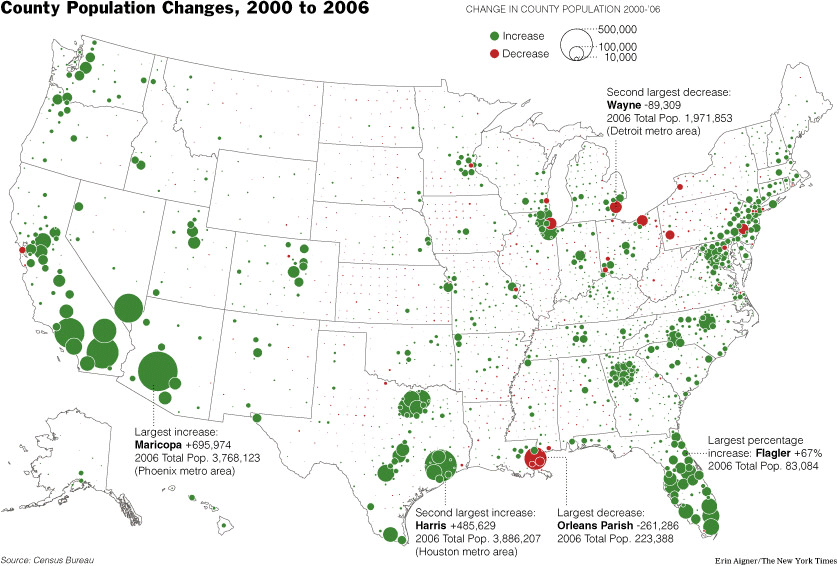
I thought of it again recently when I was talking to Chiara about cities that I felt drawn to. I realized how tied the map could be to my personal history. My paternal grandmother was born in New Orleans (giant red dot), my maternal grandfather and me in Cleveland (red dot), my mother in Pittsburgh (red dot), My parents both grew up in Flint which, had the map been made a few decades ago, would have had a nice big red dot, and the changes in Flint could easily be tied to those of Detroit/Wayne County (a big red dot again).
Prague to Berlin bike trip methods
The plan was to ride bikes from Vienna to Budhapest and then from Prague to Berlin. Plans changed, and we only ended up doing the Prague to Berlin ride. But, I wanted to make a few notes about the way that we did things in case anyone wanted to travel similarly in Europe.
Flights
We flew from the US to Europe on British Airways. They actually let you take bikes as one of your checked bags for free!  In Europe, we originally planned to take trains, but bikes were officially prohibited on some of the routes (e.g. from Milan to Prague), though Chiara was pretty certain that you could get away with it if you tried. We didn’t have any problems with traveling with the boxed bikes on any of the regional railways that we used to get to/from the airports in Italy and Germany. To travel between European destinations, we ended up using low-cost airlines. Easyjet seemed to be consistently cheap and have lots of destinations. They also let you take boxed bikes (in lieu of your checked bag) for a small fee (around 15 euros I think). It was more difficult to find the policies of other discount airlines regarding bikes, so I’m not really sure what the others offer. It was crazy how much cheaper the discount airlines were than trains, and it sort of makes it scary to think that the day of rail travel might be numbered, even in Europe, where the system is so much more culturally integrated than in the US.
Trains/Public Transport/Bike Boxes
For the plane, we just re-used the large cardboard boxes used to ship bikes from the manufacturer to bike stores. My dad got some free from a bike shop in PA to go to Europe, and to return, a bike store in Berlin also gave us some for free. We had to ask around at a few places in Berlin because, although there are bike stores as numerous as the cyclists themselves, many seemed to just carry used bikes and didn’t have the boxes. Lugging the boxed bikes, or bikes around along with boxes was a pain. For our trip from Chiara’s mom’s house outside Milan to Milan-Malpensa airport, Chiara’s brother built some ingeneous simple rollers that we fit on the boxes. It was still taxing to pull around the heavy boxes, but it would have been nearly impossible to do it without a car otherwise.
A quick note on the regional trains/public transit. The one from the station in Milan to the airport was like 11 euro (+ maybe 3 euro to get from the town where we were staying to the city. If you were taking the subway, it would be about 1 euro). Amazingly, in Berlin, we got tickets for the bikes and us (clearly marked on the automatic ticket machine in the stations) that worked for both the metro (u-bahn/s-bahn) and the regional train to the airport for under 4 euro each. In Prague, there was no way to get the bikes from the airport to the city center other than taking a rented van. The bikes cost the same as a person, so the total was going to be pretty expensive. So, we just put the bikes together, packed our paniers and rode to the airport. You can take bikes on the metro in Prague, however, and we used this to get out of the city more quickly. It wouldn’t be a problem without heavy paniers, but it was pretty difficult to carry bikes down metro station stairs. Also, in Prague, many of the metro stations were accessible mainly by very long escalators. The info points in some metro stations will be able to tell you which stops have elevators, though they’re still a tight fit. You put the bikes on an extended seatless area on the last car of the metro that is reserved for bikes and strollers.  In Berlin, metro cars that can accept bikes are marked with a bicycle symbol.
Stoves
This isn’t that important, but I wanted to note it because it was something that brought out my obsessive tendencies. Before leaving the US, we bought a stove to use while cooking at campsites. We got the multi-fuel MSR Whisperlite Internationale because we were concerned that fuel canisters would be hard to come by. This turned out to not be the case as they were available at the grocery store at the more developed campground in Barcelona, and at specialty camping stores close to where we stayed in Prague. Finding fuel for the multi-fuel stove ended up being more difficult than expected. The directions for the stove said that it could use White Gas, Diesel, Kerosene, or Unleaded Gas. We tried to use Diesel in Barcelona, and it was a disaster, with the fuel burning really inefficiently, producing gross black smoke and fumes, and leaving a sticky, oily residue on the pots and stove. In Prague, I got a tip that white gas (the recommended fuel for the stove) was called “technicky benzin” and could be found at hardware stores. We tried a few small hardware stores in the city center without luck before heading for the Hornbach store (like a Lowe’s or Home Depot in the US) outside of the city where we found the fuel in the paint section. It worked much better with less smoke, fumes, and mess than the Diesel. We saw signage for a number of hardware stores on our route, so it seems like it would be much easier to find en route, if you didn’t want to carry around fuel canisters. Still, if you have a canister stove, it seems like it’s no problem finding fuel.
Routes
We picked the Vienna to Budhapest route from a book, but the Prague to Berlin route we picked more because of the destinations that we wanted to visit. Because of this, we couldn’t really find a route on the Internet or in books. We also had a hard time finding road maps with detailed depictions of small European roads from the US. So, we used a combination of different Internet sites to figure out a route. viamichelin.com is a European map and direction site similar to google maps or mapquest. One important difference is that it lets you pick what kind of vehicle you’re traveling in and lets you select a route accordingly. One of the vehicle options that it lets you use is a bicycle! However, the maps that it provides for directions are either too zoomed out or zoomed in to be useful for navigation. So, we used Google maps and followed the via Michelin route, printing out a series of maps from Google and highlighting the route with a highlighter. The via Michelin routes were very good, and I feel like all the roads that it selected were appropriate for bicycles, and many of them took us through very beautiful parts of the countryside.  However, I wish that we could have had a larger map in Germany as many of the roads were unmarked and at junctions, only gave indications in the direction of cities that were off our maps (which were usually only about 15 km wide). If I had it to do over again, I would try harder to get a roadmap, or print larger maps from Google. The place where the narrowness of the maps was a big problem was on our second day, riding over some tough mountains from Usti Nad Labem in the Czech Republic to Dresden in Germany. After reaching Dresden, we were trying to reach a campsite in Radeburg, but accidently followed signs in Dresden towards Radeberg which was about 25 km away from Radeburg. The neighbor of the woman that we stayed with in Milan also rode from Prague to Berlin, but followed a route that was closer to rivers and that was comprised of more car-free bike paths. In Germany, there were tons of bike paths, not just in Berlin, but between even many of the small towns in the former East Germany. It was a nice surprise as many of the roads were narrow and had no shoulder.
Lodging
For lodging, in Prague we stayed at a hostel/apartment place that Chiara found in hostelworld.com, which she says is a useful site. Along the way, we stayed at a cheap hotel in Usti Nad Labem (390 Czech Crowns for a double room), two campsites in the former East Germany (9-11 euros for 2 people and a tent), and a hotel outside of Berlin that seemed very American-like (65 euro for a double room including a nice breakfast). Other than the Hostel in Prague, we didn’t really plan for lodging. There were a lot of forests with hiking trails through them where it seemed like it would be possible to camp easily (though perhaps not legally). I think that along with the aforementioned network of bicycle paths, there are numerous hiking paths crisscrossing the area, and both campsites (one which Chiara found via Google, and another which we just came upon) seemed to be near the convergence of some of these trails.
In Berlin, we stayed with a woman who we met via a site called Couchsurfing. This site is very cool, and is essentially all the framework of a social networking site like MySpace (profiles, friends, comments, messaging, etc.) but with a point. The point of the site is to connect people in far off places with each other for the purpose of offering travelers a place to stay on each-others couches. I can’t say enough about this site. It was so nice to actually stay with someone who lived in Berlin rather than being surrounded by a bunch of other tourists. Moreover, I feel like in our conversations with Marion (the woman that we stayed with), we were able to get such a perspective on Berlin and Germany which might not account for the majority perspecrive, or the “local” perspective, but felt so much more sincere and authentic than what you would find in a tour book or in most situations oriented around tourism. I stay with relative strangers a lot, so the situation is pretty comfortable to me, but Marion was really good about setting boundaries and expectations, so it was even more comfortable. I think that the Couchsurfing site does a good job or providing users with tools to build trust and a background of communication between all the people. Also, it’s so nice to stay with someone local, just because finding little needed resources or ways of navigating the city is so much easier. And of course, staying on someone’s couch is free, but I don’t think that’s the point. I think of the zero-monetary-cost place to stay as the impetus to think of more real ways to return someones kindness, like small gifts, or making dinner together.
Harry Potter and the Deathly Hallows Book Release Party @ Boxcar Books. 11p-1a. Free.
Come join the folks at Boxcar Books to celebrate the long awaited
release of Harry Potter and the Deathly Hallows, the seventh, and last
book in J.K. Rowling’s Harry Potter Series. In addition to the book’s
release at 12:01am, the party will include Harry Potter themed snacks,
games and discussions.  Costumes are suggested, but not required, and
fans of all ages are welcome.
To reserve a copy of the book, please call Boxcar Books or e-mail
abbey@boxcarbooks.org, as limited copies are available
2 Dean Crew + TBA @ Sweet Hickory. 9p.
2 Dean Crew is Dave Dean (former Bloomingtonian) and his brother playing songs that sound similar to the songs he played by himself as Dave Dean’s Musical Forklift. It is bass and drums with songs that combine the personal, political, historical, and literary in a way that is intelligent, grumpy, and insightful. I think they sound roughly like a stripped down Minutemen or Red Monkey, but they for sure have a cheap 7″ record that you can buy at Sweet Hickory and is very good so you can hear for yourself.
The Subjects, The End of The World, The Sprickets, Kentucky Nightmare. 10p. $5. 21+
The Subjects
w/ The End of The World
+ The Sprickets (CD release show!)
+ Kentucky Nightmare
Friday July 20, 10pm
@ Bear’s Place, 21+
$5
Murder By Death, The Impossible Shapes, Whipporwhill @ The Bluebird. 9p. $6/$8.
Murder by Death
The Impossible Shapes
Whipporwhill
Thursday July 26th
doors 9pm
$6 adv $8 day of show
Tickets available at The Bluebird, Tracks, Landlocked Music, and all
ticketmaster locations.
Gettysbeer party @ Guilty Pleasures. 6-10p. 21+
North Vs. South – Gettysbeer! – July 23Â 6pm-10pm
North of 3rd Street Vs. South of 3rd Street Drinking Contest
Grey for Rebs – Blue for Yanks!
Guilty Pleasures
201 E. 2nd St.
Mail a letter to Lambert Day
Lambert used to live in Bloomington, but, due to personal issues, movee away to join the Navy. His mailing address is:
S R Daniel-Marks, Lambert A
Division 933
Ship 06
Recruit Training Command
3510 illinois St
great lakes, IL
60088