Disaster, Auryn, Ox-Eye @ 110 N. Maple. 9p. $3.

May 3 Show Flyer

DIY Punk Show with Disaster, Auryn, and Ox-Eye
Saturday, May 3
110 N. Maple (near intersection of Kirkwood and Maple)
$3
All-ages

Disaster

Bloomington hardcore punk with songs about skateboarding and social justice.  Songs for download at http://disaster.terrorware.com/audio/demo

Auryn

Playing songs that are pretty and heavy, Auryn comes on tour from Pittsburgh, PA and features members of many well-known Pennsylvania-based hardcore bands.  They have songs you can listen to at http://www.myspace.com/aurynpgh

Ox-Eye

Donovan and Joel’s newly named bass and drum band.   They play music that is at times, thick, technical, rocking, and idiosyncratic.  This is what happens when you combine someone who likes Limp Wrist with someone who likes Mike Patton-style metal.

Published
Categorized as Lets Go

MED on Obama, Rev. Jeremiah Write

I’ve been interested in Michael Eric Dyson since seeing him speak at IU over the winter.  An NPR news blog wrote this about a recent interview where MED linked Obama and his pastor with the different phases of Martin Luther King Jr.’s life:

Obama is the pre-1965 King. The one the holiday is named for, said Dyson. The King who spoke of brotherhood and non-violence. The one who doesn’t scare white people, who they could incorporate into their world view.

Wright is the post-’65 King. The one Americans know little about. The King who spoke out against the war in Vietnam. The King who said that most whites in America were racists. The King who spoke out against social and economic injustice in America. People remember that King was murdered in Memphis, Dyson says. But they often forget why he was there – not to promote equality, but to help lead a strike of garbage workers in the city.

Dyson said that people forget that when King gave his “seminal” anti-Vietnam speech on April 4, 1967 at New York’s Riverside Church, he was condemned by many white – and even black – pundits and church leaders for “going too far.”

Healthy Indiana Plan Update – Accepted!

I’ve been blogging about my experience applying for Indiana’s state subsidized health insurance for low-income folks.

Last week, I received a very formal letter that I had been accepted and  a bill for the first month’s payment into my POWER (a medical expense) account.

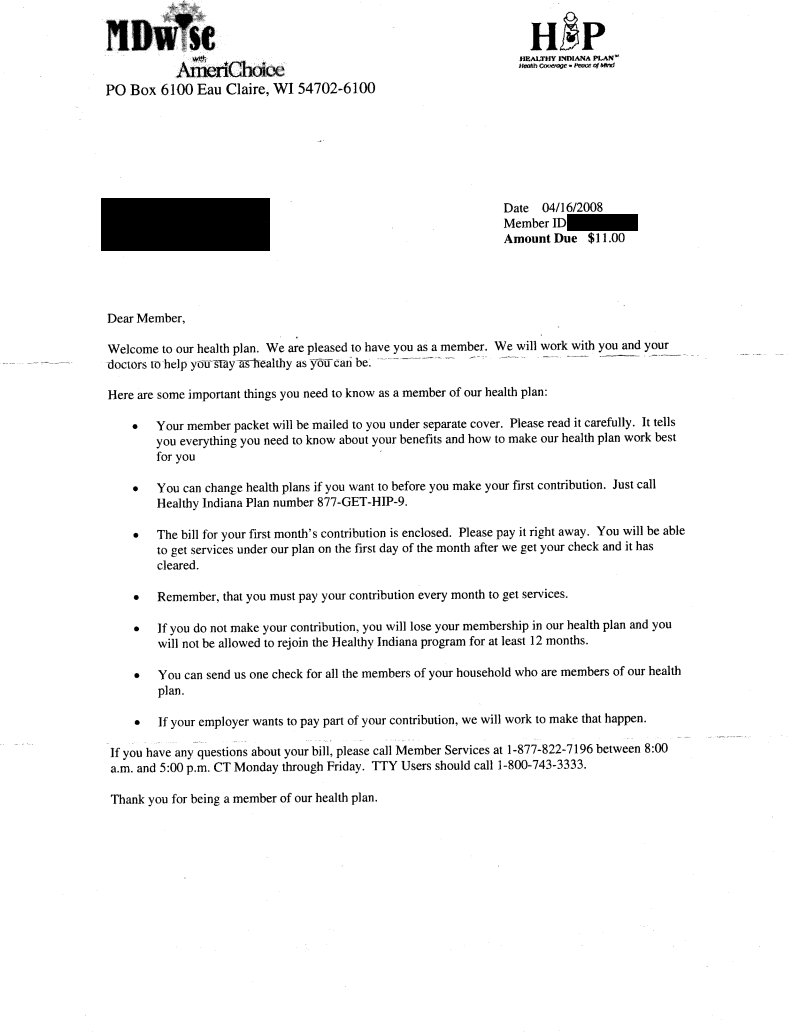
Here are the letters so others know what to expect. Click on the images to see full size.

Approval Letter:

Healthy Indiana Plan Approval Letter p. 1Healthy Indiana Plan Approval Letter p. 2

Bill

My First Healthy Indiana Plan Bill

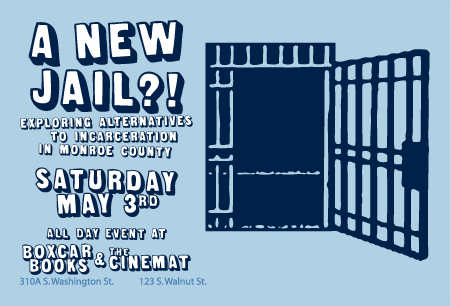
A New Jail?!: Exploring Alternatives to Incarceration in Monroe County

May 3 Jail Education Banner
Saturday, May 3, 2008
Free
A New Jail?!: Exploring Alternatives to Incarceration in Monroe County

Events At:

Boxcar Books
310A S. Washington St.
Bloomington, IN 47401
(812) 339-8710

Home

The Cinemat
123 S. Walnut St.
(812) 333-4700
Bloomington, IN 47401
http://www.thecinemat.com

A day of popular education that will explore alternatives to the current proposal of building new adult and youth jails in Bloomington. Through interactive workshops featuring community members, non-profits, experienced activists, and YOU, we will explore: What is the history of incarceration in Monroe County? What are some existing community alternatives to incarceration in Bloomington and other parts of the country? What have successful campaigns to challenge other jail constructions looked like? Several workshops will offer education, training, and networking opportunities for local folks questioning the need for new jails. The day’s events will culminate with special guest speaker Kai Barrow from Critical Resistance. This is an open event, with people from all backgrounds and political beliefs encouraged to attend.

Workshop One- 11:00 am, Boxcar Books
A discussion and Presentation on the History of the Monroe County Jail System

This workshop will begin with an interview from Indiana University Criminal Justice Department faculty member, Hal Pepinsky. Following the interview will be a facilitated discussion on the history of the jail, encouraging input from community members in piecing together the jail’s history and the sharing of personal and familial experiences with the jail.

Workshop Two- 2:00 pm, Boxcar Books
A Panel Discussion on Alternatives to Incarceration

This workshop will explore community alternatives to incarceration in Bloomington, as well as highlight successful initiatives from around the country. Representatives from different organizations will speak briefly about how their work keeps people out of jail by offering positive responses to poverty, homelessness, hunger, and conflict that enrich and restore community. Workshop attendees will be able to offer their own perspectives on what makes a community safe and whole.

Film Screening- 4:00 pm, The Cinemat
Yes, In My Backyard, A documentary by Tracy Huling

Financially-strapped communities are now begging for prisons to be built in their backyards. With plundering agribusiness, military-base closings and major industry relocation, incarceration is seen as the salvation of rural communities. Through the eyes of one farming-community-turned-prison-town, this hour documentary explores the increasing and multi-layered dependence of rural America on prison industries and subtly probes the profound implications of this dependence for both the keepers and the kept, and for our society’s understanding of and response to crime.

Workshop Three- 6:00 pm, Boxcar Books
Potluck Dinner and Discussion with Kai Barrow from Critical Resistance

Kai Barrow, one of five paid staff persons for Critical Resistance, a national grassroots organization committed to ending society’s use of prisons and policing as an answer to social problems, will lead a discussion

For more press, interview, or further contact information, please use information below:

Judah Schept
(812) 219-3611
jschept@indiana.edu

Download a flyer for this event (PDF)

balancing beam

I was responding to a friend who asked me about balancing my work life and my involvement in community activism.  As I wrote my response, I realized that it was something that I wanted to save as a reminder to myself:

Although I only work 20 hours a week or so, having a job that now requires more mental energy and has projects, responsibilities and deadlines makes it seem much bigger than 20 hours worth of space.  Also, I have a flexible schedule, which is good because it means that I can make it to most things I want, but also a problem because it means I spend a lot of time and energy scheduling and rescheduling.  I think I need to strike a better balance so that I have a more regular schedule and spend less time scheduling, even if it means having to say, “no, I can’t make it to that” more often.

Ultimately, I think that I really need to stop having such a schizophrenic existence and try to find a way to pay the bills by doing technology work to support grassroots community projects instead of trying to pay the bills and do technology work + activism.  I also need to find a way to balance my role (which I enjoy) as a technology implementer so I’m also involved in the communication, thinking, and essential work of the groups I work with and not just the IT person.  I’m not sure how to do this quite yet.

books on community informatics and radical mathematics teaching that I want to read

CI

  • Researching with Communities: Grounded perspectives on engaging communities in research Edited by Andy Williamson and Ruth DeSouza
  • Networked neighbourhoods : the connected community in context / Patrick Purcell (ed.).
  • Community informatics : shaping computer-mediated social relations / edited by Leigh Keeble and Brian D.
    Loader.
  • Social and community informatics : humans on the Net / Gunilla Bradley.

Math

  • Rethinking mathematics : teaching social justice by the numbers / edited by Eric Gutstein and Bob Peterson.

more meta blogging about Stuff White People Like

This is a response to Patrick’s response to my posting of this analysis of the Stuff White People Like blog.

I think that the language in the blog post is strong and frustrated and I’ll grant that the statements about the heftiness of the book deal probably don’t have much statistical support. Still, I think the analysis that’s important is not that the publishing industry is racist, but the idea about what is culturally popular or possible and how race plays into that. I suspect that the publishing industry, like most industries, is mainly interested in what is profitable and likely to be popular. Despite a certain frustration in the blogger’s tone, I think that this is what resonates with me about her argument. The authors got a hefty book deal, not because publishers are racist, necessarily, but because there is much more interest in white people glibly poking fun at some aspects of white culture than other critiques of race and culture, coming from both white people and people of color. The Stuff White People Like blog is popular because it provides the pretense of a critique about race and culture without requiring any change or even thinking about change. People generally seem smart enough to know that it’s not just white people who like the things mentioned on the blog, that these things aren’t a part of the life of many white people, and that abandoning these things that have been culturally assigned as white would do nothing to change the way race plays out in our culture. So, it might make people uncomfortable, make them laugh, or put the idea of race into the spotlight, but on face it doesn’t question how the things on the blog became associated with whiteness, push for changes in the cultural space that these things define, or any other change in the way multiple races are simultaneously or relatively understood.

I wouldn’t say that this phenomenon of expressing race without calling for change is inherently problematic. I recently read a book called Building Diaspora which is about people navigating their ethnic and national identity (in particular , Filipinoness) over the Internet. The book mentioned multiple instances of the importance of “You might be Filipino if …” type posts on the newsgroup and their popularity. She said that the posts were not taken to rigidly define Filipino culture or identity, but instead contained enough references that would be understood by people with connections to aspects of Filipino culture or identity that it helped satisfy part of people’s need to have some definition to Filipinoness and their own identity and for a definition of a broader Filipino community. Yesterday, I interviewed my friend as the first of a series of interviews about being multiracial. He said that for him, joking with other Asian people about Asian stereotypes or racist remarks was really important to him. So for him, humor gave him an opportunity to explore his racial identity in terms of how it was framed in his life, not in terms of Filipino delicacies, facial communication, or the practice of carry gift laden cardboard boxes through international airports as it was in the newsgroup posts studied in Building Diaspora, but in terms of his experience with racism as a perceivably non-white person growing up in a small town in Indiana. So, people coming from a lot of different cultural identities use humor to play with or think about their notion of whatever they are. This is the context in which Stuff White People Like seems to make the most sense to me. It is not a critique of whiteness or racism but a way for white people to think about one possible whiteness. In this case, unlike Samhita, the Feministing blogger, I’m not surprised at all that the Stuff White People Like blogger is white. Clearly there is a need for people in general, even white people, to examine their cultural identity using humor. I don’t think that it does the work for social justice and eliminating racism any good to view white culture as just a default (despite very apparent differences in cultural mobility and capital as deliniated by race), or to view it as monolithic or static. Still, this kind of conversation remains an assertion or question of what race is but doesn’t in itself transform the injustices of the past and present that are tied to race. Ultimately this is something that I want to see, whether it’s provided by a blog, through activism, the market, or anywhere.

I also want to address a subtext that I read into the Feministing blog post and this has to do with the mobility that is afforded to poking fun at white culture. I think that a Stuff Black People Like blog would be much less popular and much more controversial not because Black people are more easily offended but because there are just fewer negative stereotypes (and consequences) for assigning things to a white identity. I will stand strongly corrected if someone can tell me otherwise, but I would suspect that a white person has never been passed over for a job because their employer told them, “I’m sorry, your resume is great but I’m just worried that you people spend too much time eating expensive sandwiches, drinking bottled water and riding your Segway.” Cultural stereotypes are simplified, limiting, and not completely truthful regardless of which culture they represent. However, there is a big difference between stereotypes of middle to upper class white people in the U.S. and stereotypes of many other cultural groups in whether those stereotypes can be linked to fundamental beliefs about the superiority of one race over another. Comedians such as Dave Chapelle or Margaret Cho, who poke fun at the racial groups they identify with navigate difficult territory because they really satisfy the need for people to use humor to define their identity and community, but they also run the risk of perpetuating racist beliefs when those same stereotypes are identified by others as markers of inferiority. I don’t see Stuff White People Like as having to navigate around this challenge and I think that contributes to its popularity and success.

Finally, I want to address the idea of backing analysis about race with statistical evidence. While I think the proposed research strategy about race and the publishing industry could probably tell us some interesting things about both race and publishing, the amount of resources and time to compile this information is pretty significant. I would estimate maybe a month of full time work just to make the calls and compile the data, and much more time to make the connections necessary to have access to this information or to make people willing to respond (even quasi-truthfully) to questions. While this particular issue isn’t a good example, I think the idea of compiling potent statistical data about “touchy” subjects like race or gender can be problematic because if you are disadvantaged by prejudice, you could likely have fewer resources with which to conduct this research. If statistical data is taken as the only metric of credibility, it essentially requires that people with fewer resources receive the aid and attention of those with more resources. Then, there is still the factor of someone’s experience, even represented statistically, being filtered through the experience and perspective of someone who has a different experience and interests than the people being statistically represented. This could be a very good or a very bad thing. Ultimately, I think that the cause of a lack of statistical data about issues such as race needs to be examined and if access to resources is one of the factors leading to this dearth, we must ask “how do you tell the truth without statistics?”

This is a good question to ask in general, whether the resources are available to compile the statistics or not because the way that people perceive truth is a complicated thing. Hard data and analysis of that data plays into people’s decision making, for sure, but so do experiences, culture, and prejudice. Certainly, these things effect whether people perceive statistics as valid, even if there is an available criteria for evaluating statistics objectively. So, there is a value in representing things through experience or culture since that plays an important role in anyone’s decision making. A friend recently gave me a good example of this. New York City, in planning public network infrastructure projects, wanted to find out how people used the Internet. They decided, in part, to evaluate this through an online survey. Unfortunately, this format left out people who didn’t have Internet access but may have wanted it and who should be represented in the city’s infrastructure planning, especially as bridging the “digital divide” continues to be an objective of many public cyberinfrastructure projects. This strategy for information gathering could also have left out people who view Internet use as important but have such limited access that they have to prioritize their Internet tasks in such a way that completing an online survey would be difficult. So, in response to this, a community group decided to talk to various communities in NYC and to nonprofits, grassroots organizations and other groups that had a varied constituency about how the Internet and technology was being used in the city. The group conducting this research then decided that they would present their findings not as a report or collection of statistics but in youth-produced audio documentaries. I argue that this approach is not better or worse, more or less truthful than a statistical approach but that it resonates in ways that statistics cannot and can reveal truths that are obfuscated by statistics. Ultimately, I find it to be an exciting example of representing a reality with the purpose of affecting policy.