About Hoops

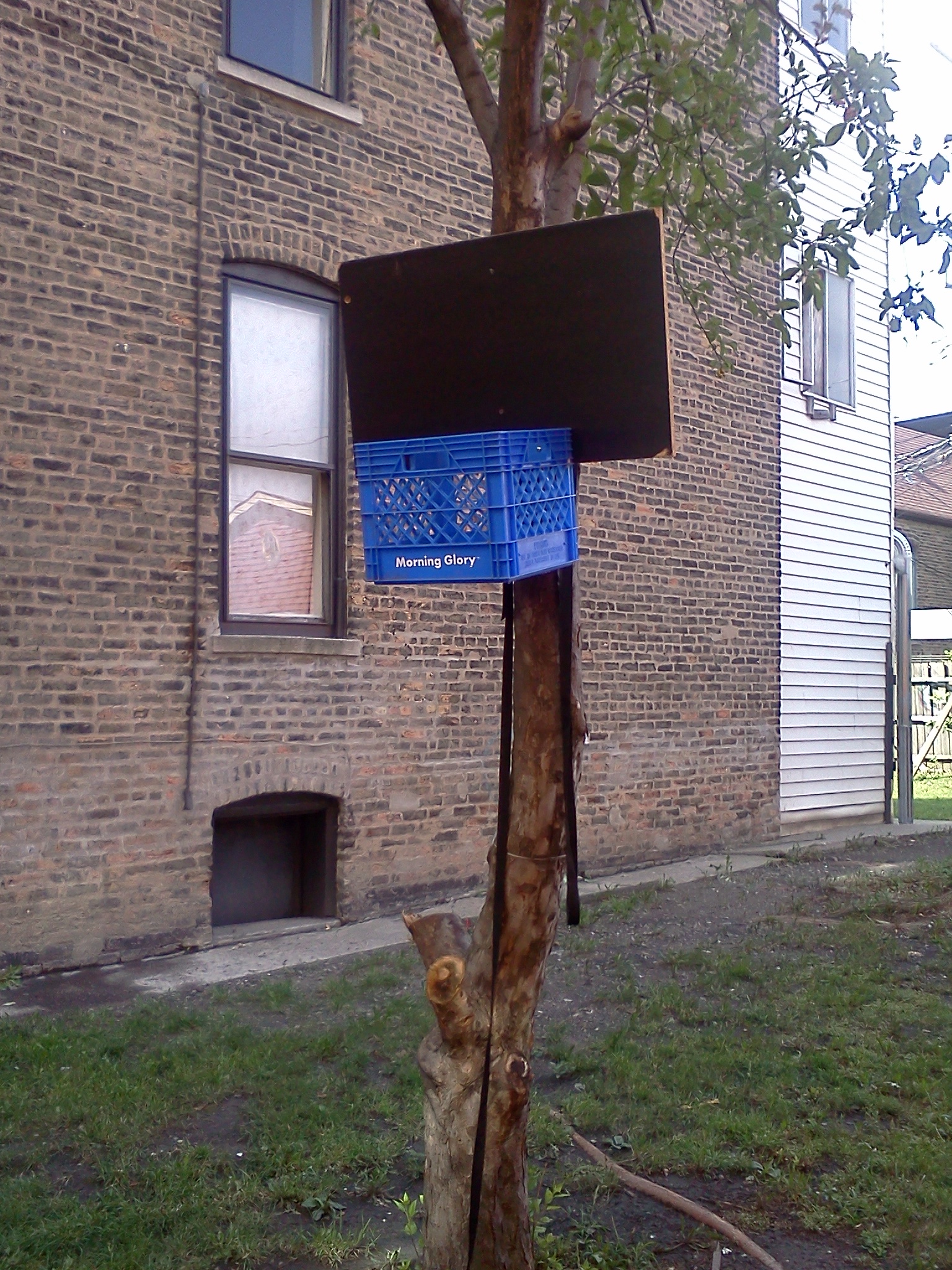
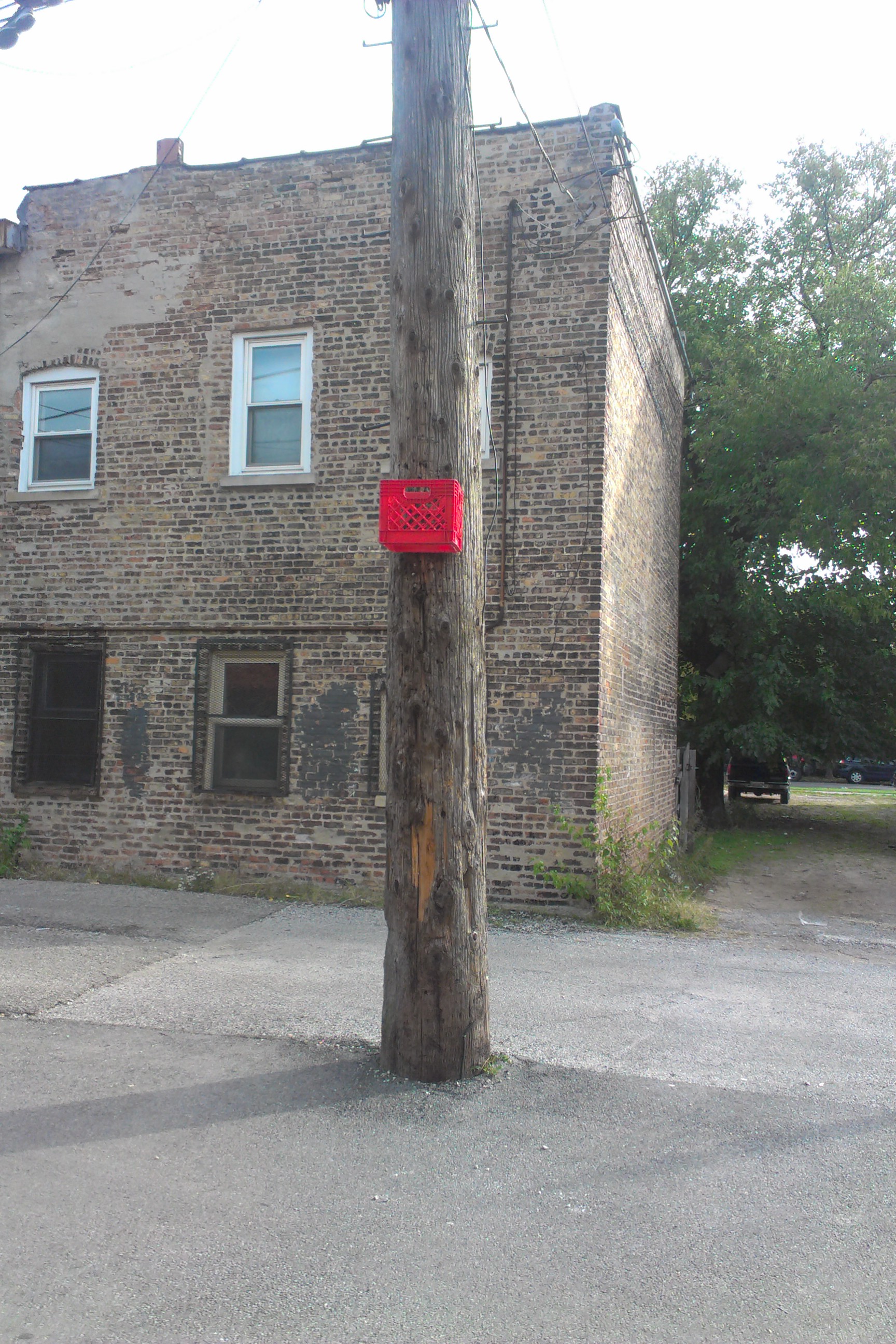
A homemade basketball hoop in a Humboldt Park alley.

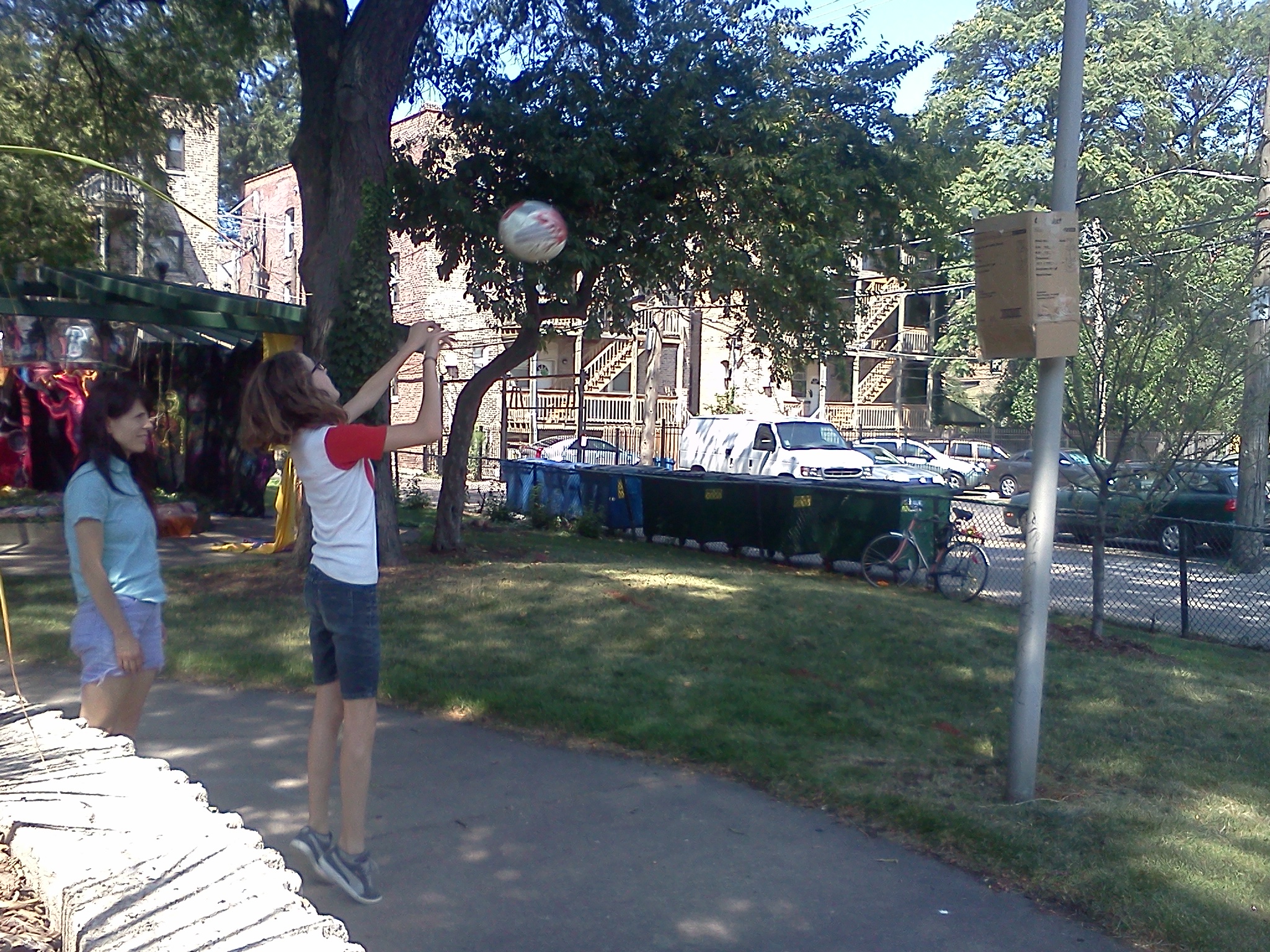
Hoops is a project that I’m undertaking to find and document, homemade basketball hoops in Chicago. I became interested in these structures when I saw a couple of guys playing in an alley near my house in Humboldt Park. Around the same time, a schoolyard basketball court in the neighborhood had been inexplicably removed and I was feeling frustrated about its loss.  Space for childhood never feels easy in this city and the ad-hoc hoops felt like an interesting facet of the way youth in the city navigate changing resources and geographies.

You can help me with the project by finding and submitting DIY hoops in your neighborhood. I’ve created a mobile web app at http://apps.terrorware.com/hoops/ that you can use from your mobile phone, or you can share photos using the #diyhoop tag on Instagram.

Installing CyanogenMod 10.1 on an HTC One V (CDMA) phone

My weekend project was installing CyanogenMod 10.1 on an HTC One V phone that I got from my housemate. The phone is made for Virgin Mobile, which uses a CDMA network. The codename I’ve seen for the phone is primoc, though I don’t quite understand how the naming convention works.  The process took me about a day and a half, though it would have only been a couple of hours if I would have realized I needed to activate the phone before I installed the custom ROM and if my backup would have worked correctly.

I’m not quite sure how to write up my experience, but I wanted to share a few warnings or things that would have saved me time and weren’t included in many of the guides.

The ROM zipfiles are hundreds of MBs

Take this into account when planning the time that you need.

Think of the process as multiple steps

A lot of guides combine these into one guide, or gloss over components. I found it helpful to research and understand each task, and also for time-boxing the process.

  1. Unlock bootloader
  2. Install custom recovery image. In this case, this was ClockworkMod Recovery (CWM)
  3. Copy the CyanogenMod and Google Apps distributions (zip files) to the SD card
  4. Install CyanogenMod and Google Apps from the zip files using CWM
  5. Flash the CyanogenMod boot image using fastboot

You don’t have to install any special drivers when using Ubuntu

To run the platform tools on Ubuntu, you need to run then using sudo, e.g.:

sudo ./fastboot flash boot boot.img

Activate the phone first!

The biggest time suck of the process is that I forgot to activate the phone before flashing CyanogenMod. The backup I made didn’t work.  In order to activate the phone (or switch it to your number), you need to use Virgin’s Activate app and this is only available on the stock ROM.  Save some pain and activate the phone using the default ROM before messing around with flashing custom ROMs. Luckily, I found this ROM based on the stock ROM which included the activate app.

There isn’t a RUU for newer versions of this phone

RUU stands for ROM Update Utility. It’s a windows executable used to restore the phone to a default install.

Useful resources

I used these as references during my install:

Illinois in the ICE Age

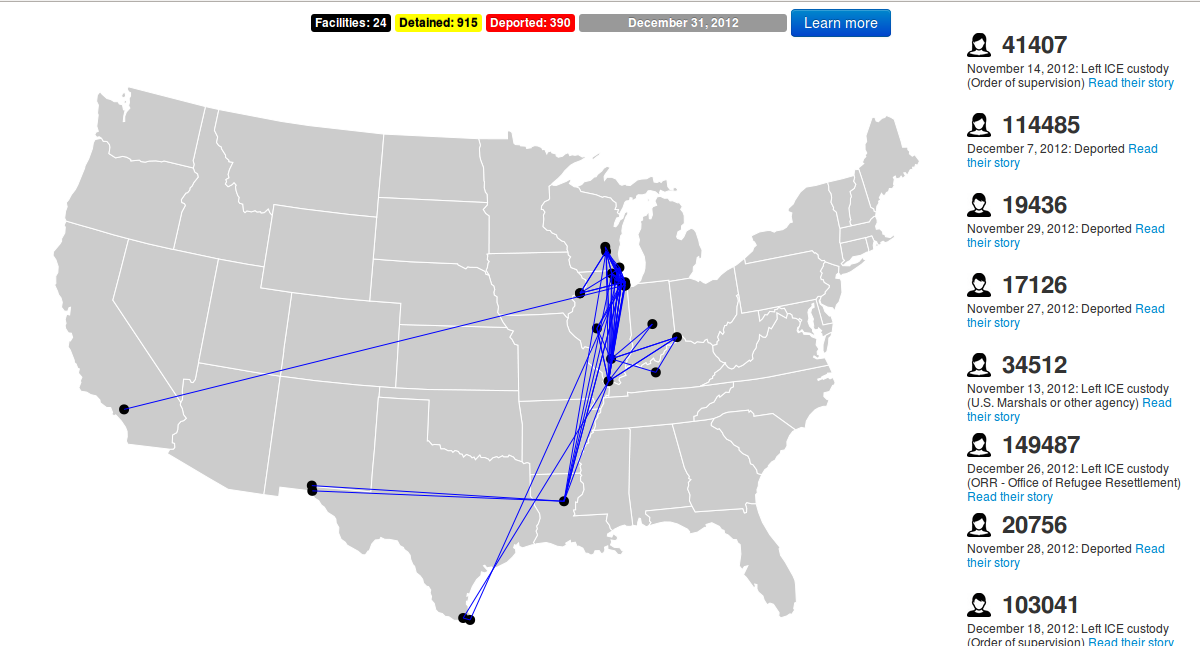
Illinois in the ICE Age Screenshot


Illinois in the ICE Age is a data visualization project that I made along with Jimmie Glover, Ruth Lopez and @taratc for Chicago MigraHack. The visualization is based on a data set provided by the Transactional Records Access Clearinghouse that describes the trajectory of 915 migrants detained in Illinois from the time they were taken into custody until they left ICE custody in November and December 2012.

We used Google Spreadsheets’ pivot tables feature to explore the data and develop questions and insights. This also provided a good way to double check programatically computed statistics.  The map animation is built using D3. I sucked the data set into a local SQLite database using the Peewee ORM and wrote some Python scripts to transform the data and export it as JSON to make it easier to visualize (especially the day-by-day updates).

The project won the “Best data visualization team project” and “Audience Favorite” awards.

Replacing hinge in plastic-framed glasses

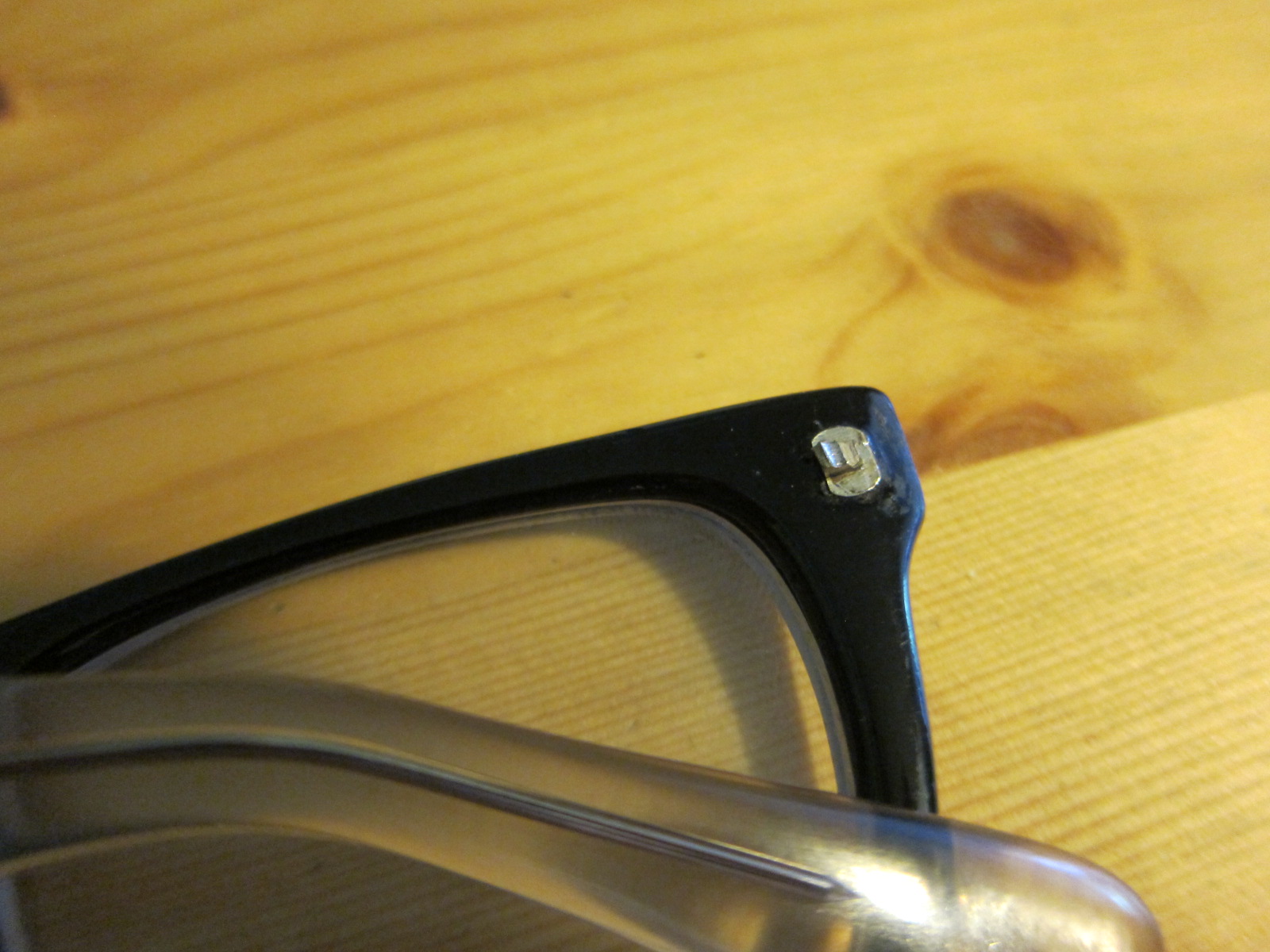
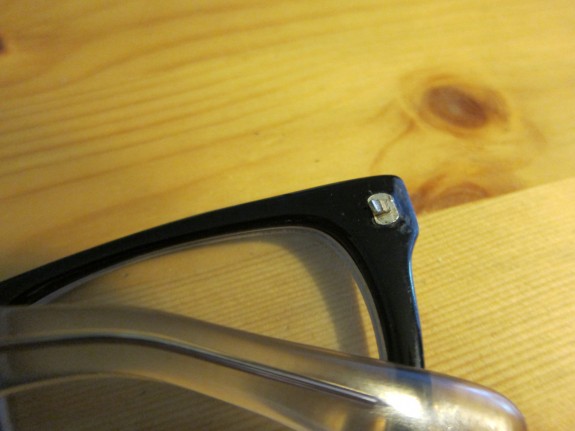
Broken glasses hinge

I’ve broken numerous pairs of sunglasses at the hinge where the temples connect to the rest of the frame.  As frustrating as it was to just toss the otherwise useful glasses, it just seemed like too much hassle and expense to try to fix them.  The surfaces seemed too rough and small to solder the broken hinge pieces back together, and how could you replace the entire hinge when it’s embedded in plastic? A friend really liked the look of a cheap pair of sunglasses, so she had them converted to eyeglasses by an optician, an operation that was cheaper than normal frames, but expensive enough to warrant trying a little harder to break the broken hinges.

It turns out it was relatively painless to replace the broken hinge with one from an inexpensive pair of sunglasses.

What you’ll need

  • A broken or cheap pair of sunglasses from a thrift store, gas station, or a broken pair you have lying around.  Make sure that the way the hinges mount match the glasses you want to repair and that the size of the hinge matches the connector on temple piece.
  • Soldering iron machine
  • Metal tweezers
  • Small screwdriver

Step 1: Remove the temples from the donor glasses

Using the small screwdriver, remove the temple pieces from each side of the donor sunglasses. This will make it easier remove the hinges.  When doing this, try sliding the temple piece of the glasses you’re going to fix onto the hinge of the donor glasses, to make sure they’re compatible.

Step 2: Remove hinges from the donor glasses

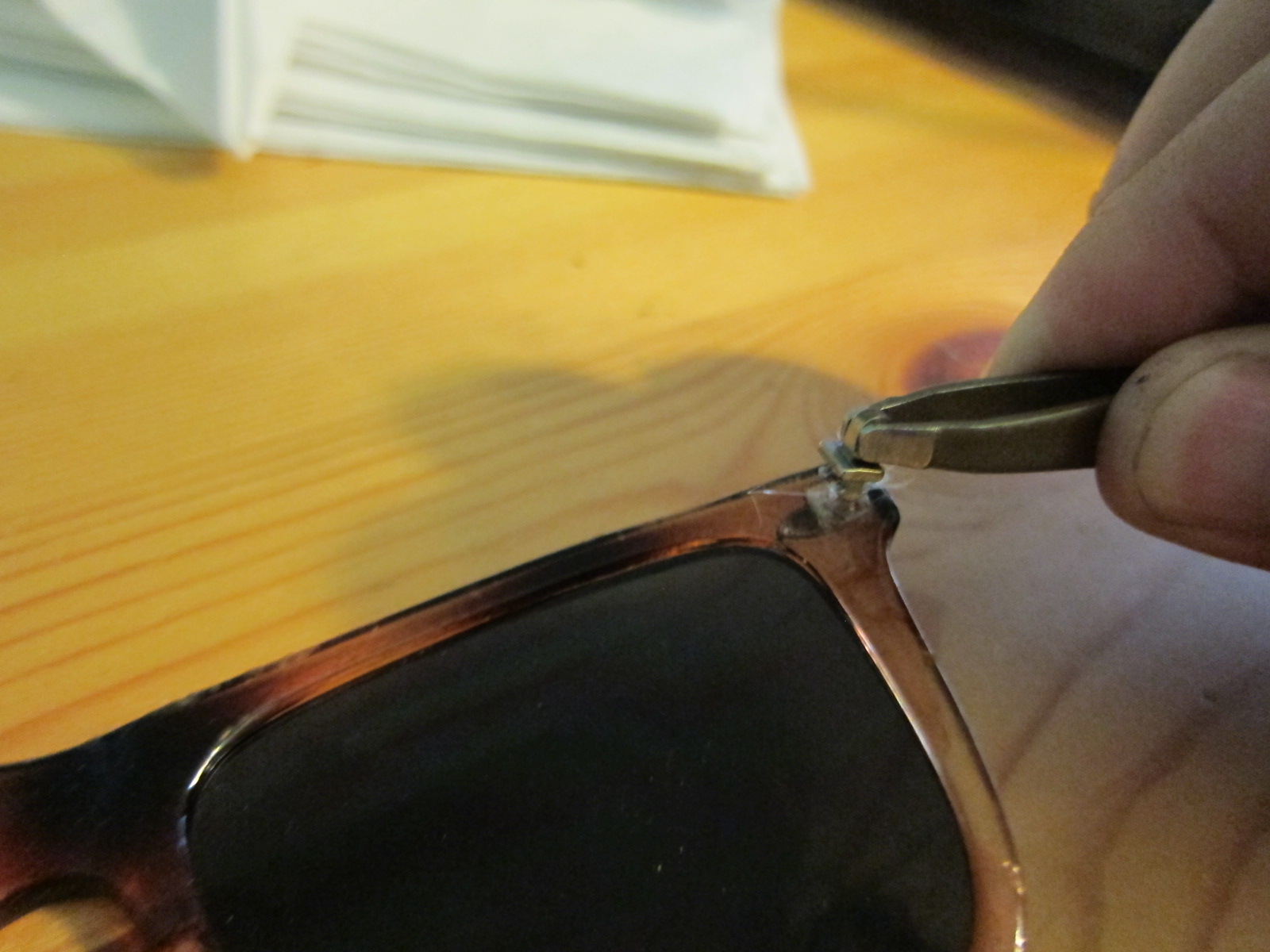
We’ll repeat this process to remove the broken hinge from the glasses we want to fix, so this is a good chance to practice being steady with the soldering iron, applying the right amount of heat, and removing the hinge with minimum damage to the frame, before working with our good frames.  Hold the tip of the soldering iron to the hinge piece, being careful not to touch the plastic. With your other hand, grip the hinge with tweezers.  As the plastic around the hinge melts from the heat transfer, gently pull the hinge up and out of the frame, trying to pull as straight as possible.  I didn’t have to heat the hinge very long to melt the plastic enough to extract the hinge.
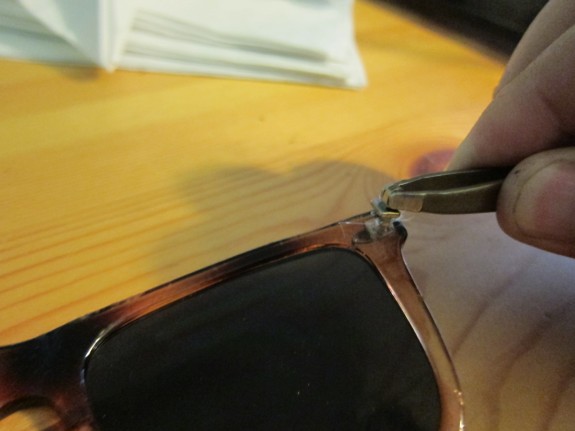
Removing the hinge from the donor glasses

Repeat this process with the other hinge to practice your technique and to have an extra part in case you drop and lose one hinge.

Step 3: Remove the hinge from the glasses you’re repairing

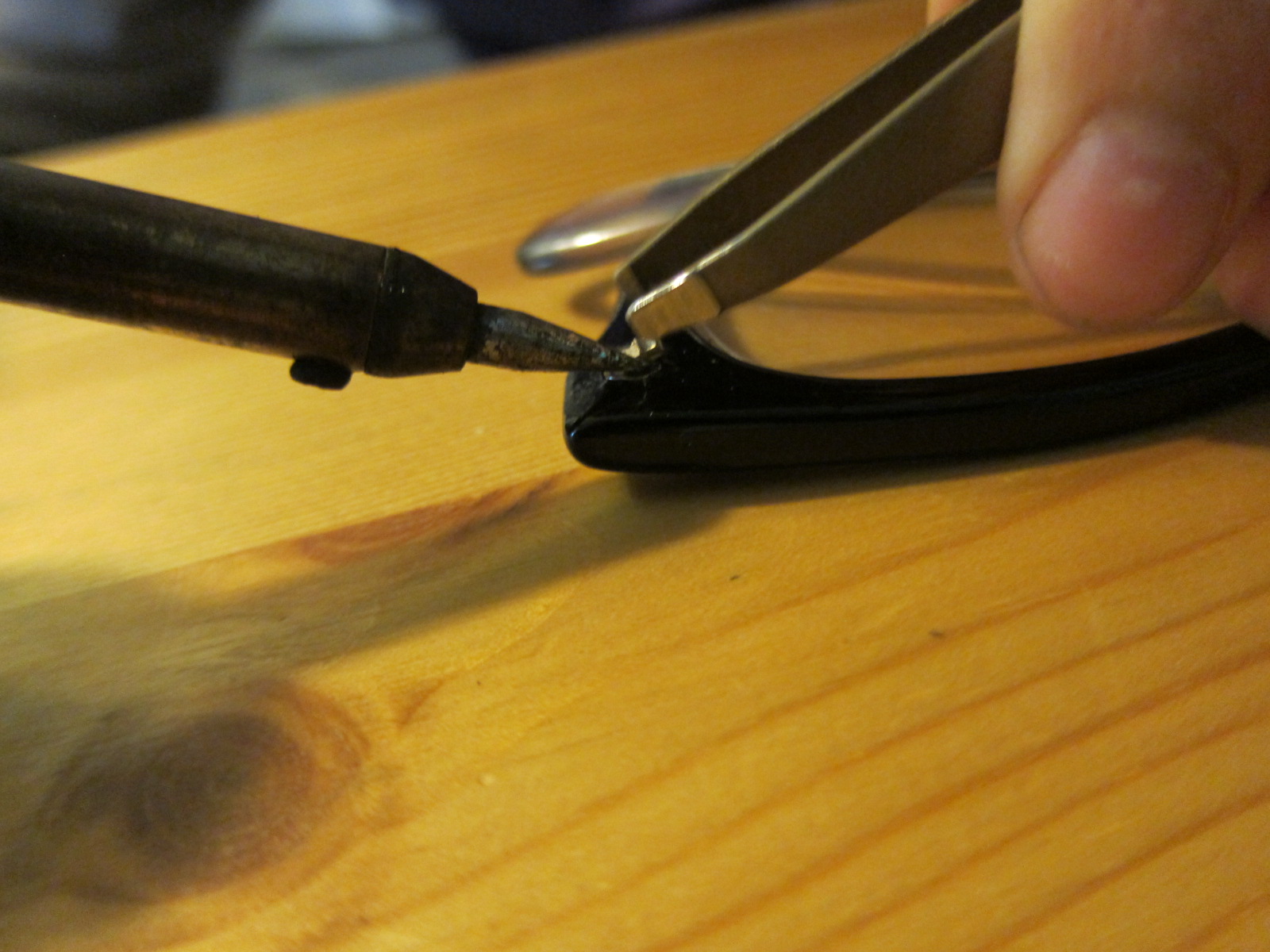
Remove the broken hinge from the glasses you’re repairing, using the same process that you used to remove the hinge from the donor glasses.
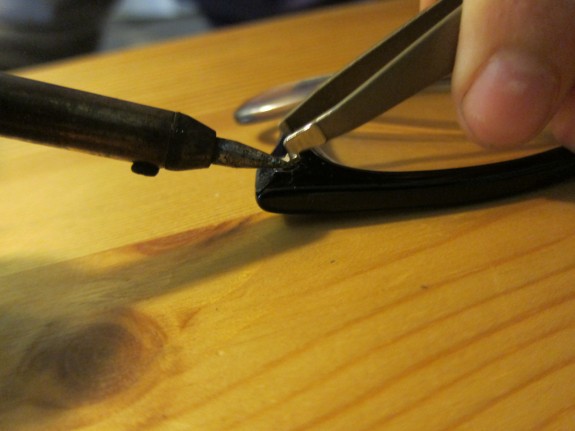
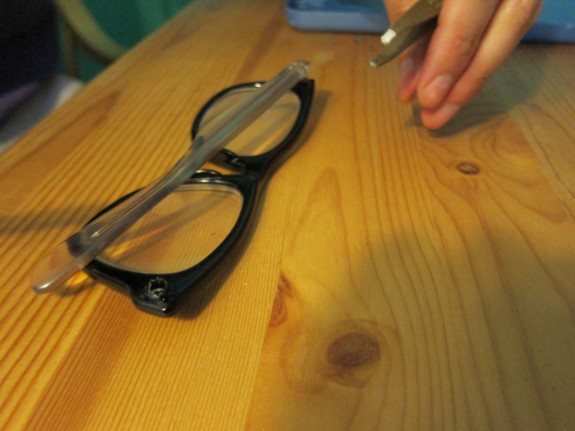
 

Removing hinge from glasses to be repaired

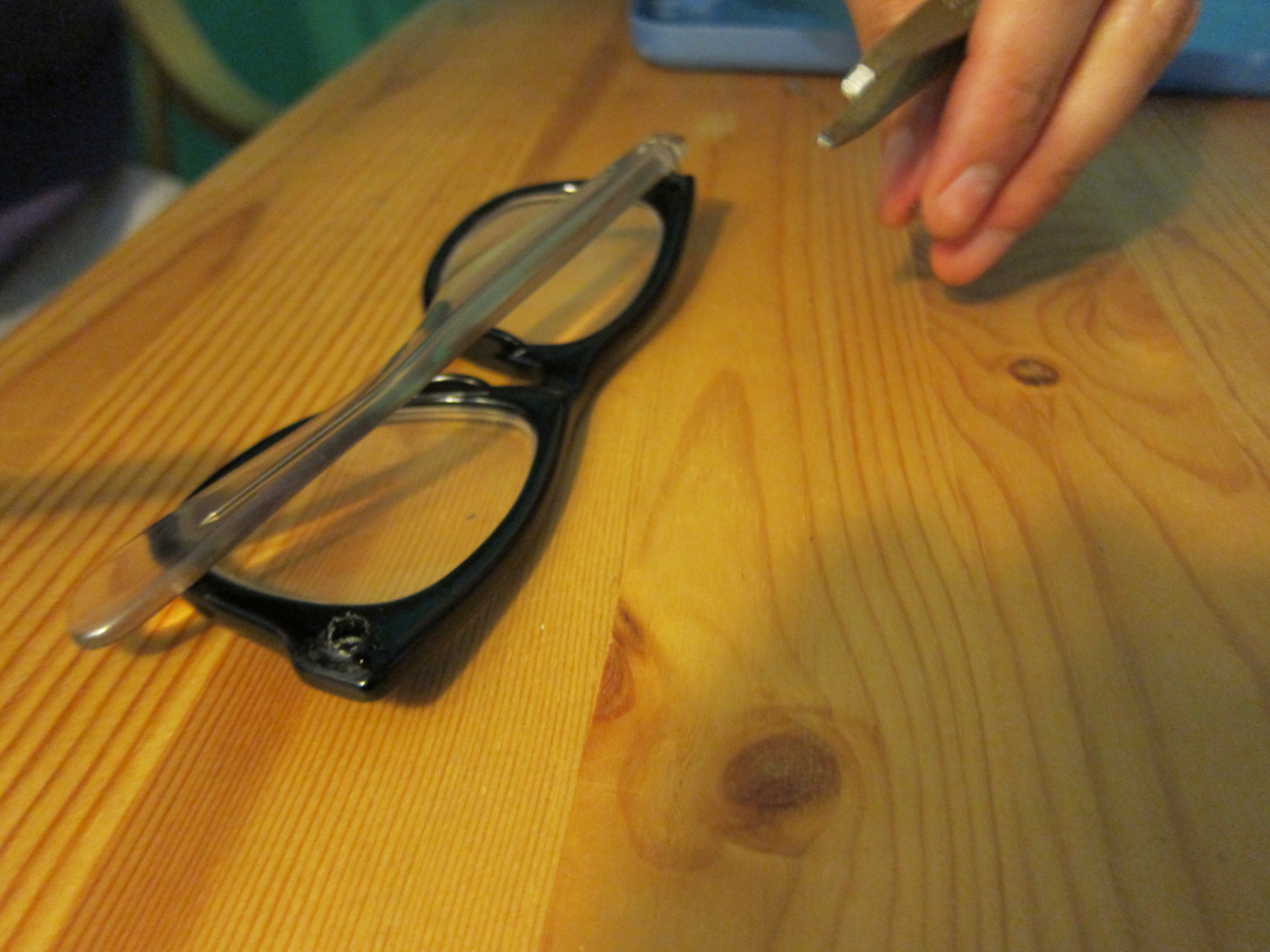
Broken glasses with hinge removed

Step 4: Replace the broken hinge

Grip one of the hinges from the donor glasses with the tweezers and position it in the hole left where the broken hinge was removed.  Try to hold it as straight and flush with the rest of the frame as possible.
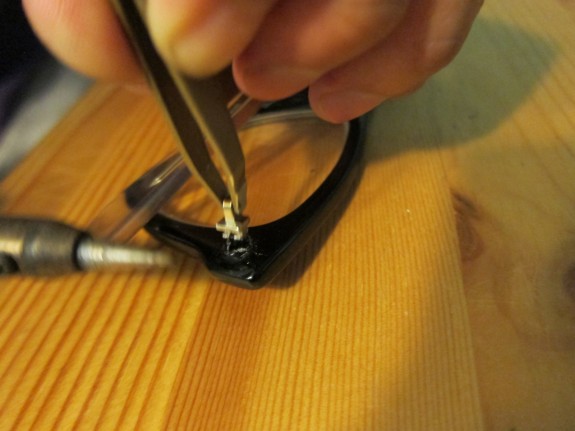
Inserting the replacement hinge

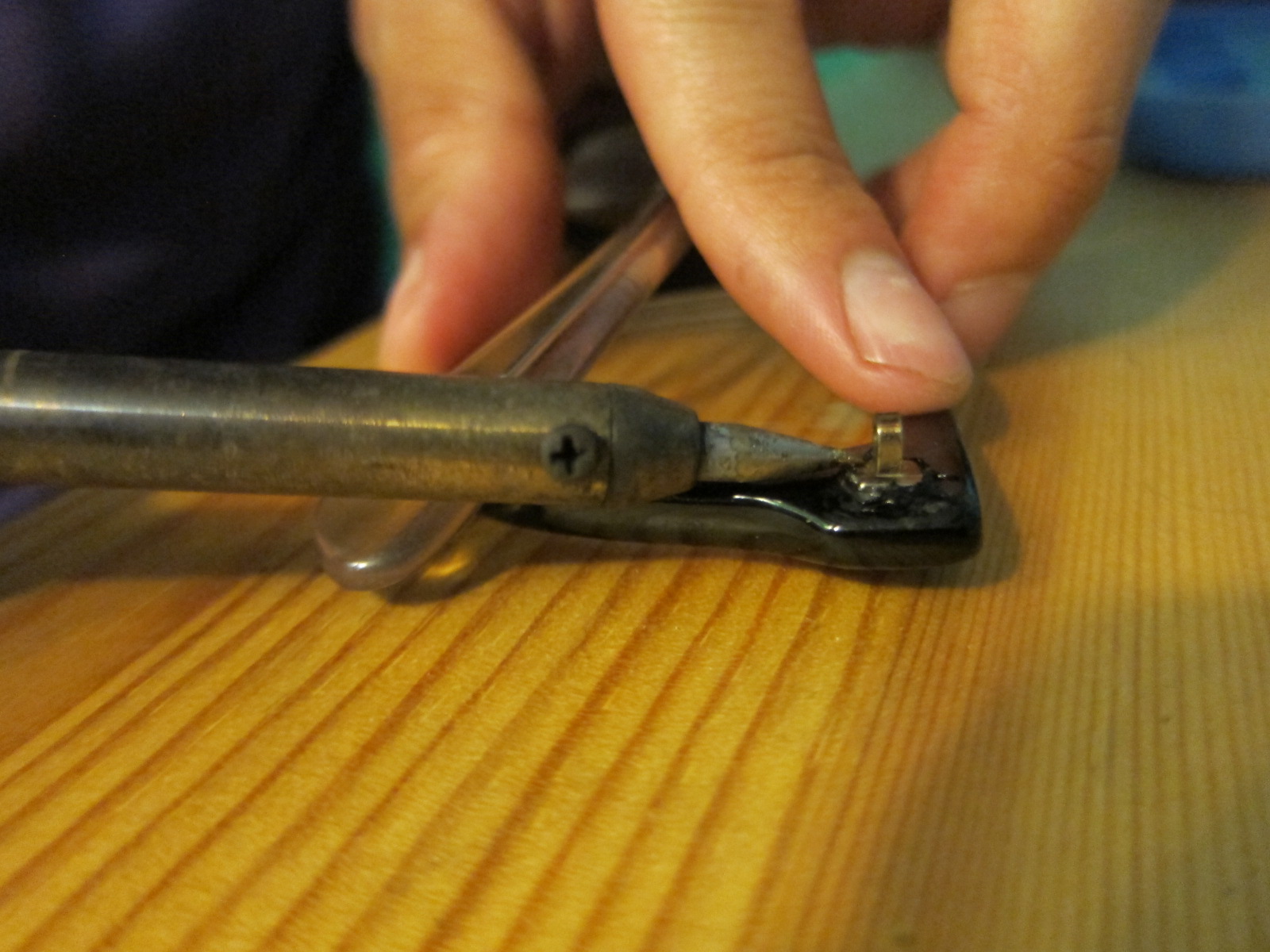
With your other hand, touch the hinge with the tip of the soldering iron until the plastic of the frame melts around the replacement hinge.  Be careful not to melt the plastic too much or push the hinge too deep into the frame. If needed, use the tweezers or the soldering iron tip to adjust the position of the hinge.
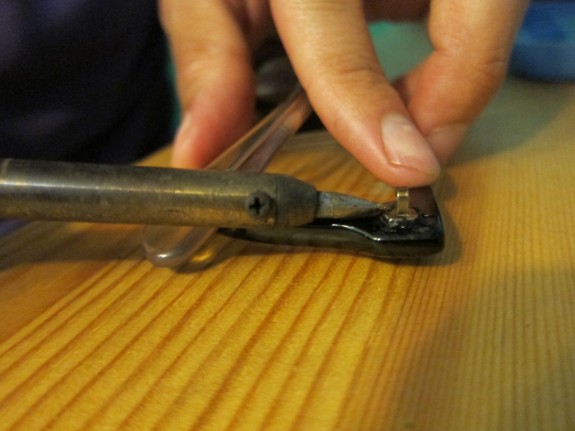
Positioning the replacement hinge

Step 5: Reattach the temple pieces

Using the small screwdriver, replace the temple piece. You’re done! You’ve just saved your favorite pair of glasses from the landfill.
Secret performances

In a thread about recent shutdowns of houses doing DIY shows in Chicago and the best way to balance keeping things on the downlow and still accessible, someone shared this awesome piece of history from The Missoula Oblongata:

At the time, Missoula’s punk and DIY community was undergoing a crackdown by the fire marshal, who had systematically shut down almost every local venue that wasn’t a bar. This meant there was no affordable and accessible place for young people to organize concerts, art shows, or events. When people responded to this by organizing shows in their own houses, the fire marshal found the houses, shut down the shows, and threatened arrests.

In response to this strange and grave situation, The Missoula Oblongata’s first production was a performance of Macbeth, which we held in secret in the basement that we’d been renting out for rehearsing. The space was only accessible through an unmarked door hidden in an alley. There was no public advertising for the performance. The performers (local artists and friends who had never been in a play before) each handed out sealed invitations to people they knew (not including the fire marshal, with whom we were all now well acquainted). The invitations instructed them to meet at The Oxford (a local dive) on April 6th at 8pm wearing a red carnation. Sure enough, on that day, at 8pm, an usher dressed like a skeleton arrived and escorted the entire carnation-wearing horde from The Oxford to the alley and the unmarked door, and then down into the basement to watch the play.

I remember this place

Where it begins, and where you leave it,
that is a question
that’s more than coordinate systems can say

Oh brittle amalgam, oh unhappy mongrel,
how I long to hold you
in your contradiction and your size.

These are overwhelming times and territories that aren’t on the map
Visions of horizon lines get lost in the creases that fall in our laps
But I remember this place

Seersucker shorts, Cincinnati, Ohio
Coney Island in Southwest
and a diner off US-15

A seat at the counter
for those who stood up at Woolworths
I strain to hear those whispers in the same place

Where you stand

They never told you there’d be days like this
From the moment you wake up, until your head hits the pillow
There’s an aching in your gut because you know that things aren’t right

And it feels like you’re failing
And it feels like we’re lost
And it feels like it’s never enough, and it feels like it comes at a cost

Oh I’m still surprised
And I feel betrayed
That the stories of those who came before bring not strength but anxiety

Does it cut you like a knife?
Because it chills me to the bone,
to feel the world’s so big and we are all alone.
We all do the best we can,
and I hope a little more,
and believe we’ll meet it where we stand.
Where you stand.

I never thought I could be something more.

And I know that it’s complicated.
And you’re left with more questions than at the start.
Please believe there’s a break in this breaking.
And know you’ll meet it where you stand.

Big words

Last weekend we lamented the loss of words.
How they were stolen and multiplied and proliferated until they lost their meaning
and power
by those who didn’t understand what they meant
but did
perceive that they had meaning
and power.

I lament these words
stretched beyond their elasticity now floppy and loose
because it feels so hard to find meaning in the first place:
Like the arguments I had as a kid, in defense of big words
,that I can only win in retrospect,
where I would have said,
“the point isn’t to bludgeon you with their size*”
* though I’d be a liar if I said it wasn’t that, a little
,”but that it’s amazing to find that one word,
that captures, that encompasses, that makes true
all the contradictions and nuance and confusion of an idea or an experience.”

That lets you escape the feeling that it hasn’t happened until you can name it.
Which I think was what I needed more than profanity*
* the words that didn’t need defended around that time.

And the lost words were like that,
powerful
essential to trying to understand something, to figure it out
but fuzzy. Foundational
even though we couldn’t quite pin down what they meant.
They could be two things at once, in two places at once.
Uncertain
but always aware of their presence.
And now their absence.