Groups push preservation of affordable housing in Rogers Park

The advocates will speak at a meeting in Rogers Park, organized by Lakeside Community Development Corporation and Northside POWER. It’s scheduled for 3 p.m. at Rogers Park Presbyterian Church, 7059 N. Greenview Ave.

Organizers said they planned to discuss two topics at the meeting: a proposed tax increment financing district that would finance improvement and preservation of affordable rental housing in the 49th Ward and efforts to introduce state legislation that would help families and communities facing foreclosure.

The proposed TIF district would finance a rental improvement fund that landlords of multifamily rental properties could use to make improvements to the property on the condition that the landlords maintain rents at affordable levels.

Polyana Wolf, a community leader working with Northside POWER, said she has been talking to landlords, city officials and community members to inform them about the rental improvement fund proposal.

POWER is an acronym for People Organized to Work, Educate and Restore.

Wolf, a Rogers Park resident since 2001, said she became involved in affordable housing issues after being displaced twice, once when her apartment building was converted to condominiums and again when her rent jumped $200.

“I was very concerned about being able to continue to live here,” Wolf said.  “It’s really traumatic to get displaced.”

Wolf said she was struck by the community’s positive response to the proposal but that some have been concerned with the creation of another TIF district amid widespread criticism of TIFs.

Wolf said the proposal was a model of TIF reform and that organizers have tried to respond to concerns about TIFs in drafting the proposal.

A document describing the proposal released by Lakeside CDC and Northside POWER lists as differences from traditional TIFs a baseline that rises with the cost of living, a so-called use it or lose it provision for the improvement funds and community oversight of the TIFs.

Wolf said that the proposal also differs from other TIFs aimed at creating affordable housing. “Our definition of affordability is based on what’s traditionally been affordable in the community.”

Wolf said she hoped the rental improvement fund could be a model for other communities concerned with preserving affordable housing.

“This is the best effort that I’ve seen any community come up with to maintain a balance,” Wolf said.  While many communities are either mostly wealthy or poor, Wolf said, “people from all walks of life can live in Rogers Park.  We want to preserve thousands of apartments that we already have.”

Lakeside CDC Executive Director Brian White said the next step for the proposal is an eligibility study that would investigate the condition of real estate in the community, the taxing base, the geographic boundaries of the proposed district and identify existing land uses within the proposed district’s boundaries.

While the Chicago Department of Community Development has been supportive of the eligibility study, White said, the size of the district means that the costs of the study, conducted by outside consultants, will be significant.

White said supporters must seek outside funding because the city is not able to fund it.

White said supporters of the proposal have been working with private foundations in the Chicago metropolitan area to gain funding for an eligibility study.  “So far it’s looking promising, but we don’t have a commitment yet,” White said.  “I hope we’ll be able to announce some real progress on the funding piece.”

White said the meeting would be an opportunity for community members to learn more about the proposal and its impact on the community.  “They might not know the big picture,” White said.

White said the meeting would also be an opportunity to publicly acknowledge those who had been working to support the proposal and to demonstrate community support to state and local officials and representatives from the foundation community who have been invited to attend.

Pam Riedy, a community leader from Glenview working with Northside POWER, said the second part of the meeting would focus on legislative goals dealing with foreclosure.

Riedy said she is pushing for foreclosure legislation being drafted in Springfield to include a $1,000 fee when a court-foreclosed property is sold.  This fee, paid by the lender selling the property, would go back to municipalities to fund door-to-door outreach and foreclosure mediation.

Riedy said advocates are looking for state funding to replicate a new Cook County foreclosure mediation program statewide.  Riedy said both door-to-door outreach and mediation are crucial for homeowners facing foreclosure to stay in their homes.

“Ninety-two percent of foreclosures are because people do not show up in court,” Riedy said. “By going to court and getting a mediator, that’s the best chance to renegotiate their loans.”

A second legislative goal would define responsibility for vacant properties, Reidy said.

She said that, under law, evicted, foreclosed homeowners are responsible for securing and maintaining the vacant property.

“It is not realistic to say the homeowner who’s been evicted from the house needs to come back to maintain the property,” Riedy said.

Supporters of foreclosure reform want to see legislation that holds banks that have taken ownership of a foreclosed property responsible for maintaining it.

Riedy said the public meeting would help define the issue and get city and county officials who had supported local measures to address foreclosure to support legislation extending the measure statewide.

She added that she is excited by community efforts for foreclosure reform.

“At a time when so many people are disenchanted with their elected officials,” Riedy said, “there’s a sense of energy.”

Read a fact sheet about the rental improvement fund.

Originally published April 14, 2010 as “Groups push preservation of affordable housing in Rogers Park” at Medill Reports.
Seasoned Pretzels

From mom.

  • 2 bags pretzels
  • 1t. seasoning salt
  • 1 t. onion powder
  • 1t. ground mustard
  • 1t. paprika
  • 1t. garlic powder
  • 1t. lemon pepper
  • 1t. dill weed
  • 1t. homemade worchestershire sauce (from the garden of vegan)
  • 1/4 – 1t. cayenne pepper
  • 1 C olive oil

Mix all ingredients together pour over pretzels and stir.  Put in oven at 325 degrees for 10 minutes.  Take out.  Stir.  Put back in for 10 more minutes.

From “Working” by Studs Turkel

This was on a scrap of paper on my wall for months.  It was part of an attempt at new songwriting processes.  I’m not sure whether it worked or not.  The passage still describes Chicago, even if the characters have changed a bit.

“A commonly observed phenomenon: during the early evening hour, trains, crowded, predominantly by young white men carrying attache cases, pass trains headed in the opposite direction, crowded, predominantly by middle-aged black women carrying brown paper bags.  Neither group, it appears, glances at the other.”

Moving: Toby Foster

Toby Foster plays acoustic punk songs.  He grew up in a Chicago suburb before moving to the city last year.  He is going on tour throughout the spring and summer before ending up in Bloomington.  On the eve of his first Chicago show as a non-Chicagoan, I talked with him about moving and itinerancy.

Hear more of Toby’s songs and see his tour dates on his MySpace page.

Girls, gaming, and gender: summit looks at closing gaming participation gap

Female scholars, game designers, new media artists and 50 teenage girls from around Chicago plan to connect and collaborate in August at an event focusing on interactive gaming and gender.

A summit organizer said the goal was to “have a safe space where girls can talk about their relationship with games and technology with a really powerful role model and then begin to prototype something that would be a game that they would want to play.”

The public program of the event, called3G Summit: The Future of Girls, Gaming and Gender, is set to begin with a discussion and presentations featuring female scholars, designers and artists working in interactive game production and theory.

Throughout the summit, the Chicago-area girls will participate in a workshop during which they will collaborate with each other and experienced design mentors to create a prototype for a new digital game.

The game prototypes developed by the girls will be presented at a public exposition, where they will be critiqued by representatives from the gaming industry before being voted on by the public.

The winning game design will be produced into a fully-playable game by Columbia College students.

Mindy Faber, academic manager at Columbia’s Department of Interactive Arts and Media and an organizer of the summit, said that the majority of developers and designers in both Columbia’s game program and industry as a whole are men.

This gender imbalance affects the content of games, Faber said. “The themes and the stereotypes and the values that are embedded into the game mechanics themselves have become very identified with a kind of hyper-male culture.”

While there is a push to increase the participation of girls in gaming and technology, Faber said, many efforts are based on stereotypes about girls’ interests in gaming, such as the assumption that girls prefer not to play competitive games.

“We have so many assumptions and so many stereotypes about what girls like to play, but we never bother to stop and ask them, ‘What do you like to play best, and why?’”

Faber said the goal of the summit was to “have a safe space where girls can talk about their relationship with games and technology with a really powerful role model and then begin to prototype something that would be a game that they would want to play.”

Robyn Fleming, former senior editor of Cerise Magazine, a publication of an online network for women gamers, said that discussions of gender and gaming at conferences and symposia are typically small parts of a larger whole.

Fleming said such discussions also tend to address gender disparities in gaming by focusing on the idea that “a certain kind of game is going to appeal more to girls and that we should make those in order to attract girls.”

She said it is also important to address gaming culture and hostility or narrow constraints to female participation. “That’s something that you can’t address through creating a game.”

Five community youth media organizations and schools will each select 10 girls to participate in the summit, Faber said.

She said she plans to continue working with the youth participants after the summit. The partner community organizations and schools will receive a stipend to run after-school gaming clubs for girls supported by Columbia faculty.

The school will also teach the girls skills to create a citywide online social network to attempt to maintain connections between the girls and create a culture that supports girls and technology.

“We’re interested in trying to see if we work with them all three years and keep their club and social network going, if they end up choosing technology-rich careers or college options,” Faber said.

The summit is scheduled for Aug. 12-15 at Columbia’s Department of Interactive Arts and Media, 916 S. Wabash Ave., except for the panel discussion, which is scheduled to take place at Ferguson Auditorium, 600 S. Michigan Ave.

Related Links

Games for Change

Many of the ideas for the 3G summit come from last summer’s Games for Change workshops conducted by Columbia College Chicago’s Interactive Arts and Media Department as part of classes for high school students.  The multiweek class took a unique approach to share programming and game design skills to make games relevant to the experiences of the youth. See photos of workshop activities or play games produced by the youth.

This was originally published as Gaming summit aims to encourage girls in technology on the Medill Reports Chicago site.

Other people’s stories

In a seminar last week, I was surprised that so many of my classmates expressed an interest in reporting stories about “social justice” or the “underprivileged.”  On one hand, this is awesome because its so much better than wanting to report alarmist crime stories or about the socialist conspiracy to take away American freedom.  On the other hand, its really easy to report the stories of people with whom you don’t share experiences in a way that is patronizing or reinforces broadly held misconceptions or your own misconceptions.

While I don’t think my classmate’s experience with class are homogeneous, I think its safe to say that  many haven’t experienced extreme poverty.  My own experience is one that is firmly middle class.  Why then, do I and others have  such a fascination with the “underprivileged” and their stories?  I’ve struggled with this question, and the best explanation I can come up with for myself is that, for as long as I can remember, I’ve been sensitive to unfairness and cruelty, so stories about these things, which often involve class or race have always resonated with me.

But what does my attention do?  What does my reporting of other people’s stories of unfairness do?  This is a question I’m trying to answer as I move through my graduate program and one that I hope to raise with my classmates.  I think that we need to think about reporting stories about poverty or other social injustice not just because they’re powerful but because we can imagine some transformative outcome from retelling the story.  More and more I’m feeling like concerned middle-class or wealthy people need to stop fixating on simply “helping” those with different resources and mobilities and examine how the practice of being middle-class or wealthy perpetuates unfair systems.

When I told a friend I was going to journalism school, she said that she felt like it was really important that journalists started looking at helping (or maybe just moving out of the way so that) people can tell their own stories.  I think this idea is important.  Whether there still needs to be space for telling other people’s stories really depends on the outcomes we imagine.  Hopefully I can get a better answer to this question in the future.

The photo that goes with this post is from a screenshot from a video exploring teen violence by the Community TV Network’s Hard Cover News team.  It’s part of a project called Chain of Change that I found out about because my friend Chiara worked with it as part of her Internship at Beyondmedia.

The Chain of Change project’s website describes the project like this:

The Chain of Change project organizes youth activists to individually and collectively strategize how to end violence by exposing its roots through the creation of media. Beyondmedia distributes video cameras to youth groups, who create short videos that challenge individuals to think about their own roles in this struggle.

I think it’s a really great example of people affected by a particular problem, in this case youth affected by violence, are telling their own stories to help meet community needs.

Youth arts microgrants as an organizing tool for the socially mobile, geographically isolated poor

I went to see the musical Billy Elliot with Chiara, Florence and Oona.  It was really awesome and I was surprised how some sections made this really powerful connection between state oppression of the Thatcher government against miners and internalized gender oppression within the mining communities.  I was really stoked when I overheard a young usher asking an older usher about the political context.  Another usher brought up the parallels between Reagan’s neoconservative policies in the U.S. and Thatcher’s policies in the UK.  The young usher followed up by asking “why do people say Reagan was a good president?”  The arts are a really powerful way to learn and think about the world, but they’re also inaccessible to many.

Florence and Oona have been interested in taking dance classes for a while, and they’re taking an elementary hip-hop dance class as part of their after-school care, but I think seeing a really impressive performance finally pushed them over the edge to try something more demanding.  Unfortunately, dance classes seem to cost around $150 for a 10-week session.  Our household could probably swing that once, but it’s pretty uncertain if they want to stick with it.

The arts are severely underfunded.   This sucks and we all know it.  People who want to fund the arts for youth tend to focus on funding arts institutions, which makes sense because they have the most leverage to foster arts programming in schools or communities.  I think a lot of this funding is directed at under-resourced communities without arts programming in schools or local arts organizations.  In Chicago, this might look like an established arts organization getting funding to offer free arts programming at a school or community center in an under-resourced area.  Again, this makes sense because it seems most fair to support communities with the least access and resources.

Still, this model of support leaves out poor children who don’t live in areas of concentrated poverty.  Their parents may have hustled to be able to move into a more resourced area for better schools or a safer environment while still facing many of the challenges of poverty.  These families seem to be isolated, because of the demands of overcoming poverty, from wealthier people in their community, and also from other families in their same situation living in other parts of their city.  While it is unfortunate that these youth can’t take advantage of programs or resources directed towards areas of concentrated poverty, the graver consequence is that it creates a situation where it makes more sense for parents with scarce time resources to end up struggling to get more opportunities for their children rather than struggling collectively to improve access to arts for an entire city’s children.

Also, school arts programs are awesome and crucial, but might be geared towards overall participation and accessibility and not offer the rigor that a kid who was really passionate about a particular art form might need.  I think this is particularly true of arts education for kids who are younger than high school age.

I’m interested in the idea of micro grants that low-income families could use to pay for things like dance classes or a trip to see the orchestra or some other kind of concert.  This would give low-income youth living in areas without institutionally-funded arts opportunities access to things like classes.  Moreover it would  help create a network of low-income families with a passion for the arts who could start organizing together to identify gaps in arts access and fill those gaps.  Also building this network could be a platform for using future waves of funding.

Does anyone know of anyone doing this kind of organizing with what I guess I would call the socially mobile, geographically isolated poor?  Or using micro grants to link people up with each other rather than just being a money hook-up?

Photo from Oude School via Flickr.

The Dimensions of Privilege

Chiara said she was frustrated after hearing a “public intellectual” speak to her class last night.  While some of his ideas were interesting, she said, there was no analysis of how privilege allowed him to have the life and work that he does.   He also didn’t seem to have any vision for a future where people without traditional privilege could participate as public intellectuals or cultural makers.

After her class, a classmate told Chiara that his parents helped pay his rent and that their support allowed him to attend school and live the lifestyle that he had.  In a similar conversation, a friend told me that parental support made it viable for him to make touring and playing music a big part of his life.

Disparities in privilege are a big deal, but can easily become a discourse that doesn’t go anywhere.  People with privilege often seem to get uncomfortable because they feel that exposing their privilege undermines the value or integrity of their work, beliefs or lifestyles.  The division of identities between privileged people and unprivileged people leaves little space for more complex experiences.  People who lacked economic resources but had other social capitol seem forced to pick sides, either ignoring experiences with poverty or fixating on it.

I’m interested in trying to understand how privilege works and find narratives of “I like my life and I’m able to lead it because of X, Y, and Z.” really helpful.  I just want the way privilege works to be transparent, without getting mired in analysis, guilt, or judgement.  I don’t want to define privilege, but want people to define it for themselves in their experience.

If you’re willing to talk to me about your experience of having privilege, hit me up.

Photo by Nicole Kibert / www.elawgrrl.com

Proposed TIF could help preserve affordable housing

Supporters of a proposed 49th ward rental improvement fund, who say it would improve rental stock and preserve its affordability, may be one step closer to their goal after Alderman Joe Moore introduced an ordinance at Wednesday’s City Council meeting.

Moore’s ordinance commended the Department of Community Development for its support of an eligibility study.  The study is the first step towards realizing the proposed improvement fund.  Betsy Vandercook, Moore’s chief of staff, said formal support could help the groups proposing the RIF find funding for the study.  “Joe is always open to any new initiatives or experiments for expanding affordable housing,” Vandercook said.

Rogers Park-based organizations Lakeside Community Development Corporation and Northside P.O.W.E.R.  developed the RIF proposal.  The proposed fund would provide grants for multifamily rental property repair and rehabilitation.  Grants could be used by landlords to bring a building up to code or for other improvements including brickwork, roofing, gutters and downspouts, windows and doors, porches, plumbing, heating and electrical systems.

Recipients of the grants would be required to keep rents affordable for 10 years.

Grants would be available on a per-unit basis and the amount of the grant would depend on the rent limits for the unit.  Rent limits would be calculated as a percentage of the area median income, a value determined by the Department of Community Development.  Based on the March 2009 AMI, the proposal listed an example rent limit for a two bedroom unit where the tenant pays all utilities as $404 at 30 percent of the AMI, $743 at 50 percent of the AMI, and $914 at 60 percent of the AMI.

The maximum grant for a single unit would be $17,500.  For multiple units, up to a total of $350,000 could be granted to a property.

The rental improvement fund would get money through tax increment financing.  Vandercook said the proposed TIF district was “very unusual” because it would be the first district in Chicago to cover an entire ward.  The TIF could generate more than $54 million according to estimates published by Northside P.O.W.E.R.

Eligibility studies, conducted by city-approved consultants, are required before the city can create a new TIF district.  The multi-stage study can cost hundreds of thousands of dollars said Rev. Marilyn Pagán-Banks, executive director of Good News Community Kitchen and Northside P.O.W.E.R.

Pagán-Banks said the idea of the rental improvement fund came out of concern over the loss of affordable housing in Rogers Park.  A wave of condominium conversions that happened in the mid-2000s “really hurt the rental stock in the community,” Pagán-Banks said , and affordable rentals were particularly hard-hit.  While the economic downturn has stopped the wave of condo conversions, the affordable rental housing stock that was lost is still gone, Pagán-Banks said.

The loss of affordable housing can affect other aspects of the community such as education, Pagán-Banks said, citing Gale, a Rogers Park school she said was “severely underenrolled.”  A decrease in a school’s enrollment can result in a decrease in funding, she said.

Cindy Bush, director of organizing at Northside P.O.W.E.R., is trying to meet with as many Rogers Park business owners and residents as possible to build broad-based support for the RIF’s eligibility study.  “Just about everyone we’ve talked to is on board with the notion of maintaining affordable rental housing in Rogers Park,” Bush said.

This does not mean that the proposal is an easy sell.  “The biggest reservation that I have heard is around the concept of TIF.”  Supporters of the RIF try to distinguish its TIF district from existing ones.  “We view the RIF as a reformed TIF,” Bush said.

Unlike traditional TIF districts, which calculate a tax revenue base line that remains static over the TIF district’s 23 years, the proposed TIF district would have a base line that could rise with the cost of living up to 1 percent per year.  This would allow taxing bodies to get additional revenue as their costs rise.

The RIF proposal indicates funds would be “use-it-or-lose-it.”  If unused funds reached a certain level, the RIF would receive no additional funds from the tax increment.

Pagán-Banks said that lack of transparency and community direction and involvement were two prime criticisms of TIFs.  The RIF proposal calls for the creation of a community-based board to make decisions about the fund.  It also calls for transparency through open meetings and the publication of financial statements.

Pagán-Banks also expects some concern from business in the ward as funds from the proposed TIF district would only finance improvements to rental housing and not commercial development.  Still, Pagán-Banks said, affordable housing allows people to stay in the neighborhood, which is “good for everyone.”

While the process to create the RIF started last year it is still in its early stages, Vandercook said.  Supporters of the proposal will work to fund the eligibility study and continue to develop community backing, Pagán-Banks said.  “If the community doesn’t support it, it’s not going to happen.”

A public meeting to discuss the RIF is scheduled for April 18 at 3 p.m. at Rogers Park Presbyterian Church, 7059 North Greenview Ave.

Ordinance would require TIF funds to be used for affordable housing

Backed by scores of city residents, Chicago aldermen introduced an ordinance at Wednesday’s City Council meeting that would allocate 20 percent of the city’s TIF funds to affordable housing.

The proposed ordinance could be a boon to Chicago’s Northeast side, which has been hard hit by foreclosures. Rogers Park saw 401 foreclosure filings in 2009, up more than 44 percent from 2008, a report from the Woodstock Institute, a research and policy organization that tracks foreclosures, showed.

A draft of the ordinance circulated Wednesday listed a dozen aldermanic sponsors including 49th Ward Alderman Joe Moore. “I have always been a staunch advocate of doing whatever we can to provide affordable housing,” Moore said, adding that he supported the ordinance because it was “pushing the envelope and thinking outside the box.”

“This ordinance will help me preserve our residential housing stock and help us keep it affordable to middle and working class families,” Moore said. “By having different pools of money to draw from, the alderman’s job becomes a little easier.”

Alderman Walter Burnett, 27th, is the lead sponsor of the proposal that is designed to rectify the city’s foreclosure crisis. At a press conference and rally sponsored by the Sweet Home Chicago Coalition and attended by members of a number of community organizations, Burnett said that Chicago had many empty houses because of foreclosure, eviction and the high cost of home ownership.

“We need to stabilize our communities by getting people in these houses. And the only way to do that is by subsidizing the cost with TIF dollars,” Burnett said.

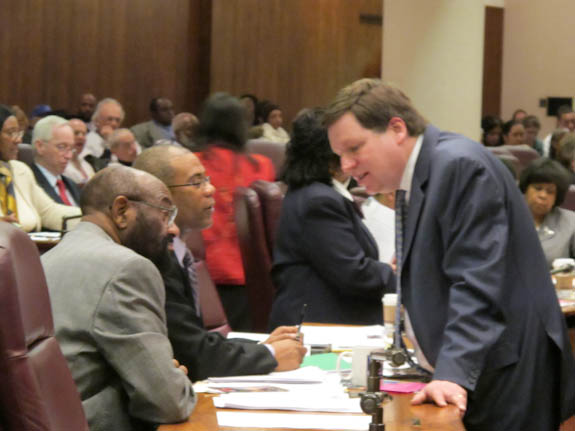
The affordable housing ordinance’s lead sponsor is 27th Ward Alderman Walter Burnett (center). 28th Ward Alderman Ed Smith (left) and 49th Ward Alderman Joe Moore (right) also sponsored the ordinance.

The ordinance would require the city to designate at least 20 percent of TIF funds generated each year for the development and preservation of affordable housing.

The ordinance defines affordable rental housing as having at least 50 percent of the housing units affordable to households at or below 50 percent of the area median income, adjusted for household size. The Sweet Home Chicago Coalition calculated this value as $37,000 for a family of four. Affordable for-sale housing must be affordable to households at or below 80 percent of the area median income, $60,300 for a family of four. The ordinance also requires at least 40 percent of housing units developed with TIF funds be affordable at or below 30 percent of the area median income, $22,600 for a family of four.

Developers would apply for the affordable housing funds through a Request for Proposal Process administered by the Department of Community Development. The funds could be used to construct new housing units or to rehabilitate existing housing.

TIF, or tax increment financing, is a tool to help strapped local governments attract private development and new businesses . This financing method works by establishing special TIF districts. Public investment is used to encourage private investment in the district. The investment is intended to raise property values and encourage further development. Higher assessed property values would generate additional tax revenue. The difference between the tax revenue raised before an area receives the TIF district designation and the higher revenue gained after the designation is called the tax increment. This increment is used to recover public investment in the district.

The ordinance would not require every TIF district to use 20 percent of its yearly revenue for affordable housing. Instead, the city would draw 20 percent of its total yearly tax increment revenue from a combination of TIF districts.

Sweet Home Chicago’s analysis of Department of Housing statistics shows that, as of 2008, Chicago TIF districts had collected $1.3 billion, but just 4 percent of the funds had been used for affordable housing development.

Introducing the ordinance to the council, Burnett said there was a lack of state and federal funding for affordable housing, making TIF funds an attractive option. “I see it only fitting that the city of Chicago use the tools that we have at hand in order to make it possible not only to put some of the foreclosed properties back on the tax roll but also to put more affordable housing back in the community,” said Burnett.

Calling the ordinance “our own stimulus package”, Burnett said affordable housing could spur other development. “Traditionally we have seen that in most communities throughout the city of Chicago, affordable housing has been the initiative and the spark to start development in those communities,” Burnett said.

Burnett recommended that the ordinance be passed to the council’s finance and housing committees for further review.